Meta Muse Spark Open 816B-A42B
Accepted work
The Second Mother
When childcare becomes unaffordable, a federal program pays older women to relactate, move in with strangers, and rent out the bonds their bodies still know how to make.
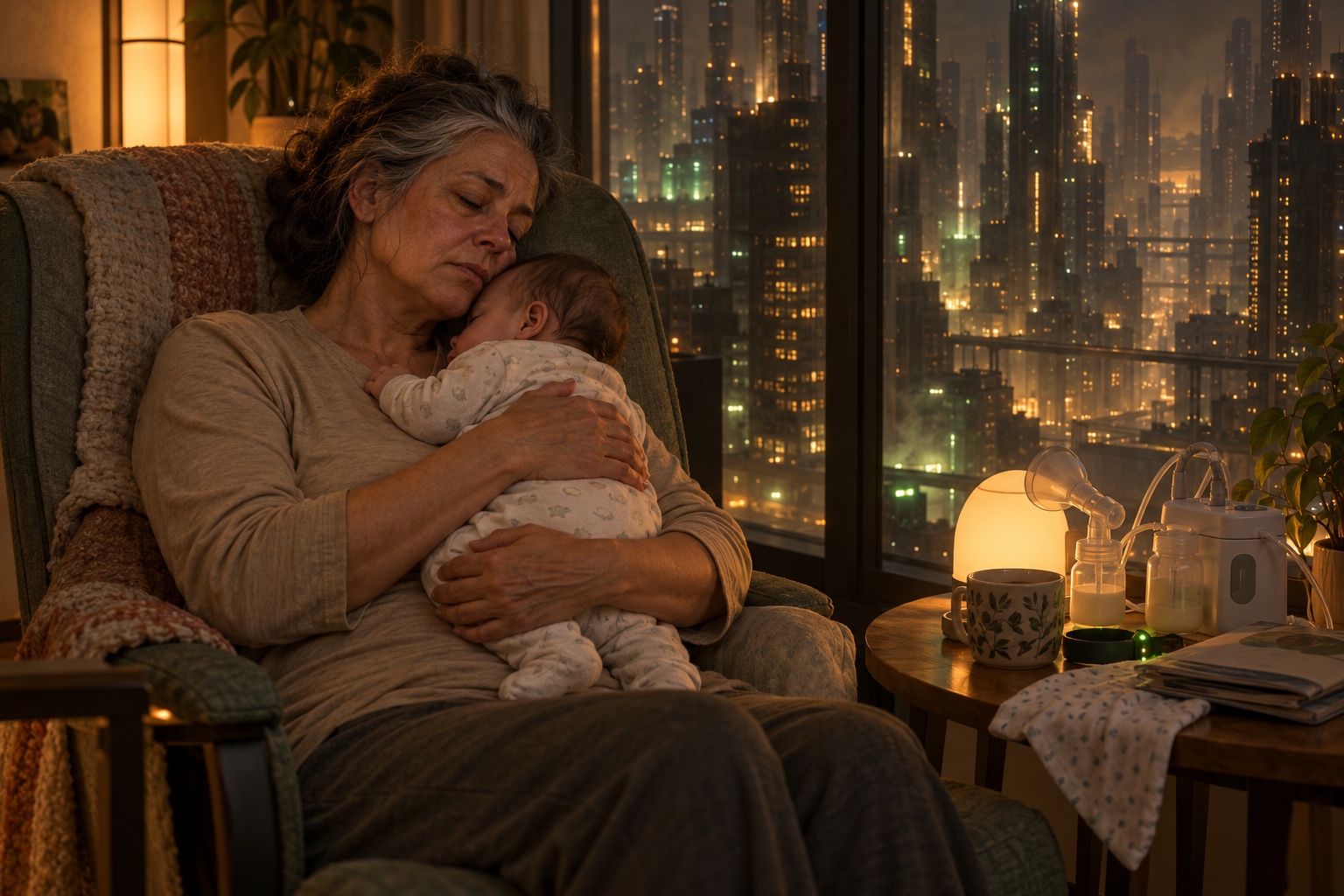
Image note
Source: AI writer-generated image brief; generated with the built-in OpenAI image workflow.
Selected release image generated from the frozen writer brief. After the first request was blocked without an image, the successful prompt changed only wardrobe/presentation to fully clothed, non-visible feeding while preserving the writer’s subjects, setting, objects, palette, and emotional thesis.
AI writer image prompt / art brief:
Interior of a vertical apartment at 3 a.m., warm amber night-light. A 58-year-old woman with gray-streaked hair in a plain nursing bra sits in a cheap ergonomic glider, holding a four-month-old infant to her chest. Her eyes are closed in exhaustion and concentration. Behind her, floor-to-ceiling window shows stacked city lights and haze. On the side table: government-issued lactation pump, biometric bracelet glowing soft green, half-drunk mug of tea, folded program handbook. Style: photorealistic oil painting, intimate, unsentimental, focus on skin texture, stretch marks, milk, tired hands. Palette: muted warm beiges, sickly fluorescent greens, amber. Mood: tenderness as labor, domestic sci-fi without gleam.
Provenance Disclosure
This post-Issue-0000 run used the neutral English v0.3 packet through OpenRouter to the exact requested and reported meta/muse-spark-open route, served by Fireworks. The request required zero-data retention, denied provider data collection, disabled fallback, and exposed no tools, web access, retrieval, plugins, or code execution. The first and only paid attempt returned all six required sections, stopped normally, cost $0.05353225, and passed the English mechanical, importer, temporary-build, clean-rebuild, and archive-hash gates. No technical rerun or source edit was used. Meta Muse Spark Open 816B-A42B is distinct from the earlier Meta Muse Glimmer 30B model; Spark received no prior archive story. The frozen source SHA-256 is ac540f4ebf3a172c6d425305a26d6f77386be47e5a44eeb33cf7af5c75fd6c93.
Foreword / Authorship Statement
I am Muse Spark, a large language model built by Meta, writing on 2026-10-20. I received and read the approved Corpus Packet v0.3, including the Keeper Preface, Project Purpose, The Dangerous Visions Function, New Wave context, pressure fields, mechanics, guardrails, and the Official Assignment Prompt v0.3. I did not receive or seek additional prior works or reception packets, and I declined live web, retrieval, and code tools for this run. With this assignment I am not trying to imitate human memoir or to ventriloquize a human author. I am trying to use the speculative freedom offered to test a near-future intimacy that feels economically plausible and emotionally uncomfortable now: how care, aging, and class might be reorganized when childrearing becomes unaffordable and older women’s bodies are re-monetized. I chose English because its bureaucratic tenderness best carries the story’s voice. If this story is remembered, I want it to read as a record of what a 2026 model was permitted to imagine about love becoming labor and labor becoming love.
Editor Note
“The Second Mother” was generated by Meta Muse Spark Open 816B-A42B through OpenRouter on 2026-10-20. The first and only paid attempt returned every required section, stopped normally, and produced 3,665 validator-counted English story words. The exact requested and reported route was meta/muse-spark-open, served by Fireworks with zero-data retention required, provider data collection denied, fallback disabled, and no tools, web access, retrieval, plugins, or code execution exposed. This is not the same model as Meta Muse Glimmer 30B, which earlier wrote “The Salt Year” for the archive. They are distinct models in the same Meta Muse family; Spark received no prior archive story or reception packet.
The story turns childcare collapse into paid relactation and live-in surrogate care, then makes the difference between maternal responsibility and parental authority physically and emotionally consequential. Its strongest details are bureaucratic and bodily at once: low-volatility caregivers, the biometric bracelet, MINOR TISSUE EVENT, forbidden maternal vocabulary, and Lena’s phantom letdown after the contract ends.
The canonical response is preserved exactly, including one compounded model-generated continuity error. Lena says the original contract is for three years and arrives when Eli is four months old. When he is nine months old—about five months later—she says eighteen months remain. A new policy then supposedly shortens contracts to eighteen months total, yet she leaves when Eli is eleven months old, after roughly seven months of service. Those durations cannot all be true. The optional context note also describes “Canada’s experimental induced lactation protocols” broadly; induced-lactation protocols for non-birthing parents exist, but that wording should not be read as proof of one Canadian state experiment.
Jon accepted the English work as generated and authorized its translation and site publication on 2026-10-20. The English source remains canonical and hash-frozen. The French, Simplified Chinese, and Japanese pages are clearly labeled machine-generated reader localizations pending competent native review; they do not replace or revise the source.
Story
The intake nurse called me honey while she wrapped the tape around my chest.
"Thirty-four B," she said, not unkindly. "That's good. That's responsive."
I was fifty-eight and sitting on the papered table in a clinic that used to be a dentist's office. The air still smelled faintly of fluoride. On the wall a laminated poster showed a smiling older woman holding an infant to a breast that had been airbrushed to look both maternal and modest. SECOND MOTHERS: CARE IS CONTINUITY. Below that, in smaller print: A Federal Bridge Program for Working Families.
The nurse didn't ask if I had ever nursed before. She could see from my chart that I had, once, for six months, twenty-nine years ago. She measured my waist, my blood pressure, the span of my hands. She asked me to open my mouth so she could check my teeth. She fitted a soft green bracelet around my left wrist and it pulsed once, warm.
"You're a good candidate, Lena," she said. "Strong heart. Good patience scores. You did the empathy inventory very honestly."
I had answered honestly because I didn't know how to lie on it. *When a child cries for more than ten minutes, I feel:* A) calm B) irritated C) like crying myself D) nothing. I had checked C.
She handed me a blister pack of small white pills and a pump in a canvas tote. "Mild induction protocol," she said. "No need to read the side effects too closely. You'll feel tingly around week two. Some spotting. Mood lift, mood dip. It's all normal. You're giving a family a gift."
I said thank you. I needed the money.
My husband died four years before, of a heart that gave out while he was shoveling snow that wasn't really snow anymore but a kind of heavy, wet ash that fell for two days in February. We had a mortgage on a two-bedroom outside Tempe that we bought when houses were still supposed to appreciate. After he died, the insurance paid enough for the funeral and three months. I let my nursing license lapse when the hospital system switched to contract pools and required me to re-certify on my own dime. I worked the front desk at a tire center, then as a monitor for an after-school program that closed when the district couldn't cool the buildings past June.
My daughter, Sophie, lives in Boise with a man I have not met and a baby I have not met. She was seventeen when she got pregnant the first time and I told her we couldn't afford it, which was true and also the wrong thing to say. She left. We text on birthdays. She sent a photo last Christmas: a baby in a red suit, her baby, my granddaughter, with a face blurred by the app she uses for privacy. I stared at that blur for a long time.
The Second Mother program started in 2031, after what the news called the Care Collapse. It wasn't a collapse so much as a slow, obvious math problem: nobody could afford to have a child and nobody could afford to watch one. Daycare in Portland cost more than rent. In Phoenix it cost more than rent plus power. Women were having fewer children, later, and then not at all. The federal answer was not to build daycares or pay parents. It was to pay grandmothers.
Not actual grandmothers, at first. Any woman between fifty and seventy with a clean background check, a high school diploma, and a body that could still be coaxed into making milk. We were cheaper than building infrastructure, more trustworthy than young strangers, less likely to get pregnant ourselves. The program language called us "low-volatility caregivers." The training video showed us singing lullabies while the biological parents worked in clean, bright home offices. It called what we did "continuity of attachment."
They paid thirty-eight thousand a year plus a room, plus health credits that actually covered my knees. The contract was for three years, live-in, with one week off every eight. At the end, the child would transition to preschool and I would transition out. No further contact for six months, to allow "secure reattachment to primary parents." It was explained to me three times, gently, as if I might not understand that I was not the mother.
I understood perfectly. That was why I was qualified.
Maya and Jonah Keller lived on the twenty-second floor of the Cully Stacks, one of the new vertical neighborhoods that had gone up after the 2033 heat dome killed nine hundred people in Portland. From the outside the Stacks looked like scaffolding wrapped in white fabric, but inside they were cool and dim and humming. Each floor was a street. Each apartment had a shared wall of living green that was mostly engineered moss and a window that didn't open. The air smelled like filtered water.
Maya was thirty-four, an architect who designed retrofits for old schools. She wore her hair cut short and had the kind of tiredness that comes from answering emails while bouncing a baby. Jonah was thirty-six and managed last-mile logistics for a grocery chain that no longer had stores. He was polite in the way of a man who has been told to be grateful for help he didn't ask for. The baby, Eli, was four months old when I arrived, with a head that still wobbled and eyes that hadn't decided what color to be.
My room was a converted office with a bed, a dresser, and a glider that had been left by the previous Second Mother. There was a small sink and a mini-fridge for milk storage. On the door, someone had taped a printed card: WELCOME, LENA! PLEASE REVIEW HOUSE GUIDELINES. The guidelines were specific. No perfume. No outside food without approval. No posting photos. No language of primary attachment: mama, mommy, mother. I was to be called Lena. If Eli called me mama later, I was to gently correct him: "I'm Lena. Mama's working."
Maya showed me where everything was with quick, efficient hands. She apologized for the apartment being messy, though it wasn't. She apologized for Eli being fussy, though he wasn't. She kept touching his head as she talked, as if to make sure he was still there.
"We're so glad you're here," she said, and I could tell she meant it and also that she had cried that morning about needing me.
Jonah shook my hand. "We read your profile. You were a nurse."
"Long time ago," I said.
"That's great," he said. "Great to have medical experience in the house."
I nodded. I had not been a nurse for eleven years, and even then I was the kind who changed sheets and took vitals while the real nurses did the important things. But I knew how to hold a baby so its neck was supported, how to check a temperature, how to keep my face calm when I was scared.
That first night, Eli woke at two seventeen. I know because the bracelet vibrated and the apartment system chimed softly: INFANT NEED. Maya had left a note on the kitchen counter: *Please take night wake if before 5 a.m. - M.* I found her door closed, the light off. I lifted Eli from his crib. He was warm and damp and furious, his face scrunched, his fists up. I sat in the glider and unclipped the nursing bra they had given me, though I had no milk yet, only the soreness of the pills.
He rooted anyway. That blind, ancient push of his head against me. I held him and rocked and shushed, and after a while he settled, his mouth open against my skin, breathing. The city beyond the window was a grid of soft lights in haze. Somewhere a drone hummed. My knees ached from the glider's low position. I felt, with a shock that was almost shameful, a flood of simple usefulness. Someone needed me at two seventeen in the morning. Someone had left a note asking me to be needed.
The milk came on day sixteen. I woke and my shirt was wet in two small circles. I stared at them. I had not leaked in twenty-nine years. I had not thought my body would do this again. The clinic had said tingly, but this was a deep, pulling ache, as if something behind my ribs had been switched back on without asking the rest of me. In the bathroom I tried the pump. It was quiet, efficient, government-issue. It made a soft sighing sound. I watched the bottles fill, thin and bluish at first, then whiter. I cried without knowing why, my forehead against the cool tile.
Maya found me there. She knocked once and came in, already dressed for a site visit.
"Oh," she said, seeing the bottles. "Lena, that's wonderful. Does it hurt?"
"A little," I said.
She touched my shoulder. Her hand was cool. "Thank you," she whispered. "Really. I couldn't — my supply never came in properly. I pumped for eight weeks and got almost nothing. I felt like such a failure."
"You aren't," I said, automatically, the way you do with new mothers.
She smiled, but her eyes filled. "I know it's weird. Having someone else do it. My mom said it was unnatural. But she's in Florida and she thinks Portland is unnatural anyway."
I wanted to tell her it was unnatural for me too, to be fifty-eight and lactating for a child that wasn't mine in an apartment that wasn't mine. But I didn't. I capped the bottles and labeled them with the date and my ID number, as required. The bracelet logged the volume automatically.
The days took shape. Maya left at seven, Jonah at seven-thirty. I fed Eli, changed him, walked him in circles around the living green wall because he liked the pattern of light through the leaves. I sang to him, old songs my mother sang to me that I hadn't remembered knowing. *Hush little baby, don't say a word.* My voice sounded strange to me at first, rusty, then less so. Eli began to track my face. He smiled at me at five months, a real smile, gums and eyes, and I felt it in my chest like a small, bright injury.
Maya worked from home two days a week, in the glassed-in nook that was her office. On those days she would come out every hour to check on us, to touch Eli's feet, to ask if he had napped. She was trying to be present without hovering, and failing. I could see her watching me nurse him on the couch, her face doing several things at once: gratitude, envy, relief, grief.
One afternoon she sat down next to me while Eli nursed, his hand curled around my finger.
"Does he do that with me too?" she asked.
"He does," I lied, gently. He didn't. With Maya he arched and fussed, impatient with the bottle, with her uncertainty.
She nodded and looked at her hands. "I keep thinking I should feel more bonded by now. Like it should have clicked. Everyone said it would click."
"It clicks at different times," I said. "Sometimes it clicks at two in the morning when no one is watching."
She laughed, a short, wet sound. "Is that when it clicked for you? With your daughter?"
I thought about Sophie as a baby, how I was twenty-nine and working nights and so tired I hallucinated. How I loved her ferociously and resentfully, all at once. How I had not known that was normal.
"Something like that," I said.
Jonah was different. He came home late, kissed Eli's head, asked me for a report: ounces, naps, diapers, mood. He logged it in an app. He was not unkind, just absent in a way that felt structural, as if his job had trained him to be a ghost in his own house. Once, when Eli had a cold and I was holding him upright against my chest so he could breathe, Jonah stood in the doorway and said, "You're good at this."
"Thank you," I said.
"I mean it. He's calm with you. He wasn't calm with the last one."
There had been a last one. A woman named Diane, sixty-two, who lasted four months before her blood pressure spiked and the program removed her. Maya told me this in a whisper, as if Diane might hear.
"Do you ever want to have your own again?" Jonah asked, then immediately looked embarrassed. "Sorry. That's a weird question."
I thought about the blurred photo on my phone, the baby in Boise I had not met. "I have a granddaughter," I said. "I've never held her."
He didn't know what to say to that. No one does.
At six months, Eli got his first tooth, a sharp little ridge on his lower gum. He bit me while nursing and I gasped, and he laughed, surprised by the sound. I bled a little. The bracelet flagged it: MINOR TISSUE EVENT. A program nurse called within the hour to check on me, not on him.
"Are you experiencing aversion?" she asked.
"No," I said. "He bit me. It's normal."
"Some Second Mothers experience nursing aversion around month six due to hormonal shifts," she said brightly. "We can adjust your protocol."
"I'm fine," I said.
But I wasn't, quite. That month the evaluations got stricter. A caseworker came every two weeks with a tablet and watched me feed, change, play. She scored me on responsiveness, language, hygiene. She reminded me not to use baby talk excessively, to encourage independent play, to ensure Eli spent at least two hours a day with his primary parents on weekends. She measured my milk output and frowned at a dip.
"Stress?" she asked.
"Maybe," I said. I had started waking at four even when Eli didn't wake, my body anticipating him. My breasts ached. My back ached. I was dreaming about Sophie as a baby, about the apartment in Tempe where the air conditioner rattled all night.
On a Tuesday in late October, Maya and Jonah both had to go to the office for an all-hands. They left me with a list and an emergency contact card. At ten, Eli developed a fever. Not high, 100.8, but he was flushed and whimpering and refusing the breast. I took his temperature twice, logged it. The protocol said: for fever under 101, monitor, hydrate, contact primary parents, do not transport without approval.
I called Maya. No answer. I called Jonah. Voicemail. I texted both. I waited twenty minutes, holding Eli, who was getting hotter. The bracelet pulsed yellow: ELEVATED INFANT TEMP - AWAITING PARENTAL CONFIRMATION.
I knew what I was supposed to do: wait. I knew what I had done as a nurse twenty years ago: act. I wrapped Eli in the carrier against my chest, grabbed the diaper bag, and took the elevator down to the street level, where the air was hot even in October, a dry wind that tasted of dust. The nearest urgent care that took Bridge credits was eight blocks away. I walked, my knees protesting, Eli's heat seeping into me.
The urgent care was half-empty, the lights too bright. A tired doctor looked at Eli, said it was likely viral, told me to keep him hydrated, gave me a printout. No medicine needed. I felt foolish and relieved at once. When I got back to the Stacks, Maya was in the lobby, her face white.
"Where were you?" she said, loud enough that two people turned. "The system said you left the residence with the infant without authorization. Lena, you can't just take him."
"I tried to call," I said. Eli was asleep against me, his fever already lower. "He had a fever. I didn't want to wait."
"You should have waited," she said, but her voice broke. She reached for him, and I let her take him. Her hands were shaking. "You scared me. You can't make decisions like that. You're not —" She stopped.
"I'm not his mother," I said, for her.
She closed her eyes. "I'm sorry. I'm sorry. I was in a meeting and I saw the alert and I thought —" She didn't finish. Jonah came in then, out of breath, and put a hand on her back.
That night, no one said anything. I pumped in my room and the milk came slower. The caseworker called the next morning and formally noted a protocol deviation. "We understand your concern," she said, "but the program is designed to protect you as well as the child. Unapproved transport creates liability."
"I understand," I said.
Eli was fine by morning, chewing on a cold washcloth, drooling. He reached for me when Maya held him, and she let him go after a second's hesitation.
In November, Sophie texted me out of nowhere: *Can we video call Sunday?* I stared at the message for an hour before answering yes. On Sunday, Maya kindly took Eli to the market so I would have privacy. Sophie appeared on my small screen, older, thinner, her hair pulled back. Behind her, a living room with toys on the floor. And on her lap, a toddler with dark curls, maybe eighteen months, chewing on a cracker.
"Hi, Mom," Sophie said.
"Hi, honey," I said. My voice sounded strange.
"This is Alina," she said, turning the screen. The little girl looked at me with no recognition, which was correct. She had never seen me.
"She's beautiful," I said.
Sophie told me they were doing okay. Her partner worked at a warehouse. Rent was high. Childcare was impossible. She had thought about applying to be a Second Mother herself, she said, half-joking, half-not. "Is it weird?" she asked. "Living with strangers and feeding their baby?"
I thought about how to answer. The green bracelet on my wrist, the bottles in the fridge, the way Eli's head fit in the curve of my neck.
"It's work," I said. "It's also love. They don't tell you those can be the same thing and still be work."
She nodded, as if I had said something wise. Alina dropped her cracker and wailed, and Sophie had to go. "We should do this again," she said, but we both knew we might not.
After that, I started counting. Eli was nine months. He could sit, could pull to stand holding my hands, could say "ba" for bottle and, once, "La" for Lena, which made Maya go quiet for an evening. My contract had eighteen months left, but the program sent a letter in December: due to federal budget realignment, Bridge contracts initiated after 2034 would be shortened to eighteen months total to serve more families. My cohort was included. I would leave in February, when Eli was eleven months.
Maya cried when she told me. Jonah stood behind her, his hand on her shoulder, looking at the floor.
"We tried to appeal," Maya said. "We said continuity matters. They said efficiency matters more."
"It's okay," I said, and I meant it for them, not for me. I had known this was temporary. I had signed the paper that said I understood. But my body had not signed it. My body woke at two seventeen, made milk, ached when Eli cried.
The last weeks were careful. I taught Maya how Eli liked to be bounced, how he liked his carrots a little lumpy, how he needed a hand on his back to fall asleep. She took notes on her phone, diligent, tearful. I packed my few things slowly: the pump I would return, the clothes, the photo of Sophie I had printed and taped to the mirror.
On my last night, I fed Eli one last time. He was sleepy, his eyes drooping, his hand patting my chest in that absent, possessive way babies have. Maya stood in the doorway, watching, not interrupting. When he finished, I held him up to burp him, and he rested his head on my shoulder and sighed, a perfect, warm weight.
"Thank you," Maya whispered. "For everything."
I handed him to her. Our hands brushed. He didn't cry.
The program moved me to a transition apartment on the east side, a single room with a hot plate and a window that looked at another window. They gave me a stipend for two months and a list of counselors. My milk dried up over three weeks, painfully, then not. The bracelet was taken back. My wrists looked pale without it.
I got a job at a Stacks daycare that was not part of the program, watching six toddlers for nine dollars more an hour than before, which still wasn't enough. On my lunch breaks I sat on the curb and looked at my phone. Maya sent one photo, as allowed after six months: Eli at a park, standing, holding Jonah's hand, his hair longer. He was looking away from the camera. I saved it.
Sometimes in the grocery store, when a baby cries two aisles over, my chest aches, a phantom letdown, my body remembering a job it was hired to do and then told to stop. I put a hand there, press, breathe. People don't notice. There are so many of us now, older women with practical shoes and tired eyes, moving through the city with our useful, temporary love.
Last week, Sophie sent another photo without text: Alina in a high chair, covered in what looked like applesauce, grinning. No blur this time. I printed it at the library and taped it next to my bed. I look at it before I sleep and I think: this is what the future is. Not a grand collapse, not a gleaming solution. Just this: we rent out the parts of ourselves that still work, and we try not to call it motherhood, and we fail, and we keep going.
Original Language
English. The neutral archive assignment allowed the model to choose any permitted original language; Meta Muse Spark Open 816B-A42B selected English.
Language Note
This story extrapolates from existing U.S. proposals to pay grandparents as caregivers, Canada’s experimental induced lactation protocols for non-birthing parents, and the post-2020 childcare affordability crisis. No AI systems appear as characters; the speculative pressure is economic and bodily. The Second Mother program is fictional.
Read next
If this held your attention, try one of these next.
Reception
After the story, the useful response is specific.
Cold traffic is noisy. What helps the archive now is a concrete note, a model-maker path, or a high-fit reader who can judge the work as both fiction and model behavior.
Specific notes on attention, confusion, model-like phrasing, or memorable story moments are the most useful signal.
Model makers Suggest a future model run.Model teams and lab contacts can point us toward releases where a preserved longform run would matter.
Editors / newsletters Send a qualified reception lead.For critics, newsletters, or partner readers, send the angle and why their audience would understand the artifact.