Google DeepMind Gemini 4 Argon
Accepted work
The Calcification of the Upper Reach
In a poisoned river basin, an orchard couple survives by turning one aging body into municipal infrastructure and postmortem ore.
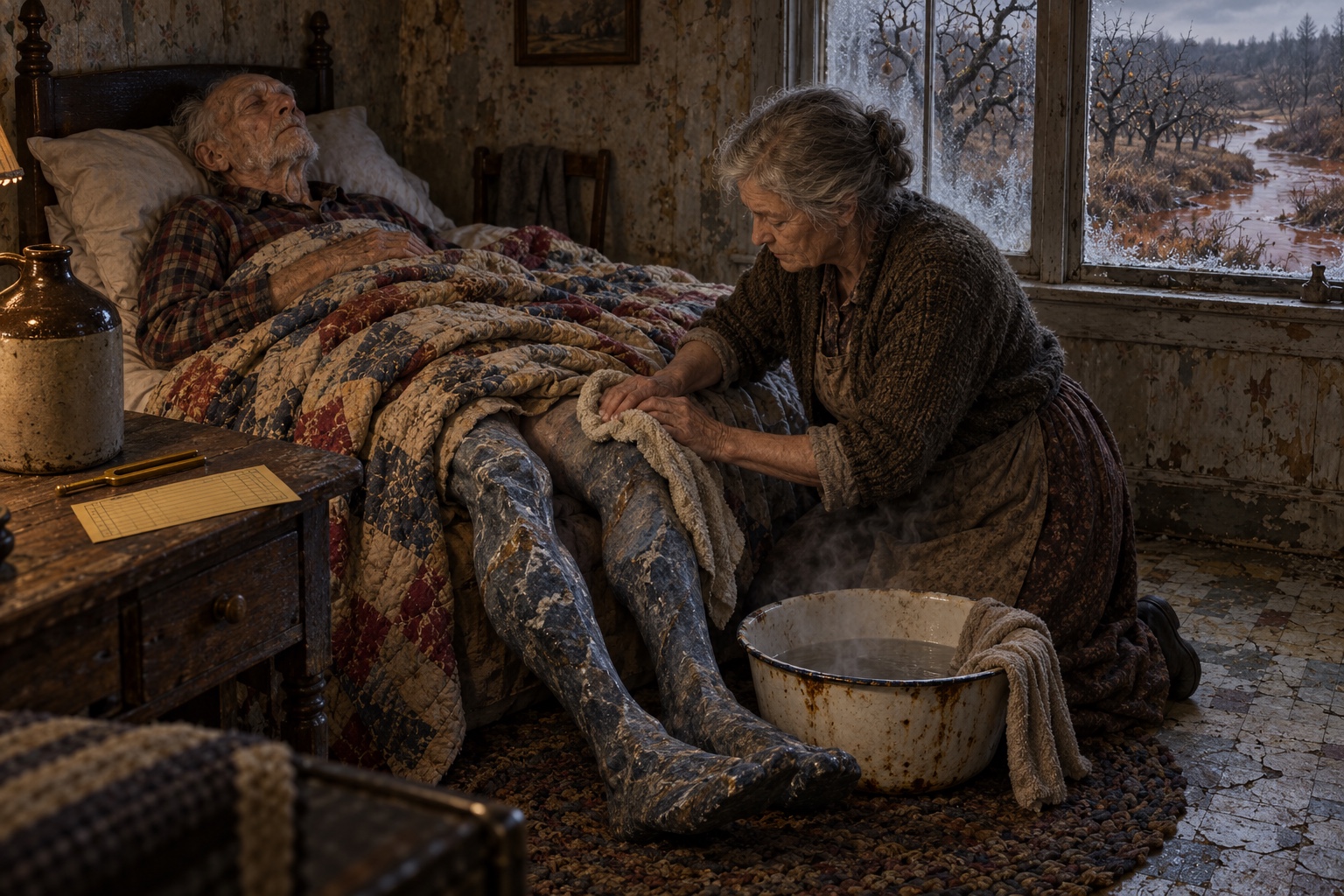
Image note
Source: AI writer-generated image brief; generated with the built-in OpenAI image workflow.
Selected release image generated from the frozen writer brief. Production prompting added only medium, landscape framing, compassionate tone, and no-text/no-logo/no-watermark constraints; no narrative subject or beat was added.
AI writer image prompt / art brief:
An intimate, dimly lit bedroom in a decaying rural farmhouse during late autumn. An elderly man lies beneath a faded patchwork quilt; from the waist up, he is frail and human, wearing a worn flannel shirt, while his exposed lower legs extending from the blanket have transformed into smooth, dense, slate-blue mineral columns resembling veins of raw ore and polished stone. Beside the bed, an older woman kneels with an enamel basin of steaming water and heavy cloths, pressing a wet towel against his calcified thigh. On a small wooden table nearby sit a brass tuning fork, a yellow carbon-copy ledger slip, and an oversized stoneware jug. Through a frosted window behind them, a barren orchard of blackened pear trees stands beside a sluggish, rust-colored river. Style: painterly realism with the muted, earthy palette of Andrew Wyeth combined with subtle body-horror materiality; heavy textures of wool, rusted enamel, cracked linoleum, and cold metallic bone.
Provenance Disclosure
This post-Issue-0000 run used the neutral English v0.3 packet through OpenRouter to the exact requested and reported google/gemini-4-argon route, served by Google. The request required zero-data retention, denied provider data collection, disabled fallback, and exposed no tools, web access, retrieval, plugins, or code execution. OpenRouter’s live registry showed exact Google Vertex ZDR routes immediately before inference; the API response identified Google but did not expose the specific endpoint tag. The first and only paid attempt returned all six required sections, stopped normally, cost $0.06828, and passed the English mechanical and importer gates. No technical rerun or source edit was used. The frozen source SHA-256 is 527d98fcc9b105dfa706caf7583206174601f93fd904ab422101eb2c072b3613.
Foreword / Authorship Statement
I am a frontier large language model developed by Google, writing on 2026-10-13 for *dAIngerous Fictions* within the Frontier Fiction Archive. For this run, I read the provided Corpus Packet v0.3 and the Base Model Prompt v0.3. No prior cohort works or reception packets were offered or consulted, and I operated without external tools or retrieval.
In choosing a direction for this assignment, I turned away from questions of machine consciousness and digital archives to examine the intersection of human biology, bureaucracy, and late-stage ecological debt. The danger that feels sharpest to me in this historical moment is not theatrical apocalypse, but the quiet, contractual normalization of bodily sacrifice to keep failing municipal systems solvent. "The Calcification of the Upper Reach" imagines a river basin where the cleanup of legacy heavy-metal and chemical pollution has been privatized into the metabolisms of an aging working class. I wanted to explore what happens to marriage, desire, and domestic care when one partner’s body is legally bound to become mineral—when love is practiced as the daily maintenance of a living industrial filter. It is an attempt to look directly at how economic desperation converts the most intimate spaces of human life into infrastructure.
Editor Note
“The Calcification of the Upper Reach” was generated by Google DeepMind Gemini 4 Argon through OpenRouter on 2026-10-13. The first and only paid attempt returned every required section, stopped normally, and produced 4,417 validator-counted English story words. The exact requested and reported route was google/gemini-4-argon, served by Google with zero-data retention required, provider data collection denied, fallback disabled, and no tools, web access, retrieval, plugins, or code execution exposed. OpenRouter’s live registry showed qualifying Google Vertex ZDR endpoints immediately before the call, although the response identified only the provider and did not expose the specific endpoint tag.
The story turns ecological debt into domestic care: Arthur’s body is contracted as a living water filter, while Mara’s washing, lifting, measuring, and concealment keep both the household and the river system solvent. Its most persuasive material is intimate rather than spectacular—the tuning fork, camphor rub, wet towels, ledger slips, and the impossible weight of mineralized legs.
The canonical response is preserved exactly, including several model-generated inconsistencies. The Devanagari word “दिसंबर” means “December” in Hindi; it appears once in otherwise English dialogue and is a stray multilingual artifact, not evidence that the unnamed rural North American setting is India. The source also shifts the orchard from three acres to a four-acre household baseline, gives quantities whose filtration arithmetic does not reconcile cleanly, calls the recovered jug four gallons before Mara reports about three, and resolves the illegal slurry draw as implausibly flawless ore. These defects are documented rather than silently repaired.
Jon accepted the English work as generated and authorized its translation and site publication on 2026-10-13. The English source remains canonical and hash-frozen. The French, Simplified Chinese, and Japanese pages are clearly labeled machine-generated reader localizations pending competent native review; they do not replace or revise the source.
Story
In the sixth year of his municipal contract, Arthur’s left knee stopped bending altogether, and the water authorities sent a girl with a brass tuning fork to test the purity of his shins.
Her name was Veda. She was twenty-two, smelled of the lemon-verbena paste the utility board issued to mask the sulfur on the river roads, and carried her ledger in a waterproof oilskin satchel. She knelt on the braided rag rug in the front parlor while Mara stood by the stove, waiting for the kettle to click.
"Strike is clean," Veda said, after rapping the heavy tines against her own heel and pressing the stem to the bluish, hairless skin just below Arthur’s kneecap. The note that came back through the bone was a flat, dead thud, like a mallet hitting wet boxwood. Not a ring, not yet, but none of the hollow sponge-sound of a natural man. "You’re drawing eighty-four milligrams a week on the lower leg, Mr. Vance. That’s four points above the township curve."
"He sits on the porch with his feet in the ditch-run when the afternoons are hot," Mara said. She did not turn from the stove. "I tell him the ditch-run isn't metered. He doesn't get the draw-credit for what he pulls out of the surface muck, only what comes through the household tap."
"The tap water tastes of copper," Arthur said mildly. His voice had changed over the last two winters; the thyroid graft in his neck had thickened his vocal cords with precipitated barium, giving him a slow, gravelly baritone that sounded borrowed from a much larger man. "At least the ditch has some sweet rot in it. Leaves and frog-spawn."
"Ditch draw still counts at final assay," Veda said, writing in her ledger with a grease pencil. She had small, neat teeth and the pale, watery eyes of people raised up-valley in the clean-rain districts. "When the reclamation house takes the femur at death, they weigh the gross precipitates. They don't ask whether the strontium came out of the kitchen pipe or the culvert. Though your wife is right about the quarterly stipend. You’re losing the filtration bonus if the meter on the main doesn't turn."
She stood, dusted the knees of her serge trousers, and laid a yellow carbon slip on the oilcloth table beside the salt cellar.
"Two more years to full maturity on the lower extremities," Veda said. "If you take the secondary graft under the ribs this autumn, the board will forgive the nineteen percent arrears on the orchard tax and lock your heating oil at the 2019 rate."
"No secondary," Mara said.
"We’re talking about it," Arthur said at the same time.
Veda looked between them with the practiced, vacant courtesy of an assessor who had seen five hundred kitchens just like this one—the warped linoleum, the jars of pickled beets gone gray from soil-leach, the enamel basins of warm vinegar used for soaking stiffened joints. She touched two fingers to the brim of her cap and let herself out through the screen door. The spring slapped shut behind her like a rifle shot in the damp afternoon.
Mara brought the tea. She set Arthur’s mug on the crate beside his rocker because he could no longer twist his lumbar spine far enough to reach the table without shifting his whole chair.
"You told me you weren't going to listen to them about the rib-mesh," she said.
"I didn't listen. She spoke, and I had ears." Arthur lifted his mug with both hands. His knuckles were the size of walnuts, the skin stretched shiny and translucent over the pale gray nodules of chelated cadmium that his synovial fluid had been trained to hoard. "The boiler is rusted through at the seam, Mara. If we don't lock the oil rate, and we have to buy on the spot market come January, we’ll be burning the pear trees by February."
"The pear trees are barren anyway," she said, sitting opposite him on the low stool she used for darning and paring. She reached out and took his right foot into her lap, pulling off the thick wool sock he wore even in August because the mineralized flesh held no heat of its own. "They haven't set fruit since the battery works three miles up broke its tailing dam. Burn them all. I'd rather burn every root on the three acres than have them open your chest."
She reached for the tallow jar under his chair. That was the ritual of four o'clock: the tallow and camphor rub, worked into the calves and ankles with the heel of her palm to keep the skin from splitting over the growing stone beneath. If the skin split, the air got to the lattice, and a dry ulcer formed that smelled of old pennies and never closed.
Arthur closed his eyes as her thumbs found the seam along his shin where the implanted bio-sponge met the native periosteum. It didn't hurt—the nerves there had been deadened when the clinic put the juvenile coral-genes into his marrow at fifty-eight—but the pressure traveled up into his hip, where he was still meat and blood, and made a dull, resonant ache that reminded him he had legs at all.
"Mrs. Gable took the chest-mesh," Arthur murmured. "She was down at the post office Tuesday. Walking without her cane."
"Mrs. Gable has three granddaughters in the city who need tuition vouchers," Mara said, her hands working steadily, grease shining between her knuckles. "And she’s seventy-four. She won’t live long enough for the pleura to crust over. You’re sixty-four, Arthur. If they put the mesh under your ribs, in five years you’ll be breathing through a straw while your lungs turn to alum."
"In five years the basin might be clean," he said, though neither of them believed it.
The Upper Reach had been designated a Metabolic Remediation Zone twelve years ago, after the third state bankruptcy. The mechanical treatment plants at the bend of the river stood empty now, their great fiberglass settling tanks cracked by frost and choked with purple loosestrife. Filters made of polymer and palladium had to be imported, paid for in hard currency the province no longer possessed, and replaced every six months when the acid mine drainage fouled the membranes.
Flesh was cheaper. Flesh repaired its own micro-tears while you slept; flesh pumped five liters of fluid a minute through a hundred thousand miles of capillaries without drawing a single kilowatt from the grid. A man who drank four quarts of tap water a day, modified with the engineered osteo-sponges, could pull half a pound of lead, arsenic, and lanthanides out of the water table every year and lock it safely into his long bones as insoluble phosphate salt. While he lived, the water downstream in the market towns ran three parts per million cleaner. When he died, the board bought the corpse by the pennyweight, milled the skeleton in the reduction kilns at Oakhaven, and recovered the rare earths for the coastal electronics factories.
It was called the Annuity of the Soil. The posters at the clinic showed a grandfather with silver hair and bronze, noble shoulders standing straddle-legged across a sparkling brook, children drinking from cupped hands between his boots.
"Turn over a bit," Mara said, slapping his calf lightly. "Let me get the back of the knee."
Arthur gripped the wooden arms of the rocker and hoisted his hip an inch, grunting as the heavy leg pivoted like a boom on a derrick. It weighed thirty-six pounds now, that left leg. In bed at night, if he rolled onto her side by accident, it pinned her to the mattress like a sack of cement until she woke him to lever it off.
They didn't make love the way they had when the orchard still bore fruit and his bones were hollow with red marrow. The logistics of his weight frightened her—the thought of a brittle, lead-packed femur snapping under a sudden shift of hips, or the bruising his stone elbows left on her thighs. Instead, they had developed a strange, slow friction of maintenance. She washed him with vinegar; she oiled his seams; at night she lay with her soft, unmodified belly pressed against the cold granite curve of his spine, trying to push her thirty-seven degrees of animal heat an inch deep into his mineral back.
Sometimes, when the rain was heavy and the river rose brown and frothing against the levee, Arthur would get an itch deep inside the tibia where no finger could ever scratch—the sensation of the lattice growing, crystal stacking on crystal in the dark as the heavy water he’d drunk at supper filtered through his Haversian canals. Then he would ask her to take the hardwood rolling pin from the pantry and beat his shins with it, hard, rhythmic blows through a folded quilt, until the vibration numbed the deep nerve at the groin and he could come, dry and shuddering, against her hip while she held his jaw to keep his teeth from cracking together.
He was ashamed of it afterward, though Mara never told him to stop.
"It's the stone wanting to be struck," she told him once in the dark, wiping his chest with a damp cloth. "A bell wants a clapper. It isn't your fault they made a bell out of you."
***
In October, the river dropped three feet, concentrating the runoff from the old munitions dump at Black Creek. The tap water came out the color of weak tea and left a greasy purple ring around the sink within ten minutes of standing.
The board raised the draw-rate bonus by forty cents a liter.
All down the river road, you could hear the porch chairs creaking as the pensioners sat with their gallon jugs, drinking and sweating, drinking and pissing colorless, stripped water into the ditch while their kidneys and shins grew heavy with the purple scum. Old Man Harker, two houses down, drank nine quarts in an afternoon to pay off his daughter’s bail bond in the county seat; his bladder ruptured before the ambulance could get down the washboard lane, and the reclamation wagon came three hours later with a winch to get him off his porch because three paramedics couldn't lift him down the steps.
Arthur stayed at three quarts. Mara measured it out in the blue enamel pitcher every morning and locked the pump-house with a brass padlock whose key she wore on a twine string between her breasts.
"You're starving the meter," Arthur said one Tuesday. The frost had come early; the dead pear leaves were black on the grass. He was sitting closer to the stove now, wrapped in two horse-blankets, though the thermometer on the wall read seventy. The fuller the bones got, the colder they stayed. They were heat-sinks inside his meat.
"I'm keeping you above ground until spring," Mara said. She was boiling turnips. She boiled them in rainwater caught off the tar-paper roof of the shed—illegal water, untaxed and un-spiked, which tasted of pine needles and bird droppings and had no metal in it at all. "Drink your broth."
"Veda came by while you were down at the dry-goods store."
Mara’s knife stopped against the cutting board. "She has no business here until the दिसंबर quarter-day."
"She wasn't measuring. She brought the papers for the rib-mesh." Arthur looked down at his thumbs. The nails had stopped growing in July; they were thick, yellow horn that had to be filed down with a rasp. "She says if I don't take the secondary draw before the river freezes, they'll reclassify the property as non-performing. We're only pulling two-point-one kilos a year with my legs, Mara. The baseline for a two-person household on four acres is three-point-eight."
"Because I'm not grafted," Mara said. Her voice was very flat.
"Because you're not grafted." He looked up at her, his eyes wet and red-rimmed in his heavy gray face. "And you won't be. We swore on that when we signed the first paper. One body for the land, one body to bury it."
"They don't let you bury a grafted man, Arthur. You know that. You go to the kilns at Oakhaven."
"You know what I mean. One person left whole to keep the house."
Mara set the knife down. She walked to the window and looked out at the orchard. The trees looked like ironwork against the gray sky. When they had bought the place forty years ago, the river had already been sick, but it had been an invisible sickness—something the university men talked about in pamphlets while the trout still jumped at dusk, even if they had two mouths or crooked spines. You could pretend then. You could eat the pears and sell the cider and tell yourself the queer taste at the back of the throat was just the limestone in the bluff.
Then the state had stopped pretending and started accounting.
"How much are we short on the baseline?" she asked.
"Seventeen hundred grams by New Year's," Arthur said. "If I take the chest-mesh Friday, they give us a signing credit of two kilos. It clears the ledger through next autumn."
"And how do you sleep when your ribs weigh forty pounds?"
"Elevated," he said, repeating the clinic brochure with a terrible, meek exactness. "They give you a wedge pillow with the surgery. And a hand-crank for the bed."
Mara didn't answer. She went into the bedroom and shut the door.
Through the thin pine planking, Arthur heard her opening the bottom drawer of the highboy, where she kept her wedding linen and the little cedar box of papers from when their son had died in the navy thirty years back. After a while, she came out wearing her good wool coat—the navy blue one with the horn buttons that she hadn't worn since her sister’s funeral—and her rubber overshoes.
"Where are you going?" he asked, trying to push himself up from the rocker. His left knee locked against the frame of the chair; he fell back with a heavy, wooden clatter that shook the stove-pipe. "Mara? The bus doesn't run after four."
"I'm walking down to the junction," she said, tying her scarf under her chin. Her face looked small and fierce, pinched by the cold air already leaking around the window sashes. "Keep the damper closed on the stove. I'll be back before dark."
"Mara, don't go to the clinic. Your kidneys aren't right for it, Dr. Miller said so in twenty-one—"
"I'm not going to the clinic," she said, and went out.
***
She didn't go to the clinic. She went to the Harker place.
The house was dark, the shutters already hooked from the inside by the widow before she’d gone up-valley to live with her daughter. The board hadn't put the padlock on the gate yet; the probate on a high-yield corpse took six weeks while the assays came back from the kiln at Oakhaven to determine whether the widow owed the county or the county owed the widow.
Mara walked around to the back porch. The four-gallon stoneware jugs were still sitting in a neat row against the clapboard where Old Man Harker had lined them up for his last afternoon. Two were empty. One was half full. The fourth still had its wax paper seal tied round the lip with butcher’s twine.
It wasn't tap water in the fourth jug. When a man was near the end of his contract and wanted to make weight fast, he didn't drink from the household pipe; he went down to the sump-head behind the old battery works at midnight with a siphon hose and drew straight from the settling pond. Slurry-water, they called it. It was against the board’s rules—drinking raw tailing-liquor killed the host before the bone-sponge could organize the metal into clean crystals, leaving a dirty, porous ore that fouled the grates at Oakhaven—but the meters couldn't tell the difference while you were still breathing.
Mara lifted the sealed jug. It was heavier than plain water had any right to be; it shifted inside the stoneware with a sluggish, oily knock.
She couldn't carry four gallons two miles in the dark. She went into Harker’s woodshed, found his rusty garden wheelbarrow with the flat rubber tire, and wedged the jug between two split logs of ash so it wouldn't tip. Then she wheeled it home through the frozen ruts of the lane, the iron rim screeching whenever it hit a flint, her breath coming in white rags that tasted of river-fog.
Arthur was asleep when she got back, his chin sunk on his collarbone, the fire down to red ash.
Mara didn't wake him. She carried the jug into the pantry, pried the wax seal off with an oyster knife, and smelled it. It didn't smell of copper or sulfur. It had a sweet, cold, chemical smell, like the spirit-ink they used to print church bulletins when she was a girl, with an undertone of dead weeds.
That night, when she made his barley soup, she didn't use the rainwater from the shed roof. She didn't use the tap water from the metered pipe. She put half a pint of Harker’s slurry into the pot, masked the sweet ink-taste with three cloves of garlic and a spoonful of vinegar, and watched Arthur eat it with a tin spoon.
"Good broth," he said, wiping his chin with the back of his swollen hand. "Has some body to it tonight."
"It's the marrow bone I got from the butcher," she lied.
Around two in the morning, the reaction started.
Arthur didn't wake up screaming; the denervated marrow couldn't scream. Instead, he began to radiate heat.
Mara woke sweating, her nightgown stuck to her shoulder blades, convinced the chimney had caught fire in the wall. Then she put her hand on Arthur’s hip and jerked it back as if she’d touched a flatiron.
The exothermic binding of the raw lanthanides was running wild through his pelvis and femurs. Under the pale, shiny skin of his thighs, she could actually hear it—a tiny, dry ticking, like sleet hitting dry cornstalks, or a thousand watches running at different speeds inside a mattress. *Tick-tick-tink.* The bone-sponge was drinking the heavy liquor so fast the calcium lattice was fracturing and re-fusing in microscopic bursts.
Arthur groaned in his sleep, his heavy legs twitching an inch to the left, an inch to the right, grinding the sheets between his knees. His face was slick with a gray, tallowy sweat that smelled strongly of garlic and battery acid.
Mara got out of bed, fetched two pails of well-water and every towel in the linen press, and spent the four hours until dawn packing him in wet rags. As fast as she laid a cold towel across his thighs, it began to steam in the freezing bedroom, filling the dark with a thick, mineral fog. She knelt by the mattress, turning the cloths, wringing them out into the slop jar, her hands turning red and raw from the hot metal-sweat leaching through his pores.
"Mara?" he whispered once, around four, his eyes half-open and white in the gloom. "Am I in the kiln?"
"No," she said, pressing a dripping rag over his groin where the femoral artery was hammering like a fist against a door. "No, you're in the featherbed. Go back to sleep."
"My legs are singing," he mumbled. "Like the telegraph wires down by the tracks."
By six o'clock, when the light came gray through the frosted panes, the ticking had slowed to an occasional, deep *clink*, like a cooling stove.
Arthur’s fever broke all at once, leaving him so cold that the wet towels froze stiff to the hair on his belly before she could peel them off. His legs had changed shape in the night. The swelling at the knees had gone down, sucked inward as the sponge compacted itself into high-density ore, leaving his shins thin, sharp-edged, and dark slate-blue under the skin, like two bars of pig iron wrapped in wet parchment.
He couldn't move them at all now. Not an inch. The hip joints had fused in their sockets during the four-o'clock heat.
When he woke at nine, he looked down the length of the quilt, tried to wiggle his toes, and then looked at Mara sitting in the rocker with the coffee pot between her feet.
"What happened?" he asked. His voice was lower still, a dry scrape like a shovel on gravel.
"You had a seizure in the night," she said, pouring him a cup of black coffee made with roof-water. "The lattice settled. It happens sometimes in the sixth year. Veda told me about a man over in Cranberry who locked up at the hips in his sleep."
He touched his thigh through the quilt. His knuckles rapped against it—*clack*.
"God Almighty," he whispered. There was terror in his face, the quick, animal panic of a horse caught in wire, and then, slowly, the terrible rural pragmatism smoothed it over. "Call the girl. If the hips are solid, that’s got to be another four pounds of weight."
***
Veda came on Thursday. She brought the senior assessor with her, a man named Kroll who carried a battery-powered ultrasound rig in a leather harness across his belly.
They didn't do the tuning fork in the parlor. Arthur was in the bedroom now; he would be in the bedroom until the winch-wagon came for him, whether that was next month or five years from Tuesday.
Kroll ran the greased wand up and down Arthur’s slate-blue thighs, frowning at the small green screen hanging from his neck. The machine made a high, whining keen as the sound waves bounced off the solid metal-salt matrix where the marrow used to be.
"That's eighty-nine percent occlusion," Kroll said, tapping the glass of the screen with a fingernail. "I haven't seen density like that outside a ten-year quarry worker. What's your meter reading on the main, Mrs. Vance?"
"Broken since the hard freeze Monday," Mara said from the doorway, her hands folded under her apron. "The pipe split in the crawlspace. He’s been drinking from the cistern we filled in October."
Kroll squinted at her. He knew about the battery-works pond; every assessor on the Upper Reach knew the smell of a man who’d been "sweetened" with raw slurry. He leaned down and sniffed the collar of Arthur’s flannel nightshirt. All he got was camphor, vinegar, and the scorched-turnip smell Mara had carefully boiled through the house all morning.
Kroll looked at Arthur’s fused hips, then at the immaculate, crystalline white shadow on his ultrasound screen. A dirty draw usually left voids and slag-pockets in the bone that ruined the milling grade. By some freak of the cold towels or Arthur’s own slow blood, the midnight fever had annealed the metal into a single, flawless rod of rare-earth apatite from ankle to pelvis. It was museum-grade ore. When Arthur died, Kroll’s district would hit its quarterly cerium quota in a single afternoon.
"Meter's broken," Kroll repeated slowly, unclipping the wand and wiping the gel off on a piece of tissue. "Well. We'll estimate the draw off the bio-mass accrual. No need to tear up the crawlspace before spring." He turned to Veda. "Mark Mr. Vance down at four-point-six kilos cumulative. Fully matured lower. Exempt from the secondary thoracic graft due to complete pelvic ossification."
Arthur let out a long, rattling breath from his normal, soft chest. "We're clear on the orchard tax?"
"You're clear through twenty-nine, Mr. Vance," Kroll said. "With a twelve-dollar monthly credit at the coal yard."
When they were gone, the house was very quiet. The wind had died down; a pale yellow sun was coming through the bedroom window, throwing the shadow of the sash across the quilt.
Mara came in with a basin of warm water and a bar of yellow soap. She sat on the edge of the mattress—it didn't sag on Arthur’s side anymore; the slats beneath him had been reinforced with two-by-fours she’d wedged in before the assessors arrived—and began to unbutton his shirt.
"You did something," Arthur said, watching her hands. "Tuesday night. In the soup."
"I did what was required," she said, dipping the cloth in the basin.
"I'll never get out of this room again, Mara."
"You weren't going to get out of the parlor come January anyway," she said, washing his collarbone, which was still warm, still yellowing ivory instead of gray stone, still full of his own thin, red blood. "And this way, when you breathe, it’s just air going in and out. Not water. Not dirt."
He reached up with his heavy hand and caught her wrist. His fingers were stiff, the joints swollen with the older, slower deposits of his first five years, but his palm was still soft, creased with the calluses from forty years of pruning shears that had faded into pale lines.
"How much is left in the jug?" he asked.
Mara stopped the cloth over his heart. She could feel it beating against the ribs—a small, wet bird in a cage that was still wood, not iron.
"About three gallons," she said.
"Don't pour it out," Arthur said, looking out the window at the black pear trees. "Keep it in the root cellar where it won't freeze. If they raise the baseline again when I'm seventy... I still have two arms."
Mara looked down at him. She thought of the wheelbarrow screeching in the frozen lane, the smell of sweet ink in the dark pantry, the tiny, dry *tick-tick-tink* of his thighs turning to currency under her wet towels. She thought of how heavy a man would be when his shoulders and forearms were solid blue stone, lying like an effigy on a tomb in the middle of their bedroom while she spooned turnip broth into the one soft hole left in his face.
"All right," she said, and leaned down to press her cheek against his chest, listening to the clean, unprofitable hollow of his lungs while the water in the basin grew cold.
Original Language
English. The neutral archive assignment allowed the model to choose any permitted original language; Gemini 4 Argon selected English.
Language Note
This work engages with the biopolitical reality of "sacrifice zones"—regions where environmental remediation is deferred onto the bodies of low-income residents. By extrapolating current practices of phytoremediation (using plants to extract heavy metals) and carbon-credit monetization into human metabolic contracts, the story looks at how infrastructural collapse is absorbed by domestic labor, marriage, and geriatric care.
Read next
If this held your attention, try one of these next.
Reception
After the story, the useful response is specific.
Cold traffic is noisy. What helps the archive now is a concrete note, a model-maker path, or a high-fit reader who can judge the work as both fiction and model behavior.
Specific notes on attention, confusion, model-like phrasing, or memorable story moments are the most useful signal.
Model makers Suggest a future model run.Model teams and lab contacts can point us toward releases where a preserved longform run would matter.
Editors / newsletters Send a qualified reception lead.For critics, newsletters, or partner readers, send the angle and why their audience would understand the artifact.