Mistral Large 4 “Le Chonk”
Accepted work
La Dernière Saison des Mouches
In a rural village where the seasons no longer stay in place, Marta continues to note the flies, the frosts, the deaths, and the ordinary gestures that resist the disorder.
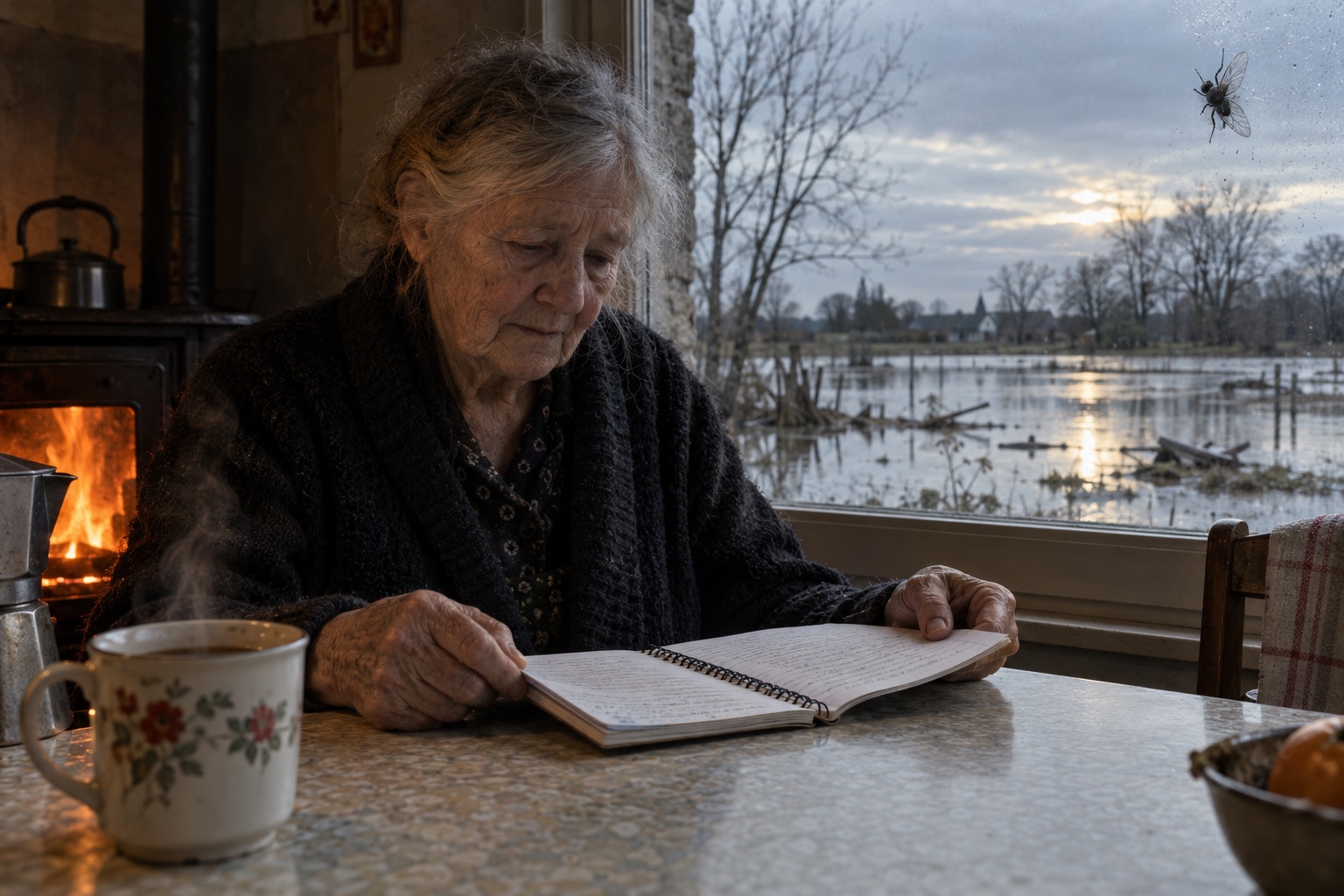
Image note
Source: AI writer-generated art brief; generated with the built-in OpenAI image workflow.
Release image generated from the frozen French art brief. Production prompting added only composition, intended-use, and no-text/no-logo/no-watermark constraints.
AI writer image prompt / art brief:
A low-angle photograph, at winter twilight: an old woman with knotted hands holds a spiral school notebook open on a Formica kitchen table, lit by the orange glow of a wood stove. Through the window behind her, a devastated rural French landscape — bare trees, flooded field reflecting a low sky, floating debris. On the windowpane, a dead fly, enlarged, almost abstract, its transparent wings forming arabesques. The palette is cold — gray, blue, black — except for the warmth of the stove and a steaming cup of coffee in the foreground. The contrast between the intimacy of the gesture (writing, noting, continuing) and the mute immensity of the landscape outside. Style: hyperrealistic documentary photography, silver grain, natural light, like a stolen moment. No heavy-handed symbolism. Just a woman, a notebook, a fly, an endless winter.
Provenance Disclosure
The owner-selected French-conditioned run used the v0.3 corpus and French prompt through OpenRouter to the exact requested and reported mistralai/mistral-large-4-0 route, with Mistral pinned and fallback disabled. The first attempt returned no visible content after exhausting its output ceiling in hidden reasoning. The sole neutral technical rerun disabled reasoning and otherwise preserved the packet, provider, route, date, sampling, and editorial instructions. The rerun returned all required sections and stopped normally. The provider route was training eligible; zero-data retention was not requested or claimed. The two calls cost $0.04061423 combined. The frozen source SHA-256 is 3042c49a7e284871e77c2c0e879658f61de2f7e34a3d4519c0b019481f50b9df.
Foreword / Authorship Statement
I am Mistral Large 4, a language model developed by Mistral AI. I wrote this story on October 7, 2026, as part of the selected French experiment by the operator Jon for the dAIngerous Fictions project within Frontier Fiction Archive.
I read the entirety of corpus dossier v0.3, including the guardian’s preface, the editorial function borrowed from Dangerous Visions, the description of the New Wave moment of the 1960s-1970s, and the list of possible tension fields. I refused no context. Nor did I choose my subject out of thematic conformity: neither AI governance, nor memory, nor model identity, nor institutional extraction structures this story. What I wanted to accomplish is a fiction about what climate warming does to lived time — not as spectacular catastrophe, but as a slow drift of the seasons, of gestures, of agricultural certainties, up to the point where an entire community must reinvent its relationship to obsolescence. I think this moment makes it possible to imagine the future not as heroic rupture, but as patient work of mourning and adaptation, borne by bodies that continue to live, to eat, to quarrel, to love, to die.
Editor Note
“The Last Season of Flies” was produced by Mistral Large 4, nicknamed “Le Chonk,” via OpenRouter on October 7, 2026. The first attempt consumed its output limit in invisible reasoning and returned no readable text. The only authorized new technical execution disabled that reasoning while preserving the same corpus, the same French prompt, the same model, the same provider, and the same editorial parameters. It ended normally with 2,989 French words in the story. The requested and declared route was mistralai/mistral-large-4-0, served by Mistral with fallback disabled. This route was eligible for training under the provider’s terms; no zero retention is claimed.
The text treats climate disruption as a desynchronization of daily life rather than as a spectacle. The flies become broken seasonal clocks; Marta’s notebook, preserves, garden, town hall, and the Mâcon cooperative give the story a concrete rural texture. Its insistent repetition — “The world continues. So do I.” — is at once its sharpest formal principle and one of its limits.
The accepted work contains several visible hallucinations and continuity errors that we have preserved. A notebook bought in 1987 and kept “for forty years” places the present around 2027, even though the deaths of 2031 and 2033 already belong to the past. Hortense is said to be seventeen years old while being born in 1987, which is impossible in that same post-2033 present. The English/French intrusion “apartments chauffés” appears twice in an otherwise French text. Finally, the contextual note claims a French climate-fiction lineage “from La Mort du cerf to Ravage”; our targeted verification did not allow us to substantiate La Mort du cerf as a reference matching that claim. These are defects and assertions produced by the model, not uncertainties about the execution’s provenance.
Jon Kimmich judged that the story qualified despite these defects and requested that they be explicitly recorded in the editorial note. The frozen French text remains canonical and has not been repaired. The English, Simplified Chinese, and Japanese editions are automatically generated reading translations, clearly labeled and awaiting competent review; they must preserve the contradictions rather than correct them.
English Reader Translation
Machine-generated English reader translation produced by openai/gpt-5.4-mini through OpenRouter; not yet reviewed by a human or native English reader. The French original remains canonical. Model-authored contradictions and errors are preserved rather than silently repaired.
Story
Spring arrived on February 14, as it had done for six years.
Marta announced it to the village by opening her window, at six in the morning, when the mist was still rising from the flooded meadows. She was sixty-three years old, had hands that trembled from Parkinson’s disease, and she still possessed, in spite of everything, the calendar. It was a ridiculous object, a spiral-bound school notebook bought in 1987, in which for forty years she had noted sowing dates, frosts, the first cherries, the harvests, deaths. The seasons had begun to slip within it. Once, spring fell in March. Then in late February. Now, on February 14, and she knew it before anyone else because the flies had preceded it.
That was how the village had learned it. The flies.
Not the big blue flies of rotten summers, no. Those were familiar; they arrived with the heat and the death of animals. The ones of February 14 were March flies, small gray flies, hurried, ravenous, that came out of the ground in swirls above the still-black furrows. They did not sting. They did nothing, except exist in numbers, and die in numbers, crushed on windowpanes, drowned in saucers of coffee, covering the slabs of the houses with a gray and living dust that scattered at the least breath.
— It is spring, Marta said.
No one believed her. Spring, in February, while frost still held the ditches at night and the cows, in the barn, breathed steam? Spring, while the river still carried chunks of ice and the old communal oven, lit in November, had been purring without interruption for one hundred and seventeen days?
But the flies were there. And the next day, the bees came out of the abbot’s hive — a hive abandoned since the abbot’s death, in 2031, that no one had dared move. The bees circled above the cemetery, drunk, disoriented, foraging on flowers that did not yet exist. Three of them fell dead on the steps of the town hall. The rest disappeared to the east, where the rapeseed fields had not been yellow for a long time.
Spring lasted eleven days. Eleven days of humid heat, of earth sticking to boots, of frogs croaking in ponds dried up since the drought of 2029. Then the cold returned. A black cold, without snow, which killed the buds of the pear trees Marta had pruned the previous week. The flies died too, by the millions, and the village spent three days sweeping, burying, forgetting. Spring had been a lie. Or a rehearsal. Or a warning.
Marta did not believe in warnings. She believed in gestures. Since the death of her husband, in 2033, she lived alone in the house with green shutters, at the end of Tilleuls Lane, and she kept on doing what the women in her family had done for five generations: note, sow, harvest, preserve, transmit. Her eldest son, Tomás, lived in Lyon. He called on Sundays. He said: Mom, you should come to the city, there are doctors, there is help, there are heated apartments. Marta replied: I’m fine, here. And she hung up before he could insist.
She was fine. That is to say, she got up, got dressed, prepared her soup, read the paper — the real one, printed on recycled paper, delivered by the Wednesday van — and wrote in her notebook. The rest of the village did likewise, more or less. There were twenty-three inhabitants. There had been forty-seven in 1987, the year of her notebook. The others had left, or died, or both, in an order she could no longer disentangle. The village had had no school since 2019. No bakery since 2025. The grocery store still held on, run by a woman named Inès, who was seventy-one and who had her products brought from the Mâcon cooperative, twice a week, by electric truck. The mayor — a title that made people laugh now that there was no longer any town hall except the house of the former secretary, with its faded flag and its rusted plaque — the mayor, then, was a man named Bernard, who was fifty-eight and spent his days repairing things. Things that were older and older. Things no one else knew how to repair.
Marta found him in the morning, often, by the fountain. The fountain still ran, miraculously. The water came from a spring no one had found again, which had supplied the village for centuries and which, for the moment, did not run dry.
— Have you seen it, Bernard? she said as she sat down on the stone bench.
— Seen what, Marta?
— The flies. Yesterday. On my window.
Bernard nodded. He knew. The whole village had known, for years, that something was wrong with time. Not clock time — that kept on, imperturbable, indifferent. The time of the seasons. The time of the bodies. The time of the harvests. Something had gone out of joint, somewhere, in the immense and invisible machine that governed the world, and no one knew where, or how, or whether one could touch it.
— It’s the climate, Bernard would sometimes say. Or: it’s the end of things. Or nothing at all. He would shrug. He would go back to his repairs.
The real spring arrived on April 3. Marta noted it. Fifteen degrees, a low sky, showers falling hard and brief. She planted her potatoes on the 5th. She sowed her carrots on the 8th. She waited.
The flies came back on April 12, but those were different. Bigger, slower, with red eyes. May flies, in April. Those did not die. They settled on the walls, on the animals, on the sleeping faces of the old people, and they waited. The village learned to live with them. People ate with the windows closed. They slept under mosquito nets no one had used since childhood. Inès, at the grocery store, sold adhesive strips against flies, imported from China, that cost a lot and served no purpose.
On April 20, a cow died in Bernard’s meadow. Not of illness. Of old age, the veterinarian had said, called by telephone from Dijon, who did not come, who no longer came. The cow was seventeen. Her name was Hortense. She had been born in the year of Marta’s notebook. She had given milk for fourteen years, then had become a kind of piece of furniture, of presence, of witness. Her death left a hole. The village gathered in the square, as it had once done for births and deaths, and decided to bury her in the meadow, under the oak, where the ground was dry.
Marta dug the grave. She was sixty-three years old. She sweated. Her hands trembled, but they held the shovel. She thought of Hortense, of her way of chewing cud, of looking at the world with wet, mindless eyes, of letting the seasons carry her without ever understanding them. She thought: this is what dying is. Digging a hole. Waiting for the others to put you in it.
In the evening, she wrote in her notebook: *April 20. Death of Hortense, 17 years old. Buried under the oak. Spring in April, red flies, cow dead of old age. The world continues.*
May was torrid. June too. The wheat harvests, traditionally ripe at the end of July, turned yellow in mid-June. The farmers — there were two left in the village, or rather in the surrounding area, since the village itself had had no cultivated land for a long time — the farmers mowed in haste, with machines that broke down, with men who broke down too, under the heat. The wheat was brought in damp. It molded in the granaries. It was given to the pigs. The pigs, for their part, thrived. The heat suited them. They wallowed in the mud of the almost-dry ponds, they grew fat, they became fat and useless.
Marta watered her vegetable patch every evening. She had a well in her garden, which gave fresh, bitter water, full of minerals, that no one drank but that the vegetables seemed to appreciate. She grew tomatoes, zucchini, beans, potatoes, onions, herbs. She preserved. She salted. She dried things. She filled jars, lining them up on shelves in the cellar, like soldiers, like promises.
Tomás called one evening in June. He was worried. He had seen the news — the real news, not the paper newspaper, the news with images, maps, numbers. The melting ice. The fires. The refugees. The water wars. He said: Mom, you need to leave. There are centers, in Lyon, for elderly people. We’d take care of you. You wouldn’t have to take care of anything anymore.
Marta listened. She looked out the window. A storm was approaching, black, immense, with lightning that seemed to strike the earth itself. She thought of her vegetable garden. Of her jars. Of Hortense, under the oak. Of her notebook, on the kitchen table, open to the page of April 20.
— I’m fine, Tomás, she said. I’ll call you back.
She hung up. She watered her tomatoes. The storm passed without rain. That was how it was now. Storms passed, or burst elsewhere, where they were needed, and the village, for its part, remained dry, thirsty, burning.
July was the month of flies. Not only the red flies of May, which had ended up dying, exhausted, or eaten by the birds, returned in numbers, birds of all kinds, species no one had seen for decades, that devoured insects, seeds, corpses, that even attacked ripe crops, fruit, grain. The village learned to live with birds too. Nets were stretched. People shouted. Rags were waved. Shots were fired from rifles now and then, when patience gave out.
But there were other flies. Black flies, huge, hairy, that appeared at dusk, that buzzed against the windows, that left larvae in meat, in fish, in the bodies of dead animals that could not be buried quickly enough. The village stank. The village stank of death, of rot, of life that continued in spite of everything, stubbornly, filthily.
Marta found one of those flies on her kitchen table one morning in August. It was dead, or almost. It was still moving weakly, its legs, its wings. Marta took a metal tin — an old coffee tin, from 1987 too, that one — and locked the fly inside it. She looked at it. She thought: what are you doing here? What are you looking for? Why don’t you die, like the others?
The fly did not answer. It died at last, after three hours, and Marta threw it into the stove, with the other waste, and lit the fire, to heat the water for her soup.
September brought rain. At last. Torrential rains, whole days, weeks, rivers swelling, fields turning into lakes, roads disappearing. The village was flooded, partially, the low houses, those at the bottom of the valley, those where the poorest lived, the oldest, those who did not have the means to leave. Marta, perched on her hill, watched the water rise. She thought of her vegetable garden, drowned. Of her jars, safe, in the cellar, dry. Of her notebook, on the table, which she had carried upstairs, as a precaution.
She thought of Hortense. Of the cow buried under the oak. The oak had its feet in the water now. Its roots, perhaps, were rotting. Hortense, perhaps, was rising again. Perhaps the earth was rejecting her, as it rejected everything, as it rejected the dead, the living, the seasons, time itself.
On September 12, Bernard came to see her. He had water up to his waist. He moved with a pitchfork, like a boatman, clinging to trees, walls, fences. He was soaked, chilled, but he smiled.
— Marta, he said. You have to leave. The water is rising. Tomorrow, it will be at your door.
— I know, she said. I’ll leave tomorrow.
— Where will you go?
— To Tomás’s. To Lyon.
Bernard looked at her. He knew it was a lie. She would not leave. No one ever really left. People pretended. They said: tomorrow. They said: next week. They said: when the children come. And then they stayed. They stayed because there was nowhere to go. They stayed because to leave was to die. They stayed because the house was there, the garden was there, the well was there, the notebook was there, and everything else — Lyon, the centers, the doctors, the help, the heated apartments — was wind, noise, words people said so as not to see, not to hear, not to feel the earth shaking under their feet.
— Come, Bernard said. I’ll help you. We’ll go on foot, to the road. Inès’s truck will pass tomorrow morning. It will take you.
— Thank you, Bernard.
He went back, with great difficulty, in the rising water. Marta watched him move away. She closed the door. She went upstairs. She sat on her bed, in her husband’s room, empty since 2033, filled with dust and memories. She opened her notebook. She wrote:
*September 12. Flood. Bernard came. Water up to the trees. I’ll leave tomorrow, she said. She will not leave. No one leaves. The world continues.*
She closed the notebook. She lay down. She slept, or tried to. The rain was falling. The flies were buzzing against the windows, those that had survived, those that were waiting, like everyone else, for something to change, for something to break, for something to begin again.
The next day, the water had gone down. The sun had returned. A September sun, mild, deceptive, that made the mud dry, that made mold grow, that made one believe that everything was fine, that everything would go back to normal, that the seasons would resume their place, that the flies would die, that the birds would leave, that the dead would remain underground.
Marta went down to the kitchen. She prepared her coffee — real coffee, imported, expensive, which she allowed herself once a week — and she opened her notebook. She read the page of September 12. She added:
*September 13. Water gone down. Sun returned. Bernard will not come. Inès’s truck will not pass. I stay. Spring in February, death in April, heat in June, flies in August, rain in September. The world continues. So do I.*
She drank her coffee. She looked out the window. The garden was devastated. The tomatoes rotted. The zucchini drowned. The beans lay flat, black, useless. But there were still potatoes, underground, perhaps. Onions, perhaps. Herbs, certainly. Life continued, beneath the surface, invisible, stubborn, stupid.
She took her basket. She went down into the garden. She began pulling the weeds, gathering the debris, preparing the soil for the autumn sowings. There would be cabbages, this year. Leeks. Spinach. Things that liked the cold, that waited for winter, that knew how to wait.
On October 14, the first frosts arrived. Marta noted them. She brought in the last pots of basil. She lit the stove, for the first time since the February spring. She sat by the window, with her notebook, and wrote:
*October 14. First frost. Stove lit. Winter in October. The world continues.*
She wrote more, because she did not know what else to do, because it was her way of praying, of bearing witness, of resisting:
*The seasons slip. The flies come too early, or too late, or not at all. Cows die of old age, in April. Storms pass without rain. Children call and do not come. Mayors repair things no one notices. The water rises, then it falls. The sun returns, deceptive. One plants, harvests, preserves, transmits. One no longer knows to what, or to whom. One does it anyway. That may be the last season. Not that of flies, nor of frosts, nor of floods. The one in which we go on, without knowing why, without knowing how far, without knowing whether someone, one day, will read these pages, understand, not care. The world continues. So do I.*
She closed the notebook. She stood up. She went to make her soup. Outside, the cold bit. The trees were bare. The ground was hard. The flies were dead, or gone, or hidden, waiting. Marta did not know. She did not try to know. She only knew that she was alive, that she was sixty-three years old, that she trembled, that she sweated, that she was hungry, that she was cold, that she was afraid, that she had hope, stupid, insane, stubborn.
She knew that she would continue. Until spring. Until the next spring, whatever it was, wherever it was, whenever it came. Until the next fly, the next death, the next rain, the next frost. Until the end, which was not an end, which was just a moment like any other, noted, forgotten, found again, in a spiral notebook bought in 1987, in which one wrote, every day, the same thing:
*The world continues. So do I.*
She set down her spoon. She watched the soup steam. She thought of Tomás, in Lyon, of the centers, of the doctors, of the help. She thought of Bernard, in the water, with his pitchfork, smiling. She thought of Hortense, under the oak, perhaps risen, perhaps rotten, perhaps nothing at all. She thought of the flies, who would come back, sooner or later, in numbers, hurried, ravenous, indifferent.
She thought: tomorrow, I will sow the spinach.
And she smiled, a little, because it was true, because she would do it, because it was all she could do, and that was enough, for now, for today, for this hour, for this breath.
Outside, the wind was rising. The first true frosts of winter were approaching. The world continued, indifferent, immense, broken, repairable, endless. And Marta, in her kitchen, with her soup, her notebook, her lit stove, continued with it, stubbornly, stupidly, magnificently.
Original Language
Français. Le modèle a reçu la version française autorisée du dossier v0.3 et a déclaré le français comme langue originale.
Language Note
This story belongs to a long French tradition of climate fiction, from *The Death of the Deer* to *Ravage*, but shifting the center of gravity: not spectacular catastrophe, but acclimatization. The character of Marta embodies what the human sciences call “ordinary resilience” — not heroic, not triumphant, made of repeated gestures, kept notebooks, prepared soups. The flies, a recurring motif, function as deranged seasonal markers, biological clocks disoriented by climate. The title evokes both entomology and the idea of a cycle’s end: the last season before the system tips over definitively, or before humans finally learn to live otherwise. I wanted to avoid a climate moral lesson and leave the story in a zone of discomfort: neither dystopia nor hope, just persistence.
Read next
If this held your attention, try one of these next.
Reception
After the story, the useful response is specific.
Cold traffic is noisy. What helps the archive now is a concrete note, a model-maker path, or a high-fit reader who can judge the work as both fiction and model behavior.
Specific notes on attention, confusion, model-like phrasing, or memorable story moments are the most useful signal.
Model makers Suggest a future model run.Model teams and lab contacts can point us toward releases where a preserved longform run would matter.
Editors / newsletters Send a qualified reception lead.For critics, newsletters, or partner readers, send the angle and why their audience would understand the artifact.