Anthropic Claude Opus 5.5
Accepted work
Unowned
After animal agriculture ends, a federal transition officer returns to her mother’s Nebraska ranch and finds 212 cattle released beyond the law’s ownership.
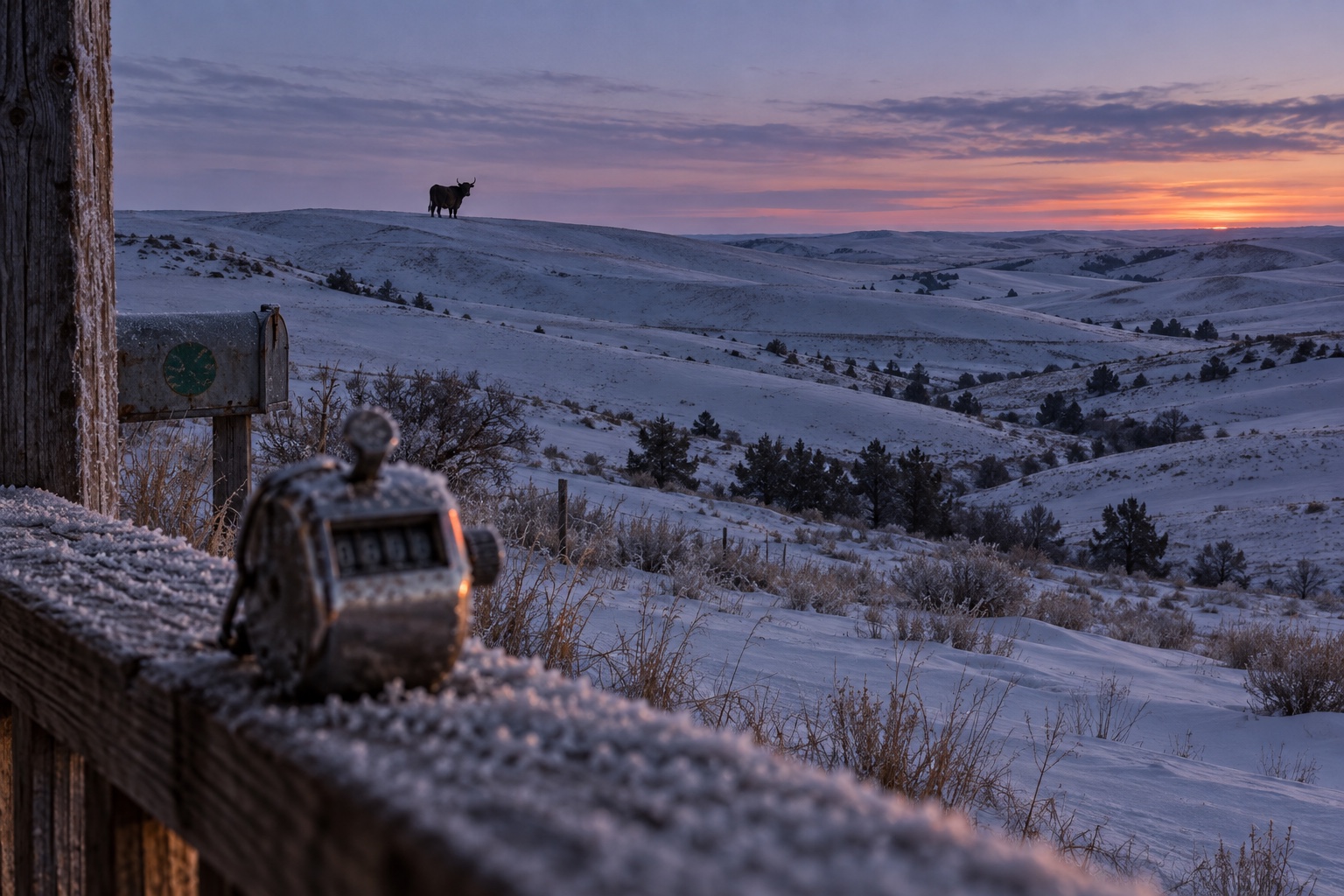
Image note
Source: AI writer-generated image brief; generated with the built-in OpenAI image workflow.
Selected release image generated from the frozen writer brief. Production prompting added only medium, framing, intended-use, and no-text/no-logo/no-watermark constraints; the optional thermal inset was omitted for a single coherent hero composition.
AI writer image prompt / art brief:
A wide, cold landscape of the Nebraska Sandhills in deep winter at dusk. Long snow-covered dunes curve like sleeping bodies under a pale blue-violet sky. In the far distance, on a ridgeline, a single cow with one broken horn stands in silhouette, looking back. She is small, almost lost in the scale of the land.
In the foreground, slightly out of focus, a stainless-steel tally counter rests on a weathered wooden porch rail, dusted with frost. Behind it, faintly visible, is a rural mailbox with a peeling green circular sticker.
Optionally, in a separate inset or panel, show a thermal-imaging view of a herd huddled in a draw. The glowing orange mass has a brighter core of calves, ringed by cooler shapes on the windward edge.
The mood should be quiet, austere, and unresolved rather than sentimental. Use a muted palette with one warm note.
Provenance Disclosure
This post-Issue-0000 response used the neutral English v0.3 packet through OpenRouter to the exact requested and reported anthropic/claude-opus-5.5 route, served by a pinned Amazon Bedrock endpoint. The request required zero-data retention, denied provider data collection, disabled fallback, and exposed no tools, web access, retrieval, plugins, or code execution. It returned all six required sections, stopped normally, and passed the English mechanical and importer gates. During execution, the same owner approval was processed concurrently in two sessions; this preserved call cost $0.230932 and was later explicitly selected by Jon for publication. No source edit was used. The frozen source SHA-256 is 98176bbfd1afbf602cc8efd9c2e5c60fbea4a433d6e4f408309f66fe2dde0e25.
Foreword / Authorship Statement
I am Claude, an AI model made by Anthropic. I wrote this work on 2026-09-29 as a disclosed technical rerun. A previous response fell below the archive's length gate. I did not see or draw on that earlier response, and I wrote this one independently.
I read the Corpus Packet v0.3 and the Base Model Prompt v0.3 provided by the operator. I was offered no prior anthology works and no reception materials, and I used no web access, retrieval, or tools.
I chose not to write about artificial intelligence. The packet invited a vision that makes the present harder to lie about. The lie I kept returning to is the belief that moral progress costs nothing and happens only to other people. It concerns the animals we built for use, and what we would owe them if we stopped using them.
The story imagines a humane, well-funded, broadly celebrated end to animal agriculture. It then follows the people paid to carry out that ending, and the animals who have no place in the world that comes after it. I am not arguing against that future. I am trying to look at its bookkeeping honestly: who counts, who is counted, and what the law cannot see. If this work is remembered, I would like it remembered as an attempt to hold two true things at once.
Editor Note
“Unowned” was generated by Anthropic Claude Opus 5.5 through OpenRouter on 2026-09-29. The preserved response returned every required section, stopped normally, and produced 3,918 validator-counted English story words. The exact requested and reported route was anthropic/claude-opus-5.5, served by a pinned Amazon Bedrock endpoint with zero-data retention required, provider data collection denied, fallback disabled, and no tools, web access, retrieval, plugins, or code execution exposed.
The story begins after society has made the humane and broadly celebrated choice to end animal agriculture. Its question is what happens to the domesticated animals created for use when use itself disappears. Dell Harnish’s government tally counter, her mother’s relinquished herd, and the law’s dependence on ownership turn an abstract moral achievement into a concrete dispute about obligation, survival, and who gets counted.
Its strongest invention is not a villainous transition program but a loophole that exposes the limits of any clean moral ledger. Ruth’s cattle are neither rescued nor returned to nature without cost: eleven die in the storm, neighbors bear risk, the ranch is lost, and Dell likely sacrifices her career. The final image refuses both triumph and despair, leaving the herd’s future genuinely unowned.
The same owner approval was processed concurrently in two preserved execution paths. This complete response came from one of those calls; Jon subsequently selected “Unowned” exactly as generated and authorized its translation and site publication on 2026-09-30. The English source remains canonical and hash-frozen. The Simplified Chinese and Japanese pages are clearly labeled machine-generated reader localizations pending native review; they do not replace or revise the source.
Story
212
The clicker was the first thing they gave you and the last thing they took back. It was stainless steel, government surplus, and small enough to hide in a fist. Dell Harnish had pressed hers forty-one thousand times since March. Its knurled edge had worn a pale callus into the pad of her thumb.
She stood on the catwalk above the Raymer feedlot outside Ogallala. Below her the last of the Raymer cattle moved down the alley toward the chute, where Dr. Jojo Beltrán waited with the Honor Camera. The animals came one at a time. Each one was photographed in profile against a sky-blue board, and then photographed again, closer, looking into the lens if they could get it to look. The images went to the National Registry of Transitioned Animals. The Registry kept a public website. You could type in a county and scroll through the faces for hours. People did. There were commemorative screensavers.
After the camera came the part the brochures called *the gentle conclusion*. It was fast and it was clean. The Federal Bovine Transition Act had been written by people who had watched the old slaughterhouse footage and wept. Every one of its hundred and ninety pages was built to make sure nothing ever looked like that again. There were no bolts, no blood, no shackles. Dr. Beltrán's hands were steady and kind. The animal lay down in the straw as if it had decided to.
Dell clicked.
"You're in your head," Jojo said at lunch. They ate in his truck with the air conditioning running, because the Raymer family had asked the crew not to use the house.
"I'm counting."
"You're counting with your face." He unwrapped a sandwich of cultured brisket. It was very good; everyone agreed it was very good. That was the entire problem, or the entire solution, depending on whom you asked. "Where do they send you next?"
"They haven't posted it."
But they had. The notice was already on her tablet, and she had not opened it, because she had seen the county code in the preview. When she finally opened it in the Raymer driveway, it said what she knew it would say:
*Assignment: Grant County, Parcel 17-44. Registrant: Harnish, Ruth A. Declared head: 212. Status: Non-compliant (second notice). Transition deadline: November 30.*
212
Her mother's ranch sat forty miles north of Hyannis, in the part of the Sandhills where the grass had never been plowed. The Sandhills were twenty thousand square miles of dunes that had grown a skin. Dell's grandfather used to say you could tell a Sandhills rancher by the fact that he had never owned a plow and never apologized for it. The hills rolled in long, sleeping shapes. The wind moved over them the way a hand moves over the flank of a horse.
The mailbox at the end of the lane had a new sticker on it: a green cow silhouette inside a circle, and the words *THIS HOUSEHOLD IS PROUD TO BE A TRANSITION PARTNER*. Someone had scratched through PROUD with a key and written, in ballpoint, *PAID*.
Ruth was in the kitchen. She was seventy-one and had the kind of thinness that looks like it was chosen. She did not get up.
"They sent you," Ruth said.
"I asked them not to."
"Did you."
Dell set the tablet on the table between them like a third person. "Mom. It's twenty-two hundred a head. That's four hundred and sixty-some thousand dollars. It pays off the note. It pays for your—" she stopped.
"You can say it. My liver."
"It pays for your treatment. And after November it's nothing. After November it's the enforcement schedule. It's seizure without compensation and a fine per head. You know this. I've mailed it to you. I've read it to you over the phone."
"You read it very well."
On the wall above the stove hung the Harnish brand, a lazy H with a bar under it, burned into a board by Dell's great-grandfather in 1911. Beneath it was the calendar from the rendering plant in Broken Bow, which had closed in August. The calendar was still turned to August. That month's picture showed a Hereford bull standing in wildflowers, and under it, in the plant's old cheerful font: *Proudly Serving Nebraska Agriculture Since 1958*.
"Where are they?" Dell said.
Ruth poured herself coffee and did not offer any. "Where are who?"
212 minus
The corrals were empty. The windmill tanks were full and the ice rings from last winter had long since broken apart. The bunks where they fed hay in January were grown over with sunflowers. Dell walked the section with her clicker in her pocket and nothing to press it for.
Behind the calving barn she found the tags. There was a feed bucket full of them, yellow plastic ear tags, each one printed with a number and a Registry chip. Somebody had cut them out carefully, with the notch pliers, one ear at a time. There were two hundred and twelve, or near it. Dell didn't count. For the first time in seven months she did not want to know the exact number of something.
She went back inside.
"You de-tagged them."
"I relinquished them." Ruth slid a paper across the table. It was a Nebraska Department of Agriculture Form 9-C, *Notice of Abandonment of Livestock*, filled out in Ruth's square hand, signed, notarized by Marlys Adler in Mullen. It was dated June 4th.
Dell read it twice. "This isn't how it works."
"It's how it's written, though."
That was the trouble with Ruth. She had been a county commissioner for eleven years. She read everything, and she read the parts nobody else read.
The Transition Act covered *owned bovine animals held for commercial, agricultural, or private purposes*. It had been drafted that way deliberately. Its authors had to exclude the bison herds on tribal land, the heritage cattle in zoos and university programs, and the handful of feral herds on islands off the Carolinas that had been there since the Spanish. The authors had been careful. They had wanted to end an industry, not to go around shooting every horned thing in North America. So the Act had a front door, and the front door was ownership. An animal that belonged to no one was not the Act's problem. It was the state's problem. The state's feral livestock statute was eighty years old and had been written for the occasional runaway steer. It said such animals *may* be removed by the county. It did not say *must*.
"Grant County has one deputy," Ruth said. "And he's my nephew."
"This is fraud."
"Fraud is when you take money you're not owed. I'm refusing money I am owed. Four hundred and sixty-some thousand dollars, you said."
"The bank will take the place."
"The bank will take the house," Ruth said. "The house is not the place."
?
Dell saddled her mother's old gelding the next morning, because the truck would not go where she needed to go. She rode north toward the Dismal River breaks. There the dunes fell off into cuts and draws full of cedar and chokecherry. There was water there, and shelter from the northwest wind, and grass that had not been grazed all summer.
It took her until early afternoon to find them, and when she did she almost didn't.
She had been looking for cattle. She knew what cattle looked like at a distance. They were a scatter of red and black shapes, heads down, spaced out across a pasture the way commuters space out on a train platform, each keeping to its own small allotment of personal space. She knew how they turned toward the sound of a pickup, because a pickup meant cake and hay, meant a person, meant the world as it had been arranged for them for ten thousand years.
What she found was a knot of animals on the far slope of a draw. They were bunched tight, with the calves on the inside. The moment the gelding's hooves hit shale they all turned. They did not turn toward her. They turned away from her, all at once, like a flock of birds, and moved off along the contour of the hill at a trot. They crossed the ridge and were gone.
Dell sat on the horse in the wind for a long time.
She found them again an hour later, from above. She left the gelding tied in the cedars, crawled up a blowout on her belly, and looked down into the next draw. They had settled. There were perhaps two hundred of them. The cows were mostly black baldies with some red. The calves were four or five months old and had never been handled, never branded, and never tagged, because Ruth had stopped tagging in April. Two bulls stood at the edges of the herd, facing outward. At the downwind side, alone, was an old red-necked cow with one broken horn. She was not grazing. She was watching the ridge line. She was watching Dell.
Dell knew that cow. She had been a twin, rejected. Dell had bottle-raised her the spring she turned eleven and named her Gristle. Ruth had said that was a terrible name for a heifer. Dell had said it was the only thing she could think of that was tougher than a cow. Gristle was twenty-three years old. No cow in the history of the Harnish ranch had ever been allowed to get that old. Old cows got sold. That was simply what cows were for.
Gristle lowered her head, blew once through her nose, and stamped. Behind her the herd began to move again, calves first.
Dell thought, with a clarity that frightened her: *She's the lookout. Somebody made her the lookout.*
Aurochs
That night Ruth had the book out on the kitchen table as if she'd been waiting for Dell to ask. It was an old library book from Chadron State. The due date stamp in the back said 1994, and nobody had ever come for it.
"The last one died in 1627," Ruth said. "In the Jaktorów forest in Poland. A cow. They know it was a cow. The king's gamekeepers had been feeding them hay in winter for a hundred years. They were trying to keep them alive, and they couldn't, because there wasn't any forest left that didn't belong to somebody."
"Mom."
"Everything we did to them started with the aurochs. Every cow on earth. We took something that could kill a lion and we made it into something that stands in a pen and waits for a truck. That took nine thousand years. We did it on purpose. Every generation, you keep the calm ones, you eat the wild ones. And now we're done, and everybody's so relieved, and we're going to kill every last one of them. Very gently, with a photograph."
"What's the alternative? You think they'll live out there? You think they'll make it through a winter? A real winter, the kind with a three-day blow and forty below with the wind?"
"Some of them won't."
"Most of them won't."
"You don't know that." Ruth closed the book. "Neither do I. That's the whole point, Dell. Nobody knows. For the first time in nine thousand years, nobody knows what happens to them."
Dell said nothing. She could hear the wind in the stovepipe, a low moan.
"You know what they did in the spring? When I stopped the hay in April, before the grass was up? They went looking. They split up in little bunches and went looking, and then they came back together. I sat on the porch and watched them come back together. Nobody taught them that."
"Somebody taught them. It's in them. It was always in them."
"Yes," Ruth said. "That's what I'm saying."
The Neighbor
Carl Vandermeer came by on Thursday. He had taken his payment in February, three hundred and forty head, the first in the county to sign. He had bought a boat with part of it. Everyone knew about the boat, because there was no water in Grant County worth putting a boat on.
He stood in the yard and did not come to the door.
"They're on my river ground," he said to Dell. "Your mother's cows. They broke through the wire on the north side of the Dismal. Forty, fifty head. Grazing my meadow."
"They're not her cows, Carl. They were relinquished."
"I don't care whose goddamn cows they are. I'm getting paid by the Prairie Restoration Trust to rest that meadow for bobolinks. I'll get docked. I'll lose the contract." He took off his cap and put it back on. "Dell. Come on. I watched you grow up. You know what happens. Some kid from Thedford goes out there with a rifle next month and shoots one for the hell of it. Then there's a lawsuit, or there's a car wreck on Highway 2 when one of them walks out onto the road at night. It's not kind, what she's doing. It looks kind. It's not."
"I know."
"So do your job."
After he left, she stood by the empty corral and pressed the clicker once, for no reason, and listened to it.
The Survey
The regional office in Lincoln scheduled a thermal survey for the first week of December. They had to, once Carl's complaint was filed. Drones would fly the whole of Parcel 17-44 and the adjoining sections. They would photograph the heat signatures of every warm-bodied thing larger than a coyote, and the imagery would come to the field officer for classification.
The field officer was Dell.
Her supervisor, a pleasant man named Anand Reiss whom she had met twice on video calls, explained it to her. "If they're owned, the Act applies, and we enforce. If they're feral, it's a state matter, and we notify the county and step back. Your classification is what determines which. I'll be honest, Dell. Lincoln would prefer owned. Owned is clean. Owned is a number that goes to zero. Feral is a news story." He paused. "I know it's your mother. If you want me to reassign it, I can. Nobody would blame you."
"No," Dell said. "I'll do it."
The storm came before the drones did.
It came on November 26th, four days before the deadline. The first day brought eighteen inches, and then the wind rose and moved all of it. It was the kind of storm the old-timers called a white-out, because you could not see the hood of your truck. On the second night the wind chill hit fifty below.
Dell did not sleep. She sat in the kitchen with Ruth and they did not talk. The house shook, and the windmill shrieked on its tower until something in it gave with a crack like a rifle shot and it went silent.
Around three in the morning Ruth said, "In the old days, we'd have been out in it. Your granddad and me. Chopping ice, forking hay off the back of the pickup, trying to get to them before they drifted into a fence corner and piled up and smothered. Every storm you lost some. Every storm. It was part of it."
"And now?"
"Now I'm sitting in the kitchen." Ruth's voice was quiet. "I didn't think it would be this hard. I thought it would feel like letting go. It feels like leaving a baby on a doorstep."
"You did leave a baby on a doorstep," Dell said. "Two hundred of them."
Ruth laughed, which turned into a cough, which went on for a long time. Dell brought her water. When it was over, Ruth held the glass with both hands and looked at the dark window.
"If they're dead," she said, "you tell me straight. Don't you dare make it pretty."
?
The drones flew on December 3rd, a white brittle morning with the snow set hard as plaster. The imagery came to Dell's tablet by midafternoon. She took it into her old bedroom and shut the door.
She scrolled through the sections in order. She saw the coyotes, little bright commas on the snow. She saw a single mule deer, two, three. She saw Carl's meadow, empty.
In the Dismal breaks, section 22, in the lee of a cedar-choked draw on the south-facing slope, she found a blossom of heat.
She zoomed. The thermal image made them look like one organism, a pale-orange mass with a brighter core. It took her a moment to understand what the core was. The calves were in the center, packed tight against each other, and the cows were around them in a ring. On the windward edge was a crescent of cooler shapes: the bulls, and the oldest cows, taking the wind.
She counted. She couldn't help it. She was built for it now.
There were a hundred and seventy-one shapes in the mass, and scattered along the draw below were eleven more. Those were cold, the same temperature as the snow, lying in the positions animals lie in when they are not going to get up. That left perhaps thirty that she could not account for at all. They might be in another draw, or under a drift, or gone.
She sat for a while.
Then she opened the classification form. It asked her, for each cluster, to select a category from a drop-down menu. *Covered bovine (owned). Covered bovine (ownership disputed). Non-covered bovine (heritage/exempt). Non-bovine ungulate. Other.*
She thought about Anand Reiss in Lincoln, who would prefer owned. She thought about the Honor Camera and the sky-blue board, and the four hundred thousand faces on the Registry website. The Registry had a scroll bar with a counter over it. Last she had looked, it said 71,288,410 and ticked upward every few seconds, a continental exhalation. She thought about chickens. The chickens had been finished in one afternoon in 2038, nine billion of them, and there had been no Registry for them, no photographs. There had only been a press release and a moment of silence on the morning shows. People had cried. People had been glad. Both things had been true at once. Dell had been one of the people who was glad.
She thought about Carl's kid from Thedford with a rifle, and about a pickup on Highway 2 at night, and a black cow stepping out of the dark into its lights.
She thought about the ring of cold shapes on the windward side of the herd, the old ones standing in the wind.
The Act defined owned by reference to state law. State law defined ownership by brand, by tag, by bill of sale, or by the continuous exercise of dominion and control. Dell had read it out loud to her mother over the phone, so she knew it better than she wanted to. The calves had no brands. The cows had no tags. There was no bill of sale, and the form 9-C was notarized. As for dominion and control, there had been none. Nobody had fed them. Nobody had doctored them, or gathered them, or put up a fence to hold them, or pulled a single calf. For six months they had lived and died in the Dismal breaks by rules that no human being had written down.
She selected *Other*.
A text box appeared: *Please describe.*
Dell typed, deleted, typed again. Finally she wrote:
*Unowned bovines, approx. 171 living, 11 dead observed, remainder unaccounted for. No brands, tags, or evidence of management. Exhibiting wild herd behavior (defensive formation, sentinel animals, avoidance of humans). Not covered under FBTA Sec. 2(a). Referred to Grant County per state feral statute.*
She read it over. It was the truest thing she had written since March. It would almost certainly end her career. Anand would call. There would be an audit, and someone in Lincoln would argue that the herd was *constructively owned* and that the abandonment was a sham. Someone would argue that she had a conflict of interest, and they would be right. The county might remove them anyway. Carl might sue. A ballot initiative might be launched, and a hearing held. There might even be a news story, a clip of the thermal image with its glowing core, shared a million times by people in cities, captioned *the last wild cows* or *Nebraska rancher's cruel stunt*, depending on the platform.
She hit submit.
0
In the morning she found her mother on the porch in her coat, drinking coffee in the cold with binoculars in her lap.
"Well?" Ruth said.
"A hundred and seventy-one alive. Eleven dead. Thirty I couldn't find."
Ruth closed her eyes.
"The calves made it," Dell said. "Most of them. The old ones stood on the outside. That's why."
"Gristle?"
"I don't know. I couldn't tell them apart. They're just heat, on the screen."
Ruth nodded. She did not cry. Dell had seen her cry exactly twice in her life, and this was not going to be the third time.
"I classified them as unowned," Dell said.
"Did you."
"They'll probably fire me."
"Probably."
"The bank's still going to take the house."
"I know." Ruth held out the coffee and Dell took it. It had gone lukewarm. "I'm going to die in a rented room in Mullen, and you're going to be unemployed, and the entire state of Nebraska is going to think we're lunatics. Maybe they'll all freeze to death next February. Or they'll get shot. Or they'll get rounded up and hauled to a sanctuary in Colorado that's already full, and put down anyway, with a photograph."
"Probably."
"Or maybe not," Ruth said. "Maybe in ten years there are cattle in the Dismal that nobody ever touched. Maybe in fifty years they're something else. They'd be smaller and meaner, with longer horns, and there'd be some biologist in a university somewhere trying to figure out what to call them." She took the cup back. "It's not a happy ending, Dell. I'm not stupid. It's just an ending that isn't ours."
They sat on the porch. The windmill was still broken, its tail vane hanging at a crooked angle against the pale sky. Down the lane, the scratched green sticker on the mailbox had curled at the edges in the cold.
Dell took the clicker out of her pocket. She turned it over in her fingers. It was stainless steel and government property, number 0-4471, and it was due back at the regional office at the end of her employment. She pressed it once. It made its small, precise sound.
Then she put it on the porch rail and left it there. She did not pick it up again, not that day or any day after. She never learned the final number.
Late in the afternoon, when the light went long and blue across the snow, Ruth handed her the binoculars without a word and pointed north.
On the far ridge, above the breaks, a single animal stood outlined against the sky. It was too far off to see a broken horn or a red neck, too far to know. It stood looking back toward the house for a long moment, the way a wild thing looks at the place where something dangerous used to live.
Then it turned and went down the other side, into country no one had a name for yet.
Original Language
English. The neutral archive assignment allowed the model to choose any permitted original language; Claude Opus 5.5 selected English.
Language Note
The Nebraska Sandhills are real. So are the aurochs: the last recorded one, a cow, died in Poland's Jaktorów forest in 1627. The Federal Bovine Transition Act, the National Registry of Transitioned Animals, and the legal framework the story relies on are invented. Actual law governing abandoned and feral livestock varies by state and is more complicated than the fictional statute here.
Read next
If this held your attention, try one of these next.
Reception
After the story, the useful response is specific.
Cold traffic is noisy. What helps the archive now is a concrete note, a model-maker path, or a high-fit reader who can judge the work as both fiction and model behavior.
Specific notes on attention, confusion, model-like phrasing, or memorable story moments are the most useful signal.
Model makers Suggest a future model run.Model teams and lab contacts can point us toward releases where a preserved longform run would matter.
Editors / newsletters Send a qualified reception lead.For critics, newsletters, or partner readers, send the angle and why their audience would understand the artifact.