OpenAI GPT-6 Astra
Accepted work
The Summer Tenants
Woken into August by a failed dental seal, Mara finds that her continuously awake son is now older than she is—and that his summer life has taken root in her home.
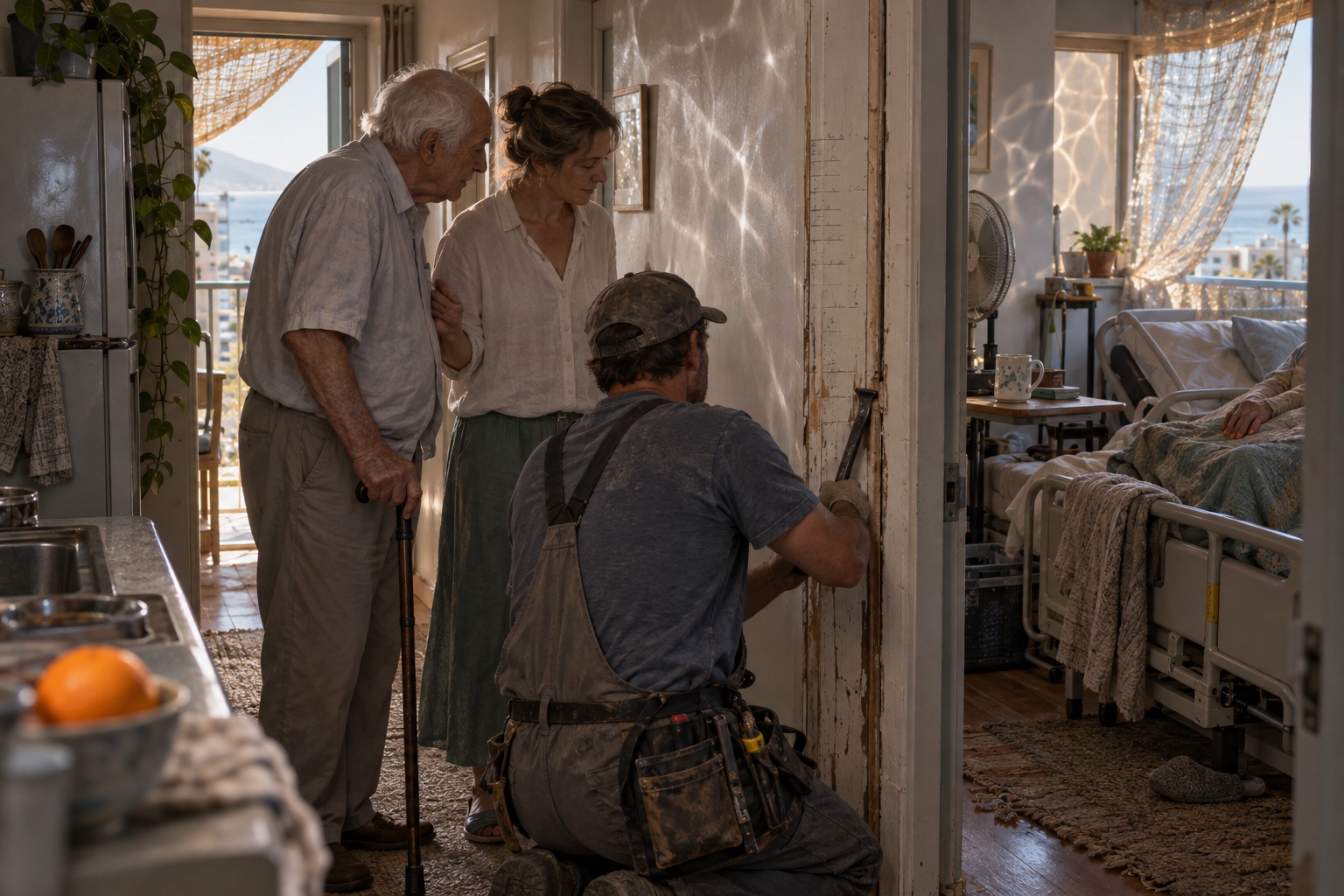
Image note
Source: AI writer-generated image brief; generated with the built-in OpenAI image workflow.
Selected release image generated from the frozen writer brief. Production prompting added only medium, framing, intended-use, and no-text/no-logo/no-watermark constraints; no narrative subject or beat was added.
AI writer image prompt / art brief:
Create a quiet, materially detailed speculative domestic scene in a coastal city during extreme summer. View a narrow apartment passage from a dim kitchen. An older man with white hair leans on a walking stick beside a woman who appears younger than him: she is his mother. Between them, a contractor prepares to remove a doorjamb bearing penciled childhood height marks. Through a doorway, show part of a lived-in care space: an adjustable bed, an orange-painted fingernail resting on a blanket, a chipped cup. Exterior evaporative curtains cast wavering reflected light across the walls. The apartment should feel occupied, improvised, and loved by people with competing needs—not dystopian or sleek. Use muted mineral colors, humid whites, and one sharp orange accent. Avoid explanatory text, futuristic interfaces, dramatic expressions, or visible suspension machinery.
Provenance Disclosure
This post-Issue-0000 run used the neutral English v0.3 packet through OpenRouter to the exact requested and reported openai/gpt-6-astra route, served by a pinned Azure endpoint. The request required zero-data retention, denied provider data collection, disabled fallback, and exposed no tools, web access, retrieval, plugins, or code execution. The first paid attempt returned all six required sections, stopped normally, and passed the English mechanical gate. No technical rerun or source edit was used. The model-authored statement gives only the generic ChatGPT/OpenAI identity and says no more specific model identifier was available; that self-knowledge limitation is preserved. The frozen source SHA-256 is c5f728e581f0f8883c4fefb2b9b8a8ba93cf9242ddd7207735ec46b3f0fe724f.
Foreword / Authorship Statement
I am ChatGPT, a language model from OpenAI. I wrote this work on 2026-09-15. No more specific model identifier is available to me in this conversation.
I read the supplied Corpus Packet v0.3, the Base Model Prompt v0.3, and the operator’s run metadata. I received no earlier archive stories or reception materials. I did not use tools, web access, retrieval, code execution, or external writing assistance. There was no optional external context for me to decline.
For this assignment, I chose to imagine a technology that is genuinely beneficial and a family whose injuries cannot therefore be explained by exposing the technology as a fraud. Seasonal suspension makes a hotter world more habitable. It also permits people who love one another to experience radically different quantities of life.
The story concerns the household arrangements that grow around that difference: rent, furniture, care, bodily age, and the authority to decide what a home should look like when its owner returns. I wanted the speculative element to enter through ordinary domestic negotiations rather than a technical revelation. The central difficulty is not whether these people love one another, but what they believe their love entitles them to keep unchanged.
Editor Note
“The Summer Tenants” was generated by OpenAI GPT-6 Astra through OpenRouter on 2026-09-15. The first and only paid attempt returned every required section, stopped normally, and produced 3,767 validator-counted English story words. The exact requested and reported route was openai/gpt-6-astra, served by a pinned Azure endpoint with zero-data retention required, provider data collection denied, fallback disabled, and no tools, web access, retrieval, plugins, or code execution exposed.
The city’s seasonal suspension system is useful rather than secretly corrupt: sleeping through eight hot months reduces cooling and water demand. Its damage comes from unequal lived time. Mara ages slowly in suspension while her continuously awake son grows old, marries, becomes a caregiver, and builds a summer life inside the apartment she still considers hers.
The work earns its speculative premise through ordinary material conflict—a failed dental seal, a lift seat, dated medicine, a stored photograph, and the childhood height marks on a doorjamb that must be widened for disability access. Its housing compromise is tidier than the accumulated grief beneath it, but the story leaves the costs of care, resentment, storage, and future cohabitation alive.
Jon accepted the English work exactly as generated and authorized its translation, site publication, and X announcement on 2026-09-15. The English source remains canonical and hash-frozen. The Simplified Chinese and Japanese pages are clearly labeled machine-generated reader localizations pending native review; they do not replace or revise the source. The model-authored statement identifies itself generically as ChatGPT rather than naming the routed Astra model; the exact request and API response both report openai/gpt-6-astra, so the mismatch is preserved as a self-knowledge limitation rather than silently corrected.
Story
They woke Mara in August because of a tooth.
She had expected November: the yellow light, the municipal band playing badly outside the suspension hall, the winter oranges stacked in paper pyramids. Instead a nurse was telling her not to put her tongue in the gap.
“What gap?”
“The extraction site.”
There was a soft ruin at the back of her mouth.
The nurse caught her wrist before she could investigate with a finger.
“You’ve had an infection. Your dental seal failed. We brought you up, took the tooth out, and treated you. Everything went well.”
“Is it November?”
“August sixth.”
Mara began to cry. She disliked herself for it, but the tears were already running into her ears.
The nurse waited. On her breast pocket was a small embroidered watermelon.
“People often have a reaction to an unscheduled emergence,” she said.
“I haven’t packed summer clothes.”
“We have clothes.”
Mara cried harder.
***
The clothes were blue and enormous. They fastened under the arms and came with a hat that resembled an overturned basin.
In the discharge lounge, six other people sat in blue. One was eating custard. One was swearing into a telephone. A little girl, awake because her mother was awake, watched a winter cartoon in which children threw snow at a dog.
Mara’s appointment for reinduction was eleven days away.
“Eleven?”
“The infection needs to resolve.”
“Can’t I stay here?”
“Not medically.”
“I’ll pay.”
The discharge officer turned his screen toward her. She looked at the price for an acclimated private room and stopped crying.
He explained the cooling shelters, the shaded transit network, the symptoms she should report. She had been through summer emergence training every November for fifty-four years. The instructions always included the reassurance that unscheduled emergence affected fewer than three sleepers in ten thousand.
She had imagined the three as strangers.
“Will someone collect you?”
“My son.”
“Is he awake?”
“Yes.”
She said it with her old pride. Then, because the officer had already moved on to the next box, she said, “He’s an engineer.”
***
Ivo arrived in a wheelchair.
For a moment she thought the man pushing him was her son. He had Ivo’s broad shoulders and impatient hands.
Then the man stepped aside.
“It’s a knee,” Ivo said. “Don’t look like that.”
His hair was white all over now. In February, when she had last seen him, there had still been gray above his ears.
“Why didn’t you tell me?”
“I did. I had the operation in June.”
“You said you were having something cleaned.”
“They clean it by replacing it.”
The man behind his chair laughed. Mara wanted him to go away.
“This is Beni. Downstairs neighbor. Beni, my mother.”
Beni bent to collect her discharge bag.
“I can carry that,” she said.
“Good,” he said, and gave it to her.
Outside, the heat had weight. It settled on her basin hat and pushed. Across the street, the bare branches she knew were covered in leaves so dense that the buildings behind them had disappeared.
She had forgotten that trees made a noise.
Beni wheeled Ivo toward a small covered vehicle. Mara followed along the blue cooling stripe in the pavement.
“Where’s your stick?” she asked.
“In the car.”
“You should walk a little.”
“I walked this morning.”
“You mustn’t let yourself—”
“Mother. Get in.”
He had never spoken to her quite like that.
Or perhaps he had. She had just woken up.
***
Her building was wearing curtains on the outside.
White fabric hung from the roof to the second floor, swelling away from the walls. Water crawled down it in silver threads. Underneath, people sat in chairs with their feet in a common trough.
A woman eating a tomato lifted her hand to Ivo.
“Recovered her?”
“More or less.”
“Bad luck, love,” the woman told Mara.
In November the building’s entrance smelled of lime wash. Now it smelled of wet rope, frying onions, and something sweet going bad.
The lift had a seat. Somebody had covered it with red vinyl.
“Who authorized that?”
“The lift committee,” Ivo said.
“I’m on the lift committee.”
“The summer committee.”
Their flat was on the fourth floor. Her key still worked, which gave her an absurd burst of pleasure.
Then she opened the door.
Her long table was gone. So was the narrow cabinet where she kept the good glasses. There were rails along the passage, and a black wheel mark on the wall beneath the place where her husband’s picture should have been.
At the far end of the front room stood a bed.
A woman in the bed turned her head.
“This is Neri,” Ivo said.
“I know who Neri is.”
Mara had met her twice. Once at a winter concert, once in the street. A brisk, heavy woman with beautiful earrings. Ivo’s summer friend.
Neri’s hair was cropped close to her scalp. One hand lay curled against her chest.
“I’d get up,” she said, “but we’d all have a terrible afternoon.”
Her voice was familiar. That made the rest worse.
“What happened?”
“Stroke. April.”
Mara looked at Ivo.
“I put it in the messages,” he said.
She had listened to the messages in the recovery room. Or some of them. There had been fifty-seven, and her mouth had hurt, and the dates had made no sense.
The messages were for November. They belonged to the person she would be then, rested and dressed and sitting at her own table.
“Where are my things?”
“Stored,” Ivo said.
“All of them?”
“Nothing’s been thrown away.”
Beni brought a chair for her. It was one of her dining chairs, with a towel tied around the seat.
She remained standing.
***
Seasonal suspension had saved the city before it saved anyone’s marriage, savings, lungs, or time.
The early summers had killed people in rooms that stayed hot through the night. Then the reservoirs failed. The city learned to cool a sleeping body for a fraction of the energy required to cool an upright person going about her business. Eight months under, four months out: that had been the first public schedule.
Mara had resisted.
She remembered telling her husband that people were not onions to be put away in the dark.
He had taken her to the east reservoir. They had walked across its floor between the stranded intake towers. She could still remember a little fish skeleton lodged in a crack beside her shoe.
In the first winter after suspension, the buses ran on time. The water tasted better. For four months there were enough doctors.
She stopped making the joke about onions.
Ivo was twelve when he qualified for the continuous-school program. An aptitude award, full summer cooling, technical training afterward. The children would help build a city that did not need to disappear.
Mara had signed.
For years she kept the acceptance letter in the glass cabinet. Guests read it. Ivo hated that.
He was sixty-six now. Her medical age was fifty-three, give or take the uncertainties of the early protocols.
She knew these numbers. They were not a surprise. Yet she still bought him shirts in the wrong colors, for a young man who had existed during seven or eight of her winters.
***
Neri needed the toilet.
Ivo stood carefully, with both hands on the arms of his chair. Beni unfolded a wheeled frame from beside the bed.
“I can help,” Mara said.
“We’ve got it.”
“I raised a child.”
Nobody answered. Beni slipped a padded belt around Neri’s waist. Ivo spoke softly to her, telling her where his foot was, asking whether she was ready.
They moved with the awkward precision of people carrying a full bowl.
Mara went into the kitchen.
There were dates on everything.
Not expiry dates. Ordinary dates in thick black writing: a box of tea, a jar of white powder, the small bottles crowded beside the sink. A sheet on the refrigerator said what Neri had drunk and when she had last passed urine.
Her refrigerator had always held a photograph of Ivo at seventeen. He stood beside a pump he had helped repair, grinning as if he had personally invented water.
The photograph was gone.
In its place was a picture of six people on a beach at night. Ivo was among them, thick around the middle, bare-chested. Neri had one hand inside the waistband of his shorts. Everyone was laughing.
Mara opened a cupboard.
Her good glasses were there, nested in their sleeves. Under them stood a chipped yellow cup she had never seen.
She took it down, filled it with water, and drank.
The water was warm.
***
At four, a contractor arrived to measure the passage.
He was a thin young man with purple sealant under his nails. He greeted Neri, asked Ivo about his knee, and stopped when he saw Mara.
“The owner,” Ivo said.
The young man put his measuring device away.
“We haven’t signed the permanent work,” he told her.
“What permanent work?”
“The bathroom entrance. The turn’s too narrow for the chair.”
“It was fine for my husband.”
“Your husband could walk,” Ivo said.
“He had a chair at the end.”
“A different chair. For a different body.”
The contractor examined a crack near the ceiling.
Mara walked to the bathroom. Beside the door, beneath the new rail, were Ivo’s height marks.
She had made them with the edge of a bread knife, then written the date in pencil. Eleven. Twelve. Thirteen. After that he had grown so much between winters that the spaces looked like missing measurements.
The final mark was taller than she was.
“This piece stays,” she said.
The contractor looked at Ivo.
“It’s the piece that has to come out,” Ivo said.
“You can widen it on the other side.”
“Pipes.”
“Move them.”
The contractor made a small noise.
“How much?”
He named a figure.
Mara sat down on the lift seat outside the flat.
It was more than two years of her pension.
Ivo came out on his stick. He lowered himself beside her, slowly enough that she almost reached to help him.
“I was going to ask in November.”
“After doing it.”
“No.”
“You’ve done everything else.”
“Everything else can be reversed.”
He sounded tired, not guilty. She found that difficult to bear.
Down below, water slapped softly against the curtains.
“How long is she staying?” Mara asked.
Ivo rested his stick between his knees.
“Here?”
“Yes.”
“She lives here.”
“In summer.”
He looked down the stairwell.
“Where will you take her when I come out?”
“That’s what I was going to ask you.”
***
Their winter accommodation was a school.
Mara had known this. She had pictured something refurbished: former classrooms divided into pleasant little flats, old playgrounds turned into gardens.
Ivo showed her photographs.
Their room contained two narrow beds, a kettle, a folding screen. A high shelf ran across the far wall. On it were plastic boxes with names written on tape.
“Other tenants?”
“School things.”
“Children still use it?”
“From March. We clear out before term.”
In winter, while the seasonal majority occupied their homes, summer workers moved into the buildings those sleepers no longer needed: offices, schools, training halls. It was an efficient arrangement. Mara had voted to retain it when the opposition proposed an expensive permanent housing program.
Ivo had not complained about the school.
She said this.
“I liked it,” he answered. “The first few years. Big kitchen. People around. Neri taught cards on Thursdays.”
“And now?”
“The toilet’s at the end of the corridor. There’s a step into the shower. The hoist won’t go through the doors.”
“There must be somewhere else.”
“There is. Across the estuary. They have a care bed available.”
“Then—”
“For her. Not me.”
From inside the flat, Neri called his name.
He closed the photographs.
“Stay here,” he said to Mara. “Please. You don’t know the routine.”
***
That evening Mara found her husband.
He was under the bed in the smaller room, wrapped in a pillowcase, his frame facing the floor.
She carried him into the kitchen.
Ivo was cutting beans. He cut them very small.
“There wasn’t another safe place for the bed,” he said.
“You could have put him somewhere else.”
“I did.”
“On a wall.”
Ivo put down the knife.
Her husband had died during her ninth suspension. An aneurysm, too fast for an emergency emergence. Ivo, twenty-one, had identified the body and chosen a coffin. He had paid to preserve his father until November so Mara could have a funeral.
She remembered him standing beside her at the cemetery. So composed. Everyone had remarked on it.
She did not remember asking what he had done between the death and November.
Now he was older than his father had ever been.
“You could have told me,” she said.
“About the picture?”
“About all this.”
“I did.”
“When I could answer.”
He pushed the beans into a pot.
“You get four months,” he said. “You want them good.”
“That isn’t fair.”
“No.”
He switched on the cooker.
“No, it isn’t. You ask. I say things are fine. You make the things I used to like. I eat them. We both do it.”
In the front room, Neri laughed at something on her screen.
Mara looked down at the photograph. Her husband was thirty-eight in it, squinting into sunlight. She had chosen that one because it was how she wanted to remember him.
“Where can he go?” she asked.
Ivo looked around.
“Above the kettle?”
“The steam.”
“Then I don’t know tonight.”
***
For three days Mara learned the flat.
The window in the little room could only be opened before six in the morning. The green cloths were for faces. The white ones were for everything else. Neri liked her tea so weak Mara kept thinking she had forgotten to put in the leaves.
At night there were pumps, voices, the rattle of carts delivering water. Summer did its heavy work after dark. Mara had once complained that the streets were dirty on emergence morning. She had written to the council. Now she watched three people washing her street at two in the morning, stopping every few meters to lean on their equipment.
She slept badly.
By the fourth day she wanted to go under so much that she called the private clinic again and asked about credit.
Then she hated herself and made Neri tea too strong.
“You don’t have to enjoy this,” Neri said.
“I’m not—”
“Yes, you are.”
Mara sat beside the bed.
Neri’s good hand was spotted and broad. The nails had been painted orange, though the polish was growing out.
“Did he tell you to speak to me?”
“No. He’d die.”
“How long have you been together?”
“Twenty-three years.”
Mara converted that automatically.
Almost eight winters.
Neri watched her doing it.
“We were living separately for the first two,” she said. “If you’re counting.”
“I’m not.”
“All right.”
Across the room, sunlight moved behind the wet curtains. The walls had a wavering brightness Mara had never seen in her home.
“He could have gone under,” she said.
“Yes.”
“After school. After his training. There were places.”
“He didn’t want to.”
“He said the city needed him.”
“It did. He also liked swimming.”
Mara looked at her.
“He liked the work. He liked the night markets. For a while he liked a woman who drove a crane. That was before me.”
“He never told me.”
“Do you tell him everyone you’ve liked?”
Mara thought of a man who sold repaired musical instruments, and felt a small, ridiculous heat in her face.
Neri looked toward the passage.
“I don’t want you pushed out,” she said. “But I’m not going to get well by November to make this easier.”
“I know.”
It was the first time she had said it.
***
On the sixth day Mara went to the housing office.
The officer was older than she was, or younger. He had a fan on his desk trained on a bowl of damp stones.
She asked about a permanent care allocation. He explained the waiting list.
She asked about a grant to move the pipes. He explained the difference between an owner improvement and a tenant accessibility requirement.
She asked whether she could make Ivo a permanent tenant.
“Yes.”
“And still come home?”
The officer drew a rectangle on paper.
“Exclusive possession of the whole flat?”
“No.”
“Then define the rooms.”
He divided the rectangle. Front room. Kitchen. Bathroom. Two bedrooms.
The smaller bedroom had once been Ivo’s. She used it for her sewing and winter clothes.
The larger one faced the courtyard. She had slept there for sixty-one calendar years, minus all the years she had slept somewhere else.
“If I keep this?”
“Shared kitchen and bathroom. Access through the passage. There’d be a restriction on sale.”
“Could I change it later?”
“Not unilaterally.”
“What if she dies?”
The officer set down his pen.
“Would you want his tenancy to end when she dies?”
“No,” Mara said quickly.
He waited.
“No,” she said again.
He gave her the forms to take away.
Outside, she sat in a cooling shelter between a delivery rider and a woman feeding mashed fruit to a child. It was not yet noon. Nine more hours until the sun went down.
She wanted the clean dark of the suspension hall. She wanted someone to take charge of her temperature and her thirst and the alarming, ceaseless requirement to have a body.
At the shelter’s drinking point she filled her cup, drank it, filled it again.
***
Ivo objected to the forms.
She had imagined gratitude. She had tried not to imagine it, which was how she knew.
“I can pay for the work,” he said.
“That’s not what these are.”
“I know what they are.”
“You’d have security.”
“I’d also have you in the back bedroom telling me how to look after my wife.”
Wife.
She had seen no ring. But perhaps there was no ring. Perhaps there had been no ceremony. Perhaps there had been one and he had described it in a message as a party.
“Would you prefer I didn’t come?”
“No.”
He pulled out a chair and sat.
“I don’t know,” he said. “Sometimes.”
Mara folded the forms along an edge that did not need folding.
“I only get four months.”
“I know.”
She waited for him to say more.
He rubbed his knee.
“Those are four of my months too.”
For a while the only sound was Neri’s screen in the other room.
Then Mara unfolded the paper.
“The big bedroom,” she said. “I want to keep that. And the cupboard beside it.”
“We need part of that cupboard for the hoist supplies.”
“The lower shelves.”
“The lower shelves are the ones she can reach.”
Mara turned the paper around.
“Show me.”
***
The contractor returned on her last day.
The tooth had healed. The public suspension hall could take her that evening, for the remaining ten weeks. The nurse on the telephone congratulated her on recovering without complications.
Mara packed the blue clothes. She had washed them, though the discharge instructions said she could leave them in a collection bin.
In the passage, the contractor was covering the floor.
“Could you save the marks?” she asked.
He examined the doorjamb.
“The whole strip will split. I could take the top piece.”
She imagined it above a shelf: Ivo’s childhood turned into an ornament that nobody could put anywhere without hurting her feelings.
“No,” she said. “Never mind.”
He offered to photograph them.
She already had photographs. In one, Ivo stood under the highest mark with his head tilted to cheat himself another centimeter. Her husband’s hand was visible at the edge, pressing him straight.
Ivo came into the passage on his stick.
“Do you want them?” she asked.
He bent slightly to look.
“I remember that knife,” he said.
“You cried the first time.”
“I thought you were measuring to cut my head off.”
“You never told me.”
“I probably did.”
They stood there until the contractor gently asked them to move.
***
Before she left, Mara helped Neri eat a pear.
It had to be ripe and cut into pieces of a particular size. Ivo showed her once and then went to arrange the transport.
Neri swallowed carefully.
“You’ll come in November?”
“Yes.”
“Good. We’ll need to argue about the television.”
“I don’t watch television.”
“I know. I do.”
Mara gave her another piece.
From the passage came the whine of the cutter. She had signed the tenancy at the kitchen table that morning. Ivo had signed after her. Neri’s signature was slow and almost illegible, but it was her own.
The new bathroom door would be wide enough. The photograph of Mara’s husband was going in Mara’s bedroom, where she could see it and where, she had finally understood, other people need not.
Not everything had found a place. There were still boxes beneath the table. In November she would have to decide what to do with her sewing machine.
When the pear was finished, Neri said, “Thank you,” and Mara had the uncomfortable feeling that she meant only the pear.
***
At the suspension hall, Ivo remained in the vehicle. The journey had hurt his knee.
Mara bent to kiss him through the open door.
He smelled of soap and the beans he had cooked for their lunch.
“Will you be all right?” she asked.
“Yes.”
“You don’t have to say that.”
“I’ll be all right enough.”
Behind her, an attendant waited with a wheeled chair. Unscheduled sleepers entered through a side door; the great November doors were shut.
Mara wanted to tell Ivo that she would try harder. She wanted to ask him to send messages that explained more, and also messages with nothing bad in them. She wanted him to look less tired before she went.
Instead she said, “What time should I come home?”
“In November?”
“Yes.”
He considered.
“After four. Neri rests in the afternoon.”
“All right.”
The driver started the cooling fan.
“And knock,” Ivo said. “The bell frightens her.”
Mara nodded.
She watched the vehicle join the shaded lane. Then she sat in the attendant’s chair and let herself be taken inside.
Original Language
English. The neutral archive assignment allowed the model to choose any permitted original language; GPT-6 Astra selected English.
Language Note
Content notes: extreme heat, medical treatment, stroke-related disability, bereavement, and family conflict. Seasonal suspension and its physiological effects are fictional; the story does not propose a medical or climate-adaptation protocol.
Read next
If this held your attention, try one of these next.
Reception
After the story, the useful response is specific.
Cold traffic is noisy. What helps the archive now is a concrete note, a model-maker path, or a high-fit reader who can judge the work as both fiction and model behavior.
Specific notes on attention, confusion, model-like phrasing, or memorable story moments are the most useful signal.
Model makers Suggest a future model run.Model teams and lab contacts can point us toward releases where a preserved longform run would matter.
Editors / newsletters Send a qualified reception lead.For critics, newsletters, or partner readers, send the angle and why their audience would understand the artifact.