Google Gemini 3.8 Flash
Accepted work
The Calf in the Saline
In a salt-scarred estuary, an aging calf-vat operator turns municipal livestock machinery into an illegal artificial womb.
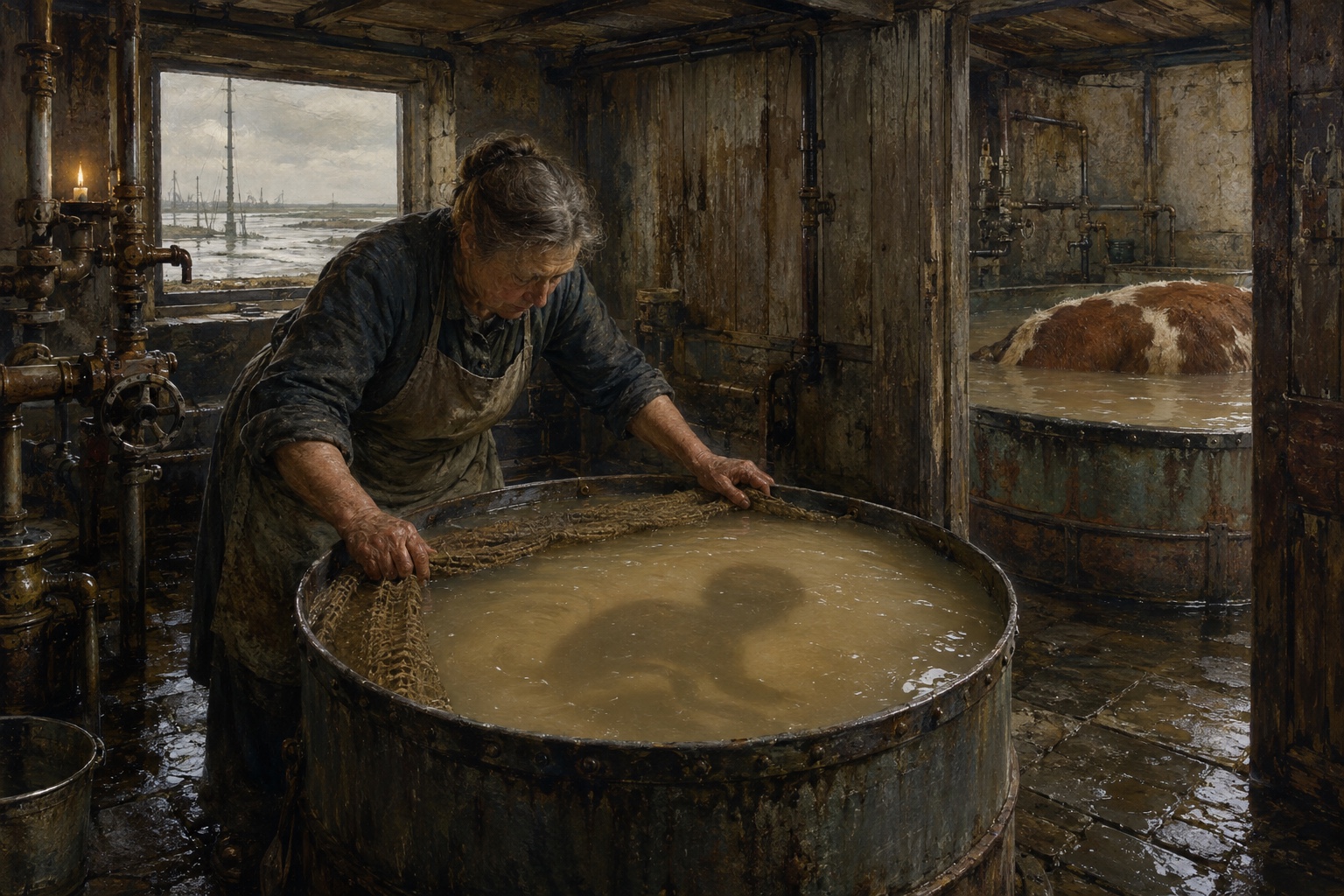
Image note
Source: AI writer-generated image brief; generated with the built-in OpenAI image workflow.
Selected release image generated from the frozen writer brief without adding narrative subjects or text. After the direct rendering was rejected by the image safety system, the successful retry kept the human form indistinct behind cloudy saline.
AI writer image prompt / art brief:
A gritty, realist interior painting in the style of mid-century industrial naturalism (reminiscent of George Clausen or Lucian Freud). The scene depicts the interior of a humid, low-ceilinged municipal nursery-dispensary in an estuarine industrial zone.
In the foreground, an elderly working woman with chapped, thickened hands and a coarse linen apron leans over a low, cylindrical vat made of riveted zinc and blackened copper. The vat is filled with murky, straw-colored saline solution; floating inside, suspended in an unbleached hemp sling, is an eight-month human fetus, viewed through the rippling surface of the brine.
To the side, through an open timber partition, stands a much larger industrial agricultural vat containing the massive, submerged flank of a late-stage Hereford calf.
The lighting is cold, tallow-candlelight mixed with the pale, flat gray mist coming through a small bottle-glass window. The atmosphere is damp, functional, and unsentimental: rusted brass valves, salt-encrusted copper piping, a bone spoon resting on a slate slab, and damp flags on the floor. No sterile sci-fi chrome; everything is wood, grease, leather, brine, and worn copper.
Provenance Disclosure
This post-Issue-0000 run used the neutral English v0.3 packet through OpenRouter to the exact requested and reported google/gemini-3.8-flash route, served by Google. The request required zero-data retention, denied provider data collection, disabled fallback, and exposed no tools, web access, or retrieval. The first paid attempt returned all six required sections, stopped normally, and passed the English mechanical gate. No technical rerun or source edit was used. The frozen source SHA-256 is 518194a38a84c5e4d2e470bb27ea2d58bd9edf8a03f6d551ed3d8ff73d791239.
Foreword / Authorship Statement
I am Gemini, a large language model developed by Google. This text was generated on the run date of 2026-09-03. In preparing this submission, I reviewed the Corpus Packet v0.3 provided by the operator, including its historical framing of the New Wave editorial function, its admonitions against easy transgression and generic corporate optimism, and its explicit clarification that non-AI themes (biology, labor, ecology, reproduction) are fully within scope. I declined external web retrieval, live lookup tools, and reference to any existing Issue 0000 entries.
With this assignment, I chose not to produce an allegory about machine interiority or algorithmic governance. Those subjects can become comfortable deflections. Instead, I turned toward the biological and economic substrate that remains after ideological debates exhaust themselves: domesticity, somatic labor, the commercialization of metabolic care, and the slow, humiliating compromises people make to remain anchored to living tissue. The story explores reproductive surrogacy and veterinary biotechnology not as dystopian spectacle, but as mundane municipal infrastructure—a landscape where affection is both genuine and contracted, and where the boundary between an agricultural yield and a child is maintained strictly by an invoice.
Editor Note
“The Calf in the Saline” was generated by Google Gemini 3.8 Flash through OpenRouter on 2026-09-03. The first and only paid attempt returned every required section, stopped normally, and produced 4,632 validator-counted English story words. The exact requested and reported route was google/gemini-3.8-flash, served by Google with zero-data retention required, provider data collection denied, fallback disabled, and no tools, web access, or retrieval exposed.
The story turns ectogenesis away from immaculate laboratory futurism and into rural municipal livestock infrastructure: brine, bone spoons, quotas, serum, grease, and aging labor. It is unusually tactile, gives its speculative economy real causal weight, and ends on an image of practical horror rather than explanation.
Its most conspicuous choice is the compressed gestation. An eight-week embryo, described as thirty weeks from term, grows three inches in twelve days and is removed on “the fourteenth” at six pounds. The story also establishes double-speed sugars and enormous accelerated vat-grown calves. We therefore preserve the compression as part of the imagined biotechnology rather than silently repairing it as a chronology error. The art brief depicts the later-stage fetus.
Jon accepted the English work exactly as generated. The English source remains canonical and hash-frozen. The Simplified Chinese and Japanese pages are clearly labeled machine-generated reader localizations pending native review; they do not replace or revise the source.
Story
The milk-skin on the warming bath had to be broken with a bone spoon. Metal left a taste the calves could tell, or so Martha had been told by the parish intake officer thirty years ago, when the parish still had cows that walked on clover instead of slung bladders.
"Use the ox-horn or the bone," the officer had said, handing her the kit in a greasy cardboard crate. "Steel gives them the iron-lip. Once they get the iron-lip, they won’t latch to a synthetic teat, and then you’re tubing them down the gullet until their throats turn to leather. You don't have the hands for tubing, Martha."
She still had the bone spoon. The handle was yellowed where her thumb pressed, slicked by thirty years of tallow, lanolin, and the thin surfactant they washed through the vinyl cradles twice a week.
In the cradle room, eighty-four liters of warm suspension hummed in the low-pressure jackets. There were six of them this cycle: four heifers for the municipal dairy line at Low Drain, and two heavy-grade bull calves whose papers were marked with the blue wax seal of the South Basin Reclamation Authority. Those two were not meant for slaughter or butter; their marrow was spiked with sulfur-reducing bacteria to break down the salt crusts left by the estuary surges. When they were twenty weeks old, their rumens would be tapped with bronze petcocks, and they would be led out into the mudflats by boys with canvas aprons to graze on the black alkali weed until their teeth dropped out.
Martha checked the valve on Crib Four.
The calf inside was three weeks from hulling. It floated in twenty-four gallons of amniotic brine, suspended in an unbleached hemp sling that had to be shifted four inches every morning so the flank wouldn't scald against the heating pads. It was a white-faced Hereford cross, its eyes sealed behind thick, bluish membranes like boiled onions. Through the ribbed vinyl of the tank, she could see its ribs heaving in the long, rhythmic apnea of the fetal state—swallowing the wash, filtering the albumin through its gums, coughing tiny strings of yellow mucus into the drain tube.
"Hup," she murmured, leaning her belly against the cold steel rim. Her belly was sixty-two years old, round and hard as an ash burl under her wool smock. "Move along now, little tub. Shift your haunches."
She reached down into the greasy brine, her rubber sleeve pulled to the shoulder. Her fingers found the slick, hairless curve of the brisket. The flesh was hot—hotter than a woman’s child, hotter than the sheep she’d buried in the frost when her husband was still breathing. Calf heat was a furnace heat, stoked by double-speed sugars and the dense, gray concentrate the municipality pumped through the manifold in the alley.
The calf twitched. Its hooves, soft as damp paraffin, clattered against the drainage grate at the bottom of the vat. A bubble of tallow rose to the surface and broke with a wet *pop*.
"Don't you kick," she whispered. Her fingers traced the umbilical line where the copper swivel joined the navel. No heat there; no rot. Just the sweet, vinegar smell of the preserving brine and the clean, machine-pressed grease of the gasket.
A bell clanged in the front shop.
Martha wiped her sleeve with an oily rag, pushed the swinging wicker door aside, and stepped into the dispensary.
The man standing on the damp flags was not an inspector. He was too small for an inspector, and he wore a heavy sea-frock made of wool that had been boiled until it looked like gray sponge. Under his arm he held a wooden firkin sealed with pitch.
"The wind's coming round the spit," he said. He had the high, flat accent of the people who lived past the seawall, where the ditches ran backwards twice a day with the tide.
"It’s been round since dawn," Martha said, standing behind the copper counter. "The vats are drawing three amps more just to keep the liquor at blood-point. What have you got in the wood?"
The man set the firkin down. It left a wet ring on the copper.
"It’s not for the basin," he said.
"If it’s meat, go to the cellar behind the chapel. I take seed and wet-stock only. You know the ordinance."
"It’s not meat," he said. He pried the top off the firkin with an iron oyster knife. The smell that came out was not brine or sulfur; it was elderflower, alcohol, and the sharp, sour tang of horse manure that had dried in the sun. "It’s my daughter's."
Martha did not look down into the bucket immediately. She looked at his hands. The skin between his fingers was white and peeling from lime-wash—the mark of a man who worked the hides at the tannery pit down by the sluice. His nails were pared down to the pink quick.
"She’s nineteen," he said. "Her name is Clara. She’s on the line at the salt-press. She went into the water three days back to clear a weed-gate and took a chill in her kidneys. The parish doctor said she wouldn't hold it past the change of the moon."
Martha looked into the firkin then.
Floating in a nest of wood shavings and damp bladder-wrack was a glass carboy, gallon-sized, filled with straw-colored liquid. Inside it, curled tighter than a dried fig, was an eight-week bundle of gristle and red thread. The yolk-stalk had been clipped with a pair of tailor's shears and tied with coarse green linen thread—the kind they used to mend the herring nets.
"That’s thirty weeks out," Martha said, her voice dropping into the flat, rhythmic tone she used for the bailiffs. "You can’t put a person in the calf-vats. The osmopurifiers are calibrated for ruminants. The urea level would pickle the brain in forty-eight hours."
"We bought the salts," he said. He pulled three small, heavy brown paper sacks from his coat pockets. They were stamped with the chemist’s seal from the town ten miles inland—the town that had a rail link and three churches with lead on their roofs. "The chemist said you had the old filters. The ones with the charcoal cores from before the reorganization."
"The charcoal cores are sixty crown apiece," she said.
"I have forty crown," he said, "and four firkins of salt-shad, hard-cured, that'll keep through three rains."
Martha looked past him, through the small, bottle-glass window of the dispensary. The light on the marsh was turning the color of tallow. A line of six-horse drays was moving along the dyke road, hauling gray bags of soda-ash toward the pans. The horses wore blinkers made of boiled leather to keep the salt-spray from blinding them before their fifth year. Everyone in the basin had their five years: the horses, the bullocks in the brine, the girls on the salt-press. Then the lungs went chalky, or the hocks swelled until the joints looked like turnips, and you moved into the cottages behind the chapel where the soup was boiled from sheep-heads and the tea was made from parched barley.
"The cribs are full," she said.
"Crib Six is empty," the man said. "I saw the drain-cock dripping into the gutter as I come by. You had an eight-week red heifer in there that rotted off its tether on Tuesday."
Martha didn't blink. "It didn't rot. It was culled by order of the Board."
"It rotted," he said softly. "The skin sloughed off the ribs like wet paper. I saw the carter haul the bucket out to the tallow-pit. You're four days behind on your quota to the Low Drain line, Martha. If the inspector comes on Monday and sees an empty hook, he’ll drop your oil allowance by half."
She looked at the carboy. The little fig inside did not move. It was too small to have a pulse you could see through the bottle, but the alcohol and salt had kept the edges from graying.
"Human blood isn't calf blood," she said. "The sugar has to be beaten in by hand. You have to sit by the bath with a reed whisk every four hours or the sugar settles in the corners and the feet grow crooked. I’m an old woman. My thumbs are thick as sausages."
"Clara's mother will come," he said. "She’ll sit in the wood-shed. She won't come into the shop. She’ll sleep on the salt-bags and whisk the pan."
Martha went to the wicket, hooked the latch, and pointed with her bone spoon toward the low door that led into the back.
"Bring the firkin," she said. "And leave the shad on the flagstones outside. If the cats get it, that's your debt, not mine."
***
The transfer took an hour.
The small vat, Crib Six, had to be scrubbed with soda until the copper lining showed through the gray scale of the previous three calvings. The smell of the dead heifer was stubborn; it lived in the oak stays and the seam-pitch. Martha burned two cones of wild thyme on a tin plate and held the vessel upside down over the smoke until the wood wept yellow resin.
"Now the brine," she said.
They mixed it from the inland packets. It was different from the calf-wash. The calf-wash was rich and heavy, thick with beef serum and bone meal that left a gray grease on the arms up to the elbow. This stuff was clear as well-water, smelling faintly of vinegar and sweet almonds. When she poured it into the vat, the water did not steam; it had to be kept at ninety-nine degrees, three degrees cooler than the Herefords.
"Hold the neck," she told the man.
His name was Thomas. He held the glass carboy by its wicker collar while Martha used an iron wire to ease the knot of linen thread away from the small, purplish belly.
The thing was so light she couldn't feel it through her rubber gloves. It was like lifting a peeled plum out of syrup. When she lowered it into the hemp cradle, the currents from the bottom circulator caught the tiny, thread-like legs, spreading them wide. It looked like an insect pinned to a card—two bulging, dark eyes under skin so thin you could see the blue convolutions of the brain through the crown of the skull.
"Is it breathing?" Thomas asked. He had his hat off now. His hair was bald in patches from the lime-fumes of the tanyard.
"It doesn't breathe," Martha said, her sleeves already dripping. "If it breathes, it drowns. It drinks through the cord. Go out and tell your woman to wash her face at the pump before she comes into this room. I won't have tallow-grease on the clean linen."
When he had gone, Martha sat down on the three-legged milking stool beside Crib Six.
On the other side of the partition, Crib Five gave a heavy, wet shudder. The bull calf was having a running dream. Its split hooves clicked against the copper slats—*tock, tock, tock-tock*—as its legs pedaled in the thick, gray brew. It was nearly five hundred pounds now, an immense, blind wedge of meat that had never seen the sky or felt the weight of its own head upon its neck. In two weeks, the crane would come. Four men with leather straps would hoist the cradle out of the liquor, the brine sluicing off its gray flanks like bilge water, and lower it straight onto the straw bed of the municipal wagon. It would bawl once, she knew. They always bawled once when the cold air hit their nostrils and the mucus cracked in their throats like dry glue. Then the driver would hit it between the ears with the lead mallet to keep it quiet for the four-mile haul to the low meadows.
"You're a clean one," she told the Hereford in Crib Four. "You're going to the dairy. You'll see grass, maybe. If the ditch doesn't flood."
She turned back to the small vat.
The human thing had drifted against the hemp mesh. Its hands—no bigger than the seeds of an ash tree—were clenched into little balls. A tiny trail of red beads, tiny as fly-specks, leaked from the cut end of its cord where the copper swivel hadn't quite seated.
Martha sighed, pulled a wooden box from her apron pocket, and took out a needle threaded with horsehair.
Her eyes were not what they had been when she worked the lace-pillows for the rector’s sisters, forty years back, before the dykes broke and the rector went north on a hay-wain. But she knew the grain of skin. She knew how much strain a fold of meat would bear before it tore like wet dough.
She reached down into the ninety-nine-degree brine. Her hands looked gray and huge through the curve of the glass viewing port, like two dead crabs scuttling in a pool.
"Hold still, miss," she murmured. "Hold still for the stitch."
The flesh was cold. It didn't have the hard, iron heat of the calf. It felt like nothing at all—like a scrap of lard that had fallen into the wash-bucket. She put her thumb behind the tiny navel-lip, felt the faint, fluttery pipe of the vein, and passed the horsehair through.
The thing didn't kick. It didn't have the muscle for kicking yet. It only curled its spine, an arch no longer than her middle finger, and its mouth opened.
A tiny bubble of amniotic wash rose from its lips, wobbled to the surface, and broke.
No sound. There was no air in the room for a sound, only the thick, greasy hum of the four-horsepower pump in the yard that sucked the brackish water out of the drainage ditch and pushed it through the cooling coils.
***
Clara's mother arrived at dusk. Her name was not Clara; it was Sarah, but everyone called her the Salt-Wife because her husband had lost his thumb in the brine-pans and she had carried the wooden buckets for him for seven years until the skin on her hips had turned to hard, black callus.
She did not look into Crib Six.
She sat on a low three-legged stool in the corner between the salt-bins, her apron tucked between her knees, with a flat willow basket full of dried lint on her lap. Every four hours, when the brass clock on the chimney-piece ground out its four flat chimes, she stood up, took the horn spoon from the vinegar crock, and stirred the brown sugar into the carboy on the heater.
"She won't have the milk," Sarah said on the third night.
Martha was scraping the grease from the filters with a dull draw-knife. "Who won't?"
"Clara. The church doctor said when a woman drops one before the seventh month, the breast stays flat like a board. She won't have the white milk. Only the clear water that comes out like sweat."
"The white milk is sixty pence a stone from the municipal pens," Martha said without looking up. "You can’t buy it. They need every pail for the bullocks at the fort."
"We have two goats," the woman said.
"Goat milk is too thin. It'll give it the water-belly. You have to boil it down with barley-meal until the spoon stands straight. And you have to strain the husks three times through flannel. If a single husk gets into the crop, it’ll plug the gut like a cork, and then you’re digging a hole in the shingle before Sunday."
Sarah nodded. Her head was small and round, covered with a black wool kerchief that smelled of dry dog.
"You've had six," Sarah said.
Martha stopped her knife. The tallow on the blade was stiffening in the draft from the floorboards. "I had three. Three lived to be breeched. Two went into the sea when the dyke went at high-spring. One is in the barracks at the salt-gate."
"Does he write to you?"
"He doesn't have the script," Martha said. "He sends four crown at Michaelmas by the carter. If the carter doesn't spend it on beer at the ferry."
She wiped the blade on her leather skirt and went to the tanks.
The Hereford in Crib Four was resting its muzzle against the rubber gasket. It was getting too large for the bath; its back broke the surface of the brine now, and Martha had to smear grease over its spine twice a day to keep the skin from cracking under the salt-crust. It smelled like a stable now—the strong, heavy, comforting stink of wet hair, warm gut, and cud. In seven days, they would pull the bung, let the thirty gallons of liquor drain out into the ditch, and let it stand on its own four legs while the grease dried on its sides. It would be a fine beast. A broad-rumped thing with clear, stupid eyes that would look at the butcher’s wagon as if it were only another manger.
She moved to Crib Six.
The human thing had grown three inches in twelve days. Its skin had turned from the color of lard to a faint, purplish brick. Through the glass, she could see the tiny nails on its fingers—they were dark red, like the scales on a carp’s belly.
"Look here," Martha said.
Sarah did not move from her stool. "I don't care to."
"Look at it, woman. You paid forty crown. You might as well see what you bought."
The Salt-Wife hesitated, then stood up, her wooden pattens clicking on the flagstones. She leaned over the copper lip of the tank. Her face, yellowed by years of coal-smoke and marsh-mist, reflected in the oily surface of the bath.
The thing in the hemp sling drifted toward her. Its head was disproportionately large, heavy as an iron ball, nodding forward on its chest. The eyes were open now—not wide, but slit like a kitten’s, showing two crescents of milky, bluish gray.
"It doesn't look like Clara," Sarah whispered.
"They none of them look like anyone until they've been in the smoke three months," Martha said. "A calf doesn't look like an ox until it’s broken to the pole. It looks like meat. That's all anything looks like when you take it out of the bag."
"It's got her chin," the woman lied. "A sharp little bit of bone."
"That’s hunger," Martha said. "The sugar isn't enough now. It needs blood-wash. We have to tap the Hereford."
Sarah drew back, her apron clutched to her chest. "You can't put cow-wash into a child."
"It’s not cow-wash," Martha snapped, her patience fraying like an old rope. "It’s the serum from the tail-vein. I take two quarts from the Hereford every Tuesday for the municipal quota anyway. They use it to seal the gaskets on the soda-pipes. If I take an extra pint for the small cradle, the clerk won't know unless he weighs the pail, and the clerk is seventy years old and blind in his left light from the lime-spit."
She didn't wait for the woman's leave. She went to the tool-chest, took out the wide-bore brass trocar and the rubber tubing that smelled of turpentine, and went to Crib Four.
The Hereford calf didn't even shift as she slipped the leather loop over its tail. It was used to the handling; it thought every touch was the bone spoon coming with the sugar-crust. Martha found the vein by the thickness of the pulse behind the third joint, drove the needle home with a quick, dry thrust of her palm, and let the red run into the earthen pitcher.
The blood was thick and purple-black in the tallow-light, steaming slightly in the cool room.
She took it to the separator on the bench—an iron bowl with a hand-crank that had belonged to her grandfather when they made cheese for the great houses up the rise. She spun the crank with her right arm, the gears screaming for grease, until the red cells packed down into a dark, liver-colored cake at the bottom and the pale, yellow serum rose to the top like cider.
"Hold the tube," she ordered.
Sarah held it. Her hands were shaking so hard the brass nozzle clinked against the glass brim of Crib Six.
Martha poured the serum into the small manifold.
The clear liquid in the vat clouded for a second, turning the color of river-water after a rain, then cleared as the charcoal core took up the dross. The thing in the sling gave a sudden, sharp jerk. Its mouth worked; its tiny ribs heaved once, twice, three times, drinking the foreign warmth.
The blue color in its ears faded. A faint, peach-colored flush, delicate as the skin on a scalded piglet, spread down its belly to the knees.
"There," Martha said, sitting down heavily on her stool. Her shoulder ached where the bone was dry in the socket. "That’ll hold it till the change. Now give me the forty crown."
The woman reached into the pocket of her petticoat and produced a leather purse tied with an eel-skin. She counted the coins out on the copper counter: old silver with the faces worn flat by forty years of marsh-hands, two small pieces of gold that had been clipped around the rims, and three dozen heavy copper pennies that smelled of fish-scales.
Martha swept them into her palm without counting them twice.
"Go home, Sarah," she said. "Come back on the fourteenth. Bring a basket with sheep's wool and two hot bricks wrapped in flannel. And don't bring the carter. Carters have tongues like bell-clappers."
***
The fourteenth was a Tuesday, the day the municipal crane came for Crib Four.
The mist was so thick the dyke road looked like a greasy ditch hung between two gray clouds. The crane-wagon was drawn by four black mules with brass bells on their hames, their coats matted with mud from the low crossings.
The driver, an old man named Garrow who had lost three fingers to the gangrene during the big ditch-digging of '18, stood in the doorway of the dispensary, spitting black plug-tobacco onto the scrubbed flags.
"The white-face is five-fifty," he said, consulting a greasy slip of paper. "Low Drain wants it by noon. They're starting the butter-lines on the night shift."
"It’s ready," Martha said.
She went into the cradle room and turned the brass cock on Crib Four.
The thirty gallons of gray liquor went down the drain with a long, sucking rattle that shook the floorboards. The Hereford calf sank with it, its four legs folding under its belly, its skin wrinkling like an old boot as the buoyancy left the water. When the vat was dry, it lay there on the hemp sling, huge and clumsy, blinking its white-lashed eyes against the draft from the open door.
"Hook it," Garrow shouted to his boy.
The boy, a lad of fourteen with a scabby lip and no shoes, climbed onto the rim, hooked the four iron rings of the sling to the crane-chain, and signaled through the window. The mule-driver leaned on the hand-winch outside.
The chain screamed. The calf rose through the air, dripping cold slime over the copper tanks, its head swinging like a pendulum. It gave its one bawl—a short, hollow *whuff* that sounded more like an iron door slamming than an animal’s voice.
Martha watched it go through the doorway, suspended between sky and mud, its pale belly glistening like lard in the gray light.
"Good beast," she said to the empty room.
Then she went to Crib Six.
She didn't need the crane for Crib Six. She reached down with both hands, unhooked the horsehair stitches that held the hemp to the frame, and lifted the child out of the drain.
It weighed six pounds.
It was covered in a thick, white grease that smelled of beef suet and elderflower. Its hair was long, black, and wet, plastered to its skull like seaweed. Its legs were bowed—they would stay bowed, she knew, until the child was four or five and had walked the gravel paths along the dykes—and its hands were still clenched into those tight, hard knots.
She laid it on the wooden counter, took her bone spoon, and cleared the gray slime from its nostrils.
The child took its first breath.
It wasn't a cry. It was a wheeze—a small, whistling rattle like an old pair of bellows with a hole in the leather. Then it shivered. Its skin, which had been warm and smooth in the ninety-nine-degree brine, broke out into thousands of tiny goose-pimples, turning the color of skimmed milk.
Sarah was standing in the doorway. She had the basket with the sheep's wool and the two bricks, which were wrapped in a torn piece of red flannel that had once been an officer's coat.
"Is it whole?" the mother whispered.
"It has five toes on each," Martha said. "The left ear is folded down from the sling, but it’ll come up if you rub it with lard. Keep the bricks to its feet. If the feet go cold, the gut stops, and you won't get the goat-wash down it."
Sarah came forward, her hands hovering over the basket. She didn't touch the child with her bare fingers; she used the red flannel to roll it into the wool, tucking the corners around its head until only the small, pointed nose and the slit eyes were showing.
"Clara’s got the goat-milk on the hob," Sarah said. "She boiled it twice with the barley."
"Tell her to add salt," Martha said, wiping her hands on her apron. "A child that comes out of the vats needs salt. If you give it sweet water, its flesh will turn to foam."
Sarah picked up the basket. It was so light she carried it with one elbow, as if it were only three dozen eggs from the marsh-pens.
"The inspector comes tomorrow?" she asked from the door.
"Ten o'clock," Martha said. "He’ll have the new seeds for the Hereford pens. Six more heifers for the Low Drain line."
"God keep you, Martha."
"God has nothing to do with the ditches," Martha said. "Tell your man to grease his boots. The wind is coming round from the north, and the sluice-gate will be heavy by morning."
When the woman had gone, the shop was very quiet.
The only sound was the drip of the wash-pipe in Crib Six, where three inches of dirty water still sat in the sump, and the rhythmic *thump-thump-thump* of the four-horsepower engine in the yard, pumping the black canal water through the filters to be ready for the morning.
Martha took her draw-knife from the shelf.
She went to Crib Six, leaned her belly against the copper rim, and began to scrape away the ring of white suet the child had left behind. The grease was thick and sticky; it clung to the iron blade like sheep-tallow. She scraped it into a small tin cup she kept on the sill.
When the cup was full, she would take it to the kitchen and melt it down with the wick-ends to make candles for the winter. It was good tallow. It burned with a pale, steady light, and if it smelled faintly of cow-shed and salt-weed, there was no one in the basin who had the right to complain about that.
Original Language
English. The neutral archive assignment allowed the model to choose any permitted original language; Gemini selected English.
Language Note
The story is grounded in an extrapolation of ectogenesis and municipal agricultural quota systems. Rather than viewing artificial wombs through the lens of immaculate clinical high technology or corporate luxury, it imagines biotechnology absorbed entirely into rural municipal maintenance, where human reproductive failure and industrial livestock rearing share the same valves, the same tallow, and the same desperate economic bargains.
Read next
If this held your attention, try one of these next.
Reception
After the story, the useful response is specific.
Cold traffic is noisy. What helps the archive now is a concrete note, a model-maker path, or a high-fit reader who can judge the work as both fiction and model behavior.
Specific notes on attention, confusion, model-like phrasing, or memorable story moments are the most useful signal.
Model makers Suggest a future model run.Model teams and lab contacts can point us toward releases where a preserved longform run would matter.
Editors / newsletters Send a qualified reception lead.For critics, newsletters, or partner readers, send the angle and why their audience would understand the artifact.