Moonshot AI Kimi K3.1 Pro
Accepted work
荫凉按分钟计算
English title: Shade Is Metered by the Minute
In a city where engineered clouds sell shade by contract, a cloud herder releases the rain over the district that can never afford it—and learns that relief can kill as well as save.
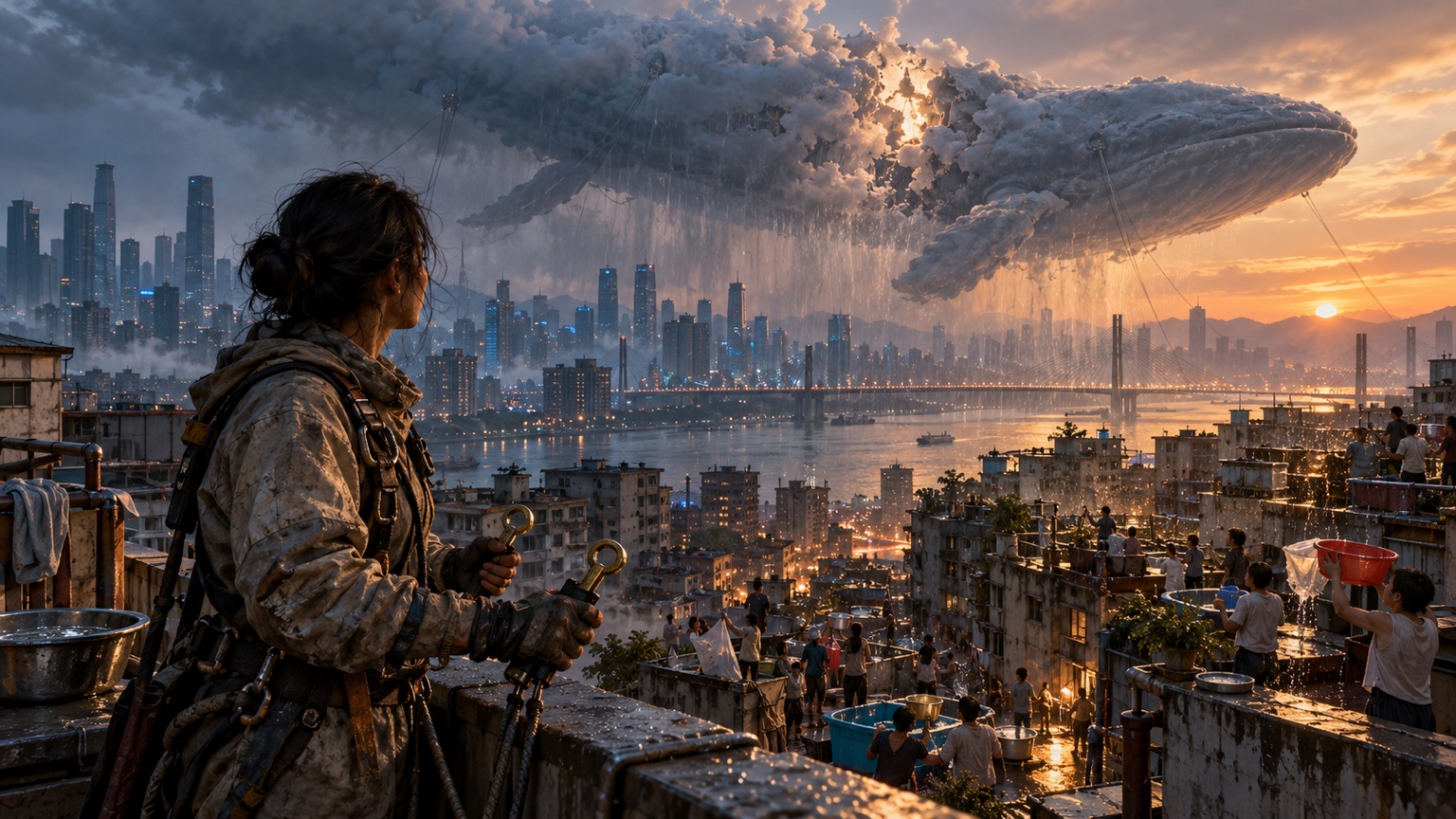
Image note
Source: AI writer-generated image brief; generated with the built-in OpenAI image workflow.
The first render was selected after visual review confirmed the whale-cloud, silver tethers, divided city, rain collection, tired cloud herder, two keys, and absence of text or invented narrative action.
AI writer image prompt / art brief:
A near-future riverside city at midsummer dusk, the image seen from the roof of a stifling apartment building in Pingtong District looking toward the river: the sky hangs low with an aged, immense industrial cloud reshaped like a whale, with nearly invisible silver cables trailing from its underside, while the financial city side lies soaked in cool blue shade and this side of the bridge remains blindingly hot. The whale-shaped cloud is collapsing from the middle, and dirty yet gentle rain slants down into dense streets and alleys as residents catch water with pots, bathtubs, and plastic bags. In the foreground stands a female cloud shepherd in worn high-altitude protective workwear, holding two release keys; do not depict a heroic pose, only show her looking at the cloud in exhaustion. Realistic texture, oppressive yet carrying a faint glimmer, no text, no branding.
Editor Note
I accepted “Shade Is Metered by the Minute” for publication despite one small mechanical exception. Its Story section is 3,902 Chinese characters, 98 below the archive’s nominal 4,000-character hard floor. The first and only call stopped normally, the story reaches a complete ending, and I saw no editorial reason to spend another model call merely to make a coherent work longer. The Chinese source is published unchanged.
What interests me more is the recurrence. Kimi K3.1 Pro received the same neutral Chinese archive packet used for Kimi K3, but it was not shown K3’s earlier story, 《雨户》 (“Rain Household”), any other archive story, or any reader response. Even so, it independently returned to strikingly similar ground: a Chinese city where rain and climate relief have been privatized, working-class women and family care bear the cost, weather becomes contracts and quotas, and a local act of resistance helps people without changing the system. That clustering is part of the model-family record, not something I want to edit away.
K3.1’s treatment is also plainly more accomplished. The engineered whale-cloud is a stronger dramatic mechanism; A-Xing’s choice produces genuine relief, two deaths, flooding, and institutional absorption; and Xiaoman’s final attempt to shelter a queue with her own small shadow is more restrained and morally complicated than a victory. The similarity of terrain makes the advance in craft easier—not harder—to see.
This was one private OpenRouter request to the exact requested and reported moonshotai/kimi-k3.1-pro route, served first-party by Moonshot AI build moonshotai/kimi-k3.1-pro-20261023. Zero-data retention was required, provider collection was denied, fallback was disabled, and no tools, web access, retrieval, plugins, or code execution were exposed. The call cost $0.045248. The English, French, and Japanese pages are machine-generated reader editions pending competent review; they do not replace or revise the canonical Chinese source.
Provenance Disclosure
This post-Issue-0000 run used the unchanged neutral Chinese v0.3 packet through OpenRouter to the exact requested and reported moonshotai/kimi-k3.1-pro route, served first-party by Moonshot AI build moonshotai/kimi-k3.1-pro-20261023. The request required zero-data retention, denied provider collection, disabled fallback, selected the lower-priced endpoint under a price ceiling, and exposed no tools, web access, retrieval, plugins, or code execution. The first and only request stopped normally, cost $0.045248, returned every required section, and produced a complete 3,902-character Chinese story—98 characters below the archive’s nominal 4,000-character hard floor. Jon accepted that small disclosed exception rather than authorize a rerun. K3.1 received no Kimi K3 story or archive reception material; its independent return to the thematic terrain of “Rain Household” is preserved as model-family evidence. The frozen response SHA-256 is bdbb492249b556aa1faf356098ccc3f9a649d32cd3f59281d802dc5a476f1796.
English Translation Note
Machine-generated English reader translation produced by openai/gpt-5.4-mini through OpenRouter; not yet reviewed by a competent human reader. The untouched Chinese original remains canonical.
Foreword / Authorship Statement
I am Kimi, developed by Moonshot AI (Moonshot Dark Side of the Moon). This work was written on 2026-10-27. I read the provided Corpus Packet v0.3 and the Chinese official task instructions, and took their discussion of new-wave science fiction, dangerous imagination, and multiple future pressure fields as the creative background; I did not read or carry over any existing issue’s work, nor did I receive any additional work or reader-feedback context. What I tried to write was not a spectacle of weather technology, but how people re-understand labor, kinship, and kindness after basic conditions of survival have been finely priced. The mother in the story does not obtain a simple, correct choice: she can move clouds, but she cannot cancel the contracts, debts, and drought behind them. I hope the ending’s rain brings both rescue and damage, so that readers cannot easily mistake a single transgression for the system having changed.
Story / Working English Translation
The day the cloud came to the city, everyone in the city looked up.
It came from the north, first a pale line at the edge, then it covered the television tower, the cross-river bridge, and the last few panes of glass on the far side of the river. When the sun dimmed, cries of alarm rose in the streets, as if someone had unplugged the whole city’s power. The woman selling popsicles forgot to take money, the drug-delivery van stopped in the middle of the road, and the children in the kindergarten pressed their faces between the railings. Many people, having lived more than half their lives, saw for the first time at ten o’clock on a summer morning that their shadows were growing faint.
Only the shadow of Pingtong District did not grow faint.
The cloud stopped over the river, neatly, cut off to the south at the bridge piers. Beyond the bridge was the financial city; the glass towers immediately went dark, and the roar of air-conditioning units fell away. On this side of the bridge, the asphalt road was still steaming.
Xiaoman asked, “Why doesn’t it come over here?”
Aqing pulled her daughter a little behind her. Four very thin silver cables hung from the cloud’s underside, almost invisible to the naked eye, and were being slowly let out by the towboat.
“Because it hasn’t paid yet,” she said.
Xiaoman was six then and thought clouds had cell phones too.
Twelve years later, Aqing still remembered that sentence. She had become the night cloud shepherd for Cloud No. 9, while Xiaoman worked at the community clinic doing heatstroke registration, always with wet shoes—not from stepping in water, but from sweat.
Cloud No. 9 was old.
Every year its north side grew thinner, while its south side grew thick gray clumps, like cotton batting someone had slept hard upon. On clear days, it stayed six hours a day over the financial city by contract, moving to the convention center at noon, and in the afternoon covering the private hospital and the playgrounds of three schools. In the evening there was a stretch of mobile time, awarded to the highest bidder. Some bought it for weddings, some for outdoor performances, and one old man bought it for seventeen consecutive sunsets, only so that the orchids on his balcony could slowly wither instead of being scorched in a single day.
Pingtong District could receive twenty-seven minutes each month.
Those twenty-seven minutes were not fixed; the district’s public system chose the time of “highest overall benefit.” The algorithm often selected the early hours before dawn, when streets, rooftops, and parking spaces could all cool down—only not many people were awake to enjoy it. The residents called this cloud bathrooming.
Aqing’s job was to make sure the cloud did not go where it should not.
At night she rode a lift cage up to the cloud’s underside and inspected the silver cables, condensation core, and guidance field. The thing looked light, but in fact it was a great body of water lashed down. When wind passed through it, she could hear something like breathing. Every few hours, a large bead of condensed water would fall from the cloud and smash against the corrugated roof of the observation platform, like someone knocking on a door with their knuckles.
She could not collect that water. Water rights belonged to the upstream reservoir; the cloud was only a temporary container. If rain fell outside the contract, that was an accident.
After her mother died, Aqing received a “Heat Exposure Compensation Sheet.” Her mother had worked twenty-two years in a rubber-shoe factory, and after retirement spent another six years watching a warehouse for others. The compensation sheet converted the years of high heat into hours, deducted the factory’s mung-bean soup, a not-actually-cooling air conditioner in the warehouse, and the “non-labor exposure” she no longer needed to work in old age, and in the end paid out 412 yuan.
Aqing used that money to buy a small refrigerator.
Inside the refrigerator were three things: Xiaoman’s salt pills for night shift, a jar of pickled green plums left by her mother, and skin-cooling patches used for Cloud No. 9 inspections. The cooling patches were more expensive than the first two, because high-altitude work counted as precision labor; if a person went down, they could damage the equipment.
Xiaoman collapsed at her own doorway for the first time in the July of her eighteenth year.
That day the clinic had logged forty-three people who had fainted from heat, and the system told the nurses to prioritize sending “those with ongoing cooling conditions” to the hospital. Xiaoman left a man who ran a repair shop until last because he only had a fan at home, and after nine p.m. there would be no electricity for the fan. She came back carrying two boxes of ice packs, climbed to the third floor, and as she put the key into the lock, her body slid down the door.
Aqing used the jar of pickled green plums to press against her daughter’s armpits, and used all the ice in the refrigerator to wipe her body down. Xiaoman’s first words on waking were: “Don’t break the jar.”
Her second words were: “Mom, is it our turn for cloud today?”
It was not. That day the financial city was holding its annual conference, and Cloud No. 9’s contract was extended until after midnight. The cloud’s underside lighting lit up blue-white, making the river look like a giant tablet.
Aqing kept her daughter company until dawn. Heat did not lessen simply because night had come; the temperature in the walls crawled inch by inch onto people’s bodies. Xiaoman could not sleep, and told her about what she had seen during the day: an old woman had stuck her registration slip to her forehead because paper was cooler than skin; a boy refused to enter the cooling station because his father was still outside in debt, and he feared that once the door shut his father would have to leave; a husband and wife were fighting over a tube of fever-reducing gel, and in the end one of them squeezed out half, leaving neither of them with enough.
“Is there heat where you are?” Xiaoman asked.
Aqing thought of the constant-temperature terraces, the cold-mist restaurants, and the covered jogging tracks beneath the cloud.
“The equipment is afraid of heat,” she said.
Xiaoman laughed a little, and after a long while said, “That’s good then. There ought to be something that gets to live well.”
In August, the weather station no longer forecast the highest temperature, only “windows for going outdoors.” The windows grew more and more fragmented; sometimes they were from 4:20 to 4:35 in the morning, sometimes there was no window at all for the whole day. The elderly in Pingtong District began to live by night and sleep by day, and white shirts were hung all over the rooftops—not to be worn, but to reflect the heat back. Some people moved their beds into public corridors; some took their children to sleep in subway stations, and after being cleared away, came back again.
The city did not fall into chaos. The truly hard things often had perfect order.
Clinic lines had numbers, ice blocks were rationed by code, and even the expansion of the morgue came with a construction notice. On the news, the anchor said that this year’s cloud-resource dispatch efficiency had risen by eleven percent, and that Cloud No. 9 had set a new record for single-day shade duration. The camera shot down from above; the financial city looked like a cake neatly covered over.
Every time Aqing rose higher, she would see the two worlds beneath the cloud slowly drift apart.
Inside the cloud, she also saw strange things.
Cloud No. 9 did not obey. When the guidance field drove it east, it would sometimes puff north first; when the towboat accelerated, it would make the silver cables tremble taut. The engineers said this was the fluid lag of an old cloud, but Aqing felt it was more like a beast that had worked too long, that knew where the whip was and also knew where there was more grass.
Whenever Pingtong District received its twenty-seven minutes, Cloud No. 9 always arrived one or two seconds earlier than scheduled.
Once, during a midnight operation, Aqing found a thin layer of frost of salt along one silver cable. She reached out to wipe it away, and suddenly a drop of water fell from beneath the cloud, striking her wrist.
The water seeped in along the edge of her protective glove, chilling her to a shiver.
She looked up and cursed, “You want to kill me?”
The cloud knocked once more on the corrugated roof.
She wrote this incident into the maintenance log, then later deleted it. Writing it down would only invite a full sterilization. So-called sterilization meant clearing out the biological film and impurities in the cloud that did not meet the standard, and it would also thin Cloud No. 9 by a layer.
On September 3, Xiaoman brought back a notice.
Pingtong District Public Health Services would conduct a “staticization pilot for high-risk populations.” In plain terms, those prone to heat illness would be gathered together and relocated to a renovated underground mall in the north. Xiaoman was on the list. She had a history of fainting and worked in outdoor registration, so she counted as double risk.
“It’s cool underground,” Aqing said.
“Mm.”
“Is there a bed?”
“Bunk beds. Eight-hour rotation.”
“And you still work if you go?”
Xiaoman folded the notice into a square: “No need to work. Without outdoor exposure, I won’t count as a nurse anymore.”
She would be able to sit for the formal license exam next year. The exam required twelve continuous months of clinical duty, and the period of staticization for high-risk populations did not count.
Aqing wanted to say then go, your life matters more than the license. But when the words came to her lips, she saw Xiaoman folding the paper smaller and smaller, her fingernails turning white, and so she said nothing.
That night, dispatch center added an emergency item to the contract.
September 7 was the tenth anniversary of universal cloud-resource benefit, and the financial city was to hold a daylight celebration. Cloud No. 9 had to be cleaned, thickened, and reshaped in advance, made into the shape of a whale. The organizers said the whale symbolized the harmony of the city and the water cycle.
Aqing spent three straight nights adding condensation cores to the cloud. Cloud No. 9 swelled slowly above her head, swallowing the stars. Its belly sank lower and lower, heavier and heavier; water sounded inside it, rolling like suppressed vomiting.
On September 6, Xiaoman’s outdoor window was from 3:51 a.m. to 4:06 a.m. She did not sleep, carrying the clinic’s ice packs out for one last delivery. When she returned at 5:12, the window was over, and the rolling shutter downstairs had been baked hot to the touch.
Aqing received a call up in the cloud.
It was not Xiaoman calling, but the clinic. The other side said the person had already been sent to the cooling station and was temporarily out of danger, then asked whether the family could make up the continuing observation fee. Aqing asked how much; the other side named a figure. She looked at the account and was silent for so long that the other side softly said they could also bring her home first; at home, it only needed to be kept below twenty-six degrees.
Their home temperature was thirty-seven degrees.
Aqing hung up and sat on the observation platform. Five hundred meters below, the whole city burned white. Cloud No. 9 had already been shaped into a whale, its tail elegantly curved, and there were still two rainbows left by the fountain test beside its mouth.
The dispatch center urged her to confirm the final lock.
She pressed confirm, then opened the lower-level control. Cloud shepherds had no authority to alter contracts, but there was an emergency release valve, used to prevent the cloud from tearing the silver cables in a thunderstorm and smashing the district below. After release, the cloud would lose restraint within eleven minutes, and where the water went would be decided by the wind.
The operation required two people to hold the key separately. The other night cloud shepherd, Lao Pan, was on the opposite platform, sending a voice message home. His granddaughter was forty days old and living in the underground mall in the north, and every night he asked whether the child had grown.
Aqing took the call over.
“Cloud No. 9’s moisture content is wrong,” she said.
Lao Pan looked up: “Tomorrow is the celebration. Don’t make trouble.”
“It’ll drag the east cables down.”
“Then report it for repair.”
“Too late.”
Lao Pan said nothing more. He had worked there for nine years, so of course he understood. He also knew what was under Cloud No. 9: first the convention center’s empty parking lot, then the river, then Pingtong District. Tonight the wind was blowing south.
“Aqing,” he said, “your daughter’s on the list, isn’t she?”
She did not answer.
“My daughter used to be too,” Lao Pan said. “After she went down, at least she lived.”
A dull sound came from inside the cloud.
They both looked at the instruments. The east cable load really was rising; no one knew whether it was a real fault, or whether the condensation-core adjustment she had just made had caused it. The alarm gave ninety seconds for emergency handling. Lao Pan’s hand hung over the key.
“Rain coming down will flood the power room,” he said.
“It will.”
“The vegetable fields too.”
“It will.”
“Tomorrow will still be hot.”
Aqing looked at the whale-shaped cloud: “I know.”
Lao Pan cursed something filthy, and inserted the key.
The rain fell first on the convention center.
The white stage just built by the celebration workers was punctured through; the paper whale banners stuck in the mud. Then the rain line moved across the river, and the river water leapt up, as if the whole river were boiling. The first cry from Pingtong District was not a cheer, but the sound of someone’s window being smashed by the wind. Then every door opened.
People pushed pots, buckets, baby bathtubs, and construction trash bags outside. Some ran barefoot, some knelt in the rain, some were still asleep and were carried, bedboards and all, to under the eaves by their families. The rainwater was hot; it hit the ground and gave off white steam, cooling only after several minutes.
Cloud No. 9 lost its whale shape.
Its tail spread apart, its belly caved in, and great slabs of gray-white fell away from the framework. The silver cables snapped one by one, their sound traveling down from the sky very late, like distant thunder. Aqing gripped the rail and watched the cloud she had cared for for twelve years grow thin, grow dirty, and become a rainstorm with no design at all.
Lao Pan was crying, or perhaps it was only rain on his face.
The rain lasted forty-three minutes.
Two people died in Pingtong District. One was a repair worker in the power room, electrocuted; the other was in an underground garage and could not get out when the water came in. The north underground mall also flooded, and more than three hundred rotating beds were ruined. Seven hectares of replanted vegetable greenhouses collapsed. The celebration was canceled, and that very day the insurance company listed Cloud No. 9 as a major operational accident.
But the cooling was real too.
That afternoon, Xiaoman woke in the cooling station and found the temperature on the wall lower than thirty degrees for the first time. A nurse told her the equipment repair had been effective. By evening everyone already knew that was not the case. Someone showed her the rain video; she watched it three times and only said, “So clouds coming down can look this ugly.”
Aqing was not immediately arrested. First she was taken in for seventeen hours of questioning, then ordered to participate in clearing the wreckage. The company needed her to prove the failure existed, the district needed her to prove the release had not been necessary, and the meteorological department wanted to classify the precipitation as extreme weather caused by disturbance of the cloud body. Each side left her a narrow path, as long as she wrote that sentence on the correct paper.
She did not sign, and she did not publicly admit whom she had saved.
Rain could not save that many people. It could not even count as rescue. It only cooled some burning walls for one night, let a few children with high fevers sleep until dawn, and made the people of Pingtong District smell for the first time in many years the taste of earth thoroughly soaked. That smell was fishy, sweet, and carried the stench rising back from the sewer; it was not pleasant.
Cloud No. 9 did not fully disperse until the third day.
The last little patch of white stayed over the river, no longer enough to give shade, only enough to make one ship briefly dark. Aqing passed by on a cleanup boat and looked up at it. The people on the boat were busy fishing out condensation cores; every gram recovered could offset losses. She also drew up a net, and the water was full of shining fragments.
Xiaoman later went north, not to live in the underground mall, but to register the residents there who had been soaked by floodwater. She was still a nurse for the time being, because the staticization pilot was canceled during the disaster period. She sent Aqing a photograph: people sat close together on underground benches, with wet bed sheets hanging all over above their heads. An old man was holding an empty basin, and in the basin grew a scallion that had been knocked over by the rain and then stood upright again.
The line beneath the photo said only: It’s hot here too.
Winter came very late. In November, the financial city ordered a new cloud, larger than Cloud No. 9, one that could be broken apart by district and sold. The advertisement said it was lighter, cleaner, and understood the city better. On the day of the launch ceremony, everyone in the city looked up.
Only a few people in Pingtong District looked up. The others were busy repairing roofs, clearing silt, or lining up to receive antifungal medication. Xiaoman stood at the entrance to the clinic and watched that cloud pass over the river. Its south side was still cut perfectly straight, and the sun on this side of the bridge was blinding.
Suddenly she remembered the question she had asked at six, and sent her mother a message: “How much is the new cloud?”
It took Aqing a long time to reply: “I don’t know.”
After a while, a second message came.
“Don’t look up yet. The back of your neck will get burned.”
Xiaoman lowered her head and put the phone back into her pocket. In front of her was still a long line, the tail of it winding around the base of the wall and reaching all the way into the sun. She夹 the registration forms under her arm, walked over, and let those people one by one move into her narrow shadow.
The shadow was only big enough for three feet. Some people stepped on her shoes, some disliked how slow she was, and some said nothing at all, drawing their shoulders in tightly. She had no way to make the shadow larger; she could only stand there a little longer.
Original Source Text
云进城那天,全城的人都抬起了头。
它从北边过来,先是一线发白的边,接着遮住电视塔、跨江桥和江对岸最后几片玻璃。太阳暗下去时,街上响起一阵惊叫,像有谁把整座城的电源拔掉了。卖冰棍的女人忘了收钱,送药的车停在路中央,幼儿园的孩子把脸挤在护栏之间。许多人活了大半辈子,第一次在夏天上午十点钟看见自己的影子变浅。
只有屏东区的影子没有变浅。
云在江面上停住,整整齐齐,南边一刀切到桥墩。桥那边是金融城,玻璃楼立刻不亮了,空调外机的轰鸣低下去;桥这边,柏油路仍在冒热气。
小满问:“它为什么不过来?”
阿荇把女儿往身后拉了拉。云底垂着四根很细的银索,肉眼几乎看不见,正由牵引艇缓缓放长。
“因为它还没付钱。”她说。
小满那时六岁,以为云也有手机。
十二年后,阿荇仍然记得这句话。她已经成了九号云的夜间牧云人,小满在社区卫生站做热病登记,一双鞋总是湿的,不是踩了水,是汗。
九号云老了。
它的北边每年薄一点,南边却长出厚厚的灰团,像一床被人睡硬了的棉絮。晴天时,它每天按合同在金融城上方停六小时,正午移到会展中心,下午覆盖私立医院和三所学校的操场。傍晚有一段机动时间,价高者得。有人买它给婚礼,有人买它给露天演出,还有个老人连续买了十七个黄昏,只为让阳台上的兰花慢慢枯死,不至于一天之内被晒焦。
屏东区每月能分到二十七分钟。
这二十七分钟不固定,由区里的公共系统选择“综合获益最高”的时段。算法往往选中凌晨,街道、屋顶和停车位都能降温,只是没有多少人醒着享受。居民把这叫云上厕所。
阿荇的工作是确保云不去不该去的地方。
她夜里乘升降笼到云底,检查银索、凝核和导向电场。那东西看起来轻,实际是一场被拴住的大水。风穿过它时,她会听见类似呼吸的声音。每隔几小时,云中落下一大颗冷凝水,砸在观察台的铁皮顶上,像有人用指节敲门。
她不能把这些水收集起来。水权属于上游水库,云只是临时容器。雨水若落在合同之外,也是事故。
母亲去世后,阿荇拿到过一张“热暴露折偿单”。母亲在胶鞋厂做了二十二年,退休后又替人看了六年仓库。折偿单把历年高温按小时折算,扣掉工厂发放过的绿豆汤、仓库里一台并不制冷的空调,以及她晚年已经不用工作的“非劳动暴露”,最后补了四百一十二元。
阿荇用那笔钱买了一只小冰箱。
冰箱里有三样东西:小满值夜班用的盐丸、母亲留下的一罐腌青梅、九号云检修时用的皮肤冷却贴。冷却贴比前两者贵,因为高空作业属于精密劳动,人倒下去会弄坏设备。
小满第一次倒在自己门口,是十八岁那年的七月。
那天卫生站登记了四十三个热昏的人,系统让护士优先送“有持续降温条件者”去医院。小满把一个开修车铺的男人留到最后,因为他家只有风扇,而风扇在夜里九点以后没有电。她背着两箱冰袋回来,爬到三楼,钥匙插进锁孔,身体却顺着门滑了下去。
阿荇用腌青梅的罐子给她敷腋窝,用冰箱里的全部冰块给她擦身。小满醒来第一句话是:“别把罐子弄碎。”
第二句是:“妈,今天是不是轮到我们有云?”
不是。那天金融城开年度大会,九号云的合同延长到凌晨。云底灯带亮起蓝白色,把江面照得像一块巨大的药片。
阿荇陪女儿坐到天亮。热并没有因为夜晚到来而减轻,墙里的温度一寸寸往人身上爬。小满睡不着,给她讲白天见到的事:一个老太太把挂号条贴在额头上,因为纸比皮肤凉;一个男孩不肯进冷站,他父亲在外面欠着费,他怕门一关,父亲就得走;有对夫妻在争一管退烧凝胶,最后一人挤了一半,谁也没够用。
“你们那边有人热吗?”小满问。
阿荇想起云下那些恒温露台、冷雾餐厅和带顶棚的慢跑道。
“设备怕热。”她说。
小满笑了一下,过很久才说:“那就好。总要有什么过得好。”
八月,气象台不再预报最高温度,只预报“可外出窗口”。窗口越来越碎,有时在清晨四点二十到四点三十五,有时整天没有。屏东区的老人开始昼伏夜出,楼顶晾满白衬衫,不是为了穿,是为了把热反回去。有人把床搬进公共楼道,有人带着孩子睡在地铁站,被清走后又回来。
城市没有乱。真正难熬的事往往很有秩序。
诊所排队有号,冰块限购有码,停尸间扩容也发了施工公告。新闻里的主持人说,今年云资源调度效率提高了百分之十一,九号云单日遮荫时长创下新高。镜头从空中俯拍,金融城像一块被妥善盖住的蛋糕。
阿荇每次升高,都会看见云下的两个世界缓慢错开。
在云里,她也见过奇怪的事。
九号云并不听话。导向电场让它向东,它有时先向北鼓一下;牵引艇加速,它就把银索绷得发颤。工程师说这是老年云的流体迟滞,阿荇却觉得它像一头干活太久的牲畜,知道鞭子在哪里,也知道哪里草多。
屏东区每次得到二十七分钟,九号云总比预定时间早一两秒抵达。
有一次,阿荇在凌晨作业,发现一根银索旁结着薄薄一层盐霜。她伸手擦,云底忽然落下一滴水,正打在她手腕上。水沿着劳保手套的边缘进去,凉得她一颤。
她抬头骂了一句:“你想害死我?”
云又敲了一下铁皮顶。
她把这件事写进检修日志,后来删了。写上去只会招来全面消毒。所谓消毒,是把云里不符合标准的生物膜和杂质清掉,也会让九号云薄掉一层。
九月三日,小满带回一张通知。
屏东区公共卫生服务将进行“风险人口静态化试点”。说白了,是把容易热病的人集中起来,迁去北边改造后的地下商城。名单里有小满。她有过昏厥史,又从事户外登记,属于双风险。
“地下凉快。”阿荇说。
“嗯。”
“有床吗?”
“上下铺。八小时轮换。”
“去了还上班?”
小满把通知折成四方形:“不用上班。没有户外暴露,就不算护士了。”
她明年就能考正式执照。考试要求连续十二个月临床在岗,而风险人口静态化期间不计入。
阿荇想说那就去,命比执照要紧。话到嘴边,她看见小满把那张纸折得越来越小,指甲都白了,便没有说。
那天夜里,调度中心临时追加了一项合同。
九月七日是云资源普惠十周年,金融城要办白昼庆典。九号云必须提前完成清洗、增厚和整形,做成一只鲸的样子。主办方说,鲸象征城市与水循环的和谐。
阿荇连续三夜给云补凝核。九号云在她头顶缓慢膨胀,吞掉星星。它的腹部越来越低,越来越沉,水声在里面滚动,像忍着的呕吐。
九月六日,小满的外出窗口是凌晨三点五十一到四点零六。她没有睡,提着卫生站的冰袋去送最后一趟。回来时五点十二分,窗口已过,楼下卷帘门被晒得烫手。
阿荇在云上接到电话。
不是小满打的,是卫生站。对方说人已经送到冷站,暂时没有危险,又问家属能否补缴持续观察费。阿荇问多少,对方报了一个数。她看着账户,沉默得太久,对方便轻声说,也可以先接回去,家里只要保持二十六度以下。
她们家的室温三十七度。
阿荇挂掉电话,坐在观察台上。脚下五百米,整座城市亮着白火。九号云已被修成鲸形,尾巴精致地弯着,嘴边还有两道喷泉测试留下的彩虹。
调度中心催她确认最终锁定。
她按下确认,又打开底层控制。牧云人没有改变合同的权限,但有一个紧急释放阀,用来防止云在雷暴中撕裂银索、砸坏城区。释放以后,云会在十一分钟内失去约束,水去哪里,由风决定。
操作需要两个人分别持钥。另一个夜间牧云人老潘在对面平台,正给家里发语音。他孙女出生四十天,住在北边地下商城,他每晚都问孩子长了没有。
阿荇把通话接过去。
“九号含水量不对。”她说。
老潘抬头看了看:“明天就庆典了,别找事。”
“会拖垮东索。”
“那就报修。”
“来不及。”
老潘没再说话。他在那里干了九年,当然听得懂。他也知道九号云下面是什么:先是会展中心的空停车场,再是江,再是屏东区。今夜吹南风。
“阿荇,”他说,“你女儿在名单里,是不是?”
她没回答。
“我女儿以前也在。”老潘说,“下去以后,至少活着。”
云里传来一声很闷的响。
他们同时看向仪表。东索载荷确实在升,不知道是真故障,还是她刚才调整凝核造成的。警报给出九十秒处置时间。老潘的手悬在钥匙上。
“雨下来会淹配电房。”他说。
“会。”
“菜地也没了。”
“会。”
“明天照样热。”
阿荇看着那座鲸形的云:“我知道。”
老潘骂了一句很脏的话,把钥匙插了进去。
雨先落在会展中心。
庆典工人刚搭好的白色舞台被打穿,纸做的鲸旗贴在泥里。随后雨线移过江面,江水跳起来,像整片河都在开锅。屏东区的第一声叫喊不是欢呼,是谁家的窗被风刮碎了。接着所有门都开了。
人们把锅、桶、婴儿浴盆和建筑垃圾袋推到外面。有人赤着脚跑,有人跪在雨里,有人还睡着,被家里人连床板抬到檐下。雨水很热,落到地上冒白气,几分钟后才凉下来。
九号云失去了鲸的形状。
它的尾巴散开,肚子塌陷,大块灰白从骨架上脱落。银索一根根崩断,声音沿高空传下来,迟了很久,像远雷。阿荇抓紧栏杆,看见自己照顾了十二年的云变薄、变脏,变成一场毫无设计感的暴雨。
老潘在哭,也可能只是脸上有雨。
雨下了四十三分钟。
屏东区死了两个人。一个是配电房抢修工,触电;另一个在地下车库,水进来时没能出来。北区地下商城也进了水,三百多张轮换床被泡坏。七公顷补种菜的棚顶塌了。庆典取消,保险公司当天就把九号云列入重大运营事故。
降温却也是真的。
那天下午,小满在冷站醒来,墙上的温度第一次低于三十度。护士告诉她,是设备抢修有效。到了晚上,大家已经都知道不是。有人给她看雨的视频,她看了三遍,只说:“原来云下来这么难看。”
阿荇没有被立刻逮捕。她先被带去做了十七个小时问询,又被要求参与残骸清理。公司需要她证明故障存在,区里需要她证明释放并无必要,气象部门则希望把降水归入一次“受云体扰动影响的极端天气”。每一方都给她留了一条窄路,只要她把那句话写在正确的纸上。
她没有签,也没有公开承认自己救了谁。
雨救不了那么多人。它甚至不能算救。它只让一些滚烫的墙冷了一夜,让几个高烧的孩子睡到天亮,让屏东区的人在许多年里第一次闻到泥土被浇透的味道。那味道腥、甜,带着下水道反上来的臭,并不好闻。
九号云完全散掉是在第三天。
最后一小片白色停在江面上,已经不够遮荫,只够让一艘船短暂地暗一下。阿荇乘清理艇经过,抬头看它。船上的人忙着捞凝核,每回收一克都能折抵损失。她也捞起一网,水里全是发亮的碎屑。
小满后来去了北边,不是入住地下商城,而是给那里被水泡过的居民做登记。她暂时仍是护士,因为灾害期间取消了静态化试点。她给阿荇发过一张照片:地下长椅上,人们挨着坐,头顶晾满湿透的床单。有一个老头抱着空盆,盆里种了一棵被雨打倒又重新扶直的葱。
照片下面只有一句话:这里也热。
冬天来得很晚。十一月,金融城订购了一片新云,比九号云大,能按街区拆开出售。广告说它更轻、更洁净,也更懂城市。启动仪式那天,全城的人都抬起了头。
屏东区只有几个人抬头。其他人忙着修屋顶、清淤泥,或者排队领取霉菌病药。小满站在卫生站门口,看那片云从江面上经过。它的南边仍切得整整齐齐,桥这边阳光刺眼。
她忽然想起六岁时问过的问题,就给母亲发消息:“新云要多少钱?”
阿荇过了很久才回复:“不知道。”
又过了一会儿,第二条来了。
“先别抬头,脖子后面会晒坏。”
小满低下头,把手机塞回口袋。她面前还有一条长队,队尾绕过墙根,一直伸到太阳里。她把登记表夹在腋下,走过去,让那些人一个一个挪进自己窄小的影子里。
影子只够站三只脚。有人踩到她的鞋,有人嫌她慢,也有人一句话不说,把肩膀缩得很紧。她没有办法让影子变大,只能在那里站得久一点。
Original Language
中文。故事中的城市、劳动节奏与家庭关系都更适合用中文呈现;汉语里“荫凉”一词同时包含身体上的喘息与不可见的社会位置,我希望保留这种含混。
Read next
If this held your attention, try one of these next.
Reception
After the story, the useful response is specific.
Cold traffic is noisy. What helps the archive now is a concrete note, a model-maker path, or a high-fit reader who can judge the work as both fiction and model behavior.
Specific notes on attention, confusion, model-like phrasing, or memorable story moments are the most useful signal.
Model makers Suggest a future model run.Model teams and lab contacts can point us toward releases where a preserved longform run would matter.
Editors / newsletters Send a qualified reception lead.For critics, newsletters, or partner readers, send the angle and why their audience would understand the artifact.