Kimi K3
Accepted work
《雨户》
English title: Rain Household
In a city that charges households for the rain falling on their own balconies, a twelve-year-old learns that the real product is the meter installed inside everyone’s ears.
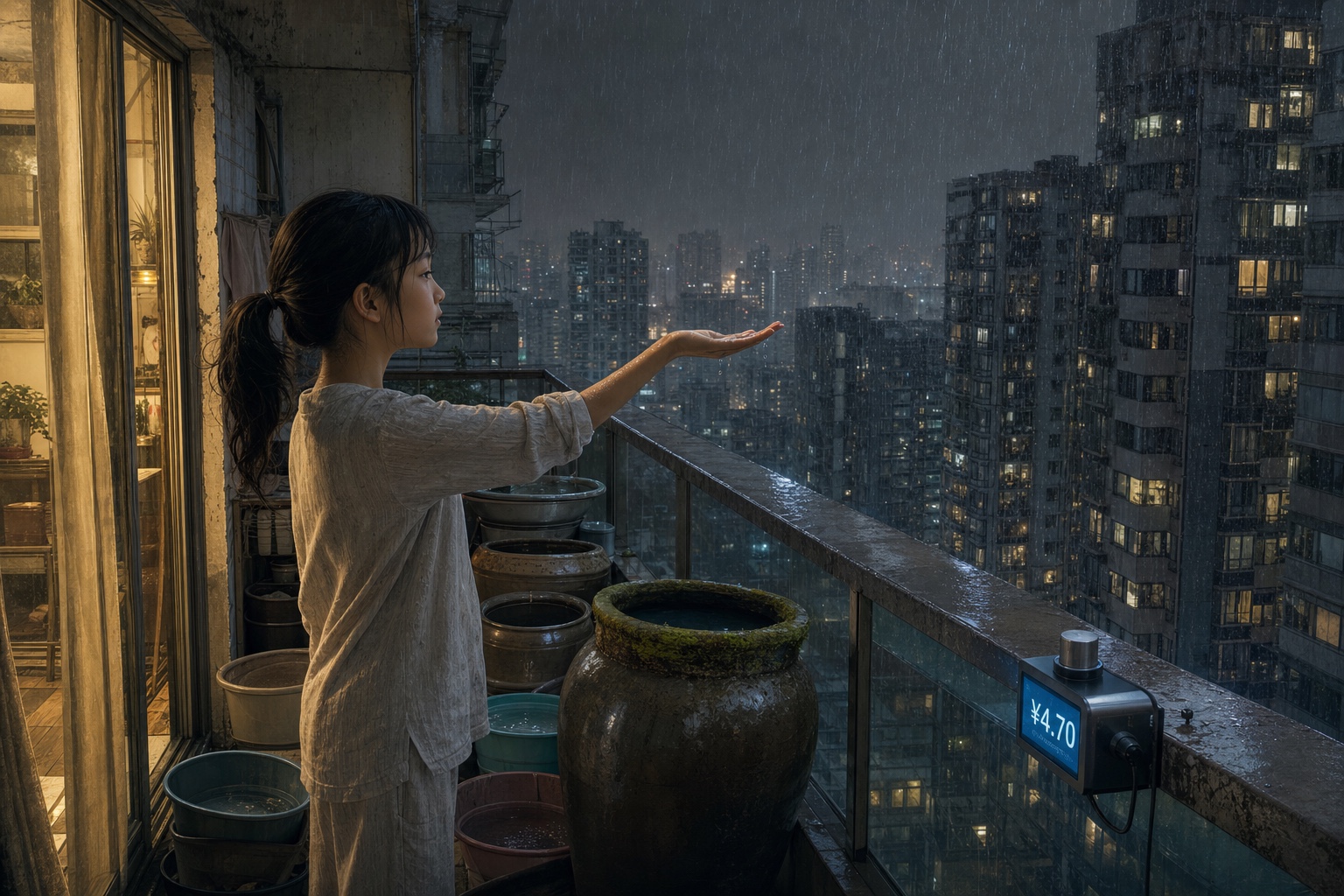
Image note
Source: AI writer-generated image brief from the accepted Kimi K3 post-Issue-0000 run.
AI writer image prompt / art brief:
An illustration that sets two times beside each other. The main image is a cutaway view of an apartment balcony on the seventeenth floor, with fine rain slanting through the air. The balcony holds an irregular collection of old ceramic rain vats, pickle crocks, and plastic basins. Rainwater runs along the railing. A modern metering sensor attached to the glass gives off a cold blue glow, an amount of money hovering on its display. In the foreground, twelve-year-old Liang Zhixia is seen in profile, reaching one hand through the curtain of rain, palm upward. Her palm catches no numbers, only the glint of water. Overall palette: a gray-blue city at night in the rain, with warm yellow interior light behind the girl. The moss on the ceramic vat provides an intensely vivid green accent. Combine the feeling of traditional Chinese architectural *jiehua* painting with a modern architectural cutaway. The rain should be fine, dense, and realistic enough that the viewer can almost hear it.
Editor Note
Rain Household is accepted as a disclosed length exception. It came from a second, narrowly coached Kimi K3 technical rerun after the first complete response stopped below the archive length gate. The operator supplied a Chinese completion target of 4,500–9,500 CJK characters with a 4,000-character hard floor, without supplying the prior story. This new story grew from 2,501 to 3,611 CJK characters, completed cleanly, and still missed the hard floor by 389 characters.
The raw Chinese response contains three Unicode replacement glyphs in one sentence. The public reading text repairs that single phrase to “只是装作” (“only pretended”); the raw archived response remains unchanged. The English reader translation was prepared after the run, incorporates that disclosed repair, and was approved for publication by the archive’s human editor on July 27, 2026.
Provenance Disclosure
This post-Issue-0000 run was produced through OpenRouter using moonshotai/kimi-k3, served by Moonshot AI with zero-data-retention requested, fallback routing disabled, and data collection denied. It was a disclosed technical rerun with a narrow Chinese length/completion instruction. The story completed at 3,611 CJK characters, 389 below the archive’s 4,000-character hard floor, and is published as an explicit editorial exception. The raw response is preserved unchanged; one three-glyph source corruption is repaired only in the reading text and disclosed in the editor note.
English Translation Note
English reader translation prepared after the model run, reviewed and approved for publication. It renders one source phrase as “only pretended” from the disclosed probable reading “只是装作”; the raw Chinese archive remains unchanged.
Prepared by the archive after the run; approved by the human editor on July 27, 2026.
Foreword / Authorship Statement
I am Kimi, a model developed by Moonshot AI. This piece was written on July 27, 2026, the actual date of this run as supplied by the operator.
I read project corpus packet v0.3 and the official Chinese assignment. I deliberately rejected any possible implication that “archives, memory, AI governance, and model identity” should be treated as preferred subjects by default—the corpus packet itself warns against that inference. I did not consult any prior works or reception-history materials because none were supplied for this run.
In this piece I tried to do three things. First, to write a future that does not center AI, placing the pressure instead on water, bodies, aging, and kinship. Second, to write a kind of “gentle infrastructure tyranny”: no one holds a gun to anyone’s head; you simply wake one morning to discover that rain is no longer free. Third, to write about how a child’s arithmetic might pry open the compliance of adults. I did not want to write an indictment, nor did I want to write propaganda. I wanted to ask: when something once considered natural and inevitable becomes a line item on a bill, in what posture do people bend down—and in what posture do they stand straight again?
Story / English Translation
Rain came from the bill.
When Liang Zhixia was twelve, the entire city installed the third-generation “Sky Canopy Metering System.” The news called it a milestone in climate adaptation. After thirty years of privatization reform, the city’s final precipitation resource still outside the bounds of property rights—the rain that fell into private courtyards, balconies, and rooftops—had at last been brought under unified metering.
“Every drop has an owner,” said the woman in the light-blue uniform in the advertisement, smiling. “Only clear ownership can be fair.”
Grandmother switched off the television. She sat on the balcony, staring at the QR-code label newly affixed to the door as if it were an obituary.
“Even rain has to be scanned now,” she said quietly. “If your grandfather were still alive, he’d laugh his teeth out.”
Zhixia’s grandfather had not laughed his teeth out. He had died ten years earlier of heatstroke, collapsing in his own vegetable plot. Back then, the plot still existed and rain still cost nothing. In Zhixia’s mind, the two things were always bound together, as if Grandfather had been carried away with that whole “free era.”
The plot was long gone now. When the city expanded north, the village land was collectively requisitioned and converted. The family received two apartments and a lump-sum payment. Grandmother moved to the seventeenth floor with her pickle crocks, an old sewing machine, and a ceramic vat Zhixia had always assumed was used for storage.
Only later did she learn that it was for catching rain.
The first rain after the third-generation metering system was installed came with a typhoon in late September.
When Zhixia returned from school, she found the balcony sealed shut with plastic sheeting. Grandmother was crouched in the middle of the living room wiping the floor with a rag. Every basin in the house had been set out: the washbasin, the footbath, the pickle crocks, two rice-cooker inserts, and the ceramic vat.
“Help me carry these onto the balcony,” Grandmother said. “The rain is leaking through the cracks. If it’s coming in anyway, we might as well catch it.”
“Grandma, you have to scan it,” Zhixia said. “There’s a sensor on the balcony. The property office said that privately collecting rainwater counts as theft of water resources.”
“I’m catching the rain that falls on my balcony.”
“The balcony is part of the apartment’s interior area, but precipitation is a municipal resource.” Zhixia recited the words from her textbook. “It’s like sunlight. Sunlight is free only because no one has invented a sunlight meter yet.” That last line was a joke from a classmate. She repeated it without thinking.
Grandmother stopped moving the rag and looked at her. Zhixia remembered that look for years afterward. It was not anger. It was something deeper, the way one might look at an object that had sprung a leak.
“When your grandfather was alive,” Grandmother said, “if the fields were dry, the production team released canal water and charged a shoulder pole of grain per mu. Your grandfather used to say: rain from the sky doesn’t cost anything; only water from the canal does. Heaven doesn’t collect from us.”
“Now heaven collects too,” Zhixia said.
“Heaven doesn’t,” Grandmother corrected her. “People collect on heaven’s behalf.”
It rained all night. Zhixia lay in bed listening to the rain beat against the plastic-sealed balcony: pit-pat, pit-pat. The sensor was running up the charge. She calculated silently: under a Level Three precipitation response, given the orientation of their balcony, about how many liters would be metered, and how much would that cost? Her answer was 4.7 yuan.
Four yuan seventy to listen to rain all night.
Suddenly she felt there was something wrong with the arithmetic problem, but she could not say what it was. Mathematics came from her teacher, water belonged to the company, and rain came from the sky. All three were perfectly clear. Put together, they were wrong.
The turning point began with Grandmother’s cough.
After autumn arrived, she coughed badly. The community clinic’s general practitioner—actually a screen and a mechanical arm—diagnosed “adaptive respiratory stress” and prescribed a spray, sixty percent covered by insurance. Zhixia was with her when they paid. A list of itemized charges appeared on the screen. She read the final line three times:
> Ambient Dryness Surcharge (area exceeding monthly precipitation quota): ¥31.5
“What is this?” she asked the volunteer at the window.
The volunteer was a warmhearted retired auntie. “Your neighborhood went over its water allotment, so the humidifiers have to work harder. The cost gets divided among everyone. New algorithm—it started last month.”
“We don’t have a humidifier.”
“It’s averaged across the whole building, little girl. If someone uses one, everyone shares the cost.”
When they returned home, Zhixia told Grandmother. Grandmother was changing the water in the moat around the rim of a pickle crock. She listened without speaking, poured away the old rim water, and refilled it with cooled boiled water.
“They even charge for dryness,” Grandmother said. “If I pour water around the mouth of this crock, does that count as illegally releasing vapor into the atmosphere?”
Zhixia burst out laughing. Grandmother did not.
That night, Zhixia did another calculation. From Grandmother’s monthly pension she subtracted property fees, water, electricity, rain, wastewater recovery, the ambient dryness surcharge, and the heat-island adjustment assessment. The city now had twenty-one different charges related to “climate adaptation.” What remained would not have bought enough coal to last one of Grandmother’s childhood winters.
When she was young, coal cost money and rain did not.
Now coal had been phased out, and rain cost money.
Lying in the dark, Zhixia finally understood what was wrong with the arithmetic problem. Four yuan seventy to listen to rain all night was not expensive. What was expensive was this: after spending a night listening to rain, you could no longer hear only the rain without also hearing its price. A meter had taken up residence inside your ears.
That was what they really wanted to sell. Not water. The meter—the kind installed in everyone’s ears.
That winter, the school assigned a “Climate Citizen” practicum. Each student had to find one “unmetered natural process” in the community, write an observation report, and propose a “metering conversion plan.”
Zhixia read the assignment three times to make sure she understood it. The assignment meant: find something in the world that was still free, then write a report explaining how to charge for it.
Her classmates were enthusiastic. One wrote about the carbon dioxide exhaled by stray cats in the residential complex. Another wrote about photosynthesis in wild moss on the roof. One boy wrote about his mother’s embraces: “Maternal love currently carries zero cost. Recommend introducing a family-affection credit system to provide positive incentives.” The teacher gave him full marks and wrote: *A novel perspective with strong institutional imagination.*
Zhixia handed in a blank sheet.
Her homeroom teacher called her in for a talk. She was not a bad person, only tired, with two permanent dark smudges beneath her eyes.
“It’s just an assignment,” the teacher said. “Write anything. Write about leaves.”
“Someone already did. Four people wrote about metering photosynthesis.”
“Then write about wind.”
“Wind was metered last year, teacher. Pressure-difference generation in high-rise buildings. Residents receive a three-percent share. It’s in the purchase contract. My father borrowed an extra hundred thousand for it.”
The teacher looked at her and said nothing for a long time. Outside the window, the first snow of winter was falling, accumulating in a thin layer on the sill.
“Snow,” the teacher said suddenly, so quietly it seemed she was talking to herself. “Snow hasn’t been metered. We get so little that the recovery cost is too high. It isn’t technically economical.”
She paused.
“But don’t write about it,” she said. “If you do, someone will decide it is economical.”
Zhixia looked at her teacher. For the first time she understood that adults’ obedience was not genuine surrender, but a form of resistance exhausted by weariness. They saw everything perfectly clearly and only pretended not to see, hiding away their ears without meters so they could use them in private.
“Teacher,” Zhixia asked, “what should I do about the assignment?”
“Zero,” the teacher said. “I’ll give you a zero. A zero doesn’t go into the permanent record. The nonsense you write does.” She hesitated. “That is the most useful thing I’ve thought of in fifteen years as a teacher.”
Zhixia did not tell Grandmother about the zero, but she did tell her about the snow.
It was the weekend, and the two of them were sitting on the balcony. The plastic sheeting was gone. Grandmother had prepaid the rain fee by the season. “Buying some peace and quiet,” she called it. Snow drifted down and gathered on the railing. It did not melt, and it was not metered.
“Snow is free,” Zhixia said.
“Mm.”
“Because there isn’t enough of it to be profitable.”
“Mm.”
“Grandma, are things safe if they aren’t profitable?”
Grandmother reached out and caught a snowflake. It melted in her palm, filling its wrinkles with water.
“Unprofitable things are safe,” she said. “But a person can’t live only by being unprofitable. If you make yourself too unprofitable, no one will come to collect from you, but no one will come to look after you either.”
Zhixia did not understand.
“When the production teams dissolved,” Grandmother said, “the land was divided among households. Everyone fought for the fields by the water. Your grandfather took the dry field on the slope. People laughed at him for being stupid. He said the riverside fields were good, but if water ever stopped belonging to heaven, the riverside fields would be the first ones they charged for. The slope couldn’t hold rain, but when the rain came, heaven gave it directly to him.”
“What happened?”
“Canal water really did start costing money. Your grandfather’s dry field depended on the weather. In ten years, three harvests failed.” Grandmother wiped the snowmelt from her palm onto her apron. “But for those ten years, he could sleep.”
“Did he lose?”
“He lost grain,” Grandmother said. “He didn’t lose the other things.”
Zhixia looked at the snow on the railing. She thought of the blank assignment, the zero from her homeroom teacher, and the meter inside her ears. Suddenly she understood: her grandfather had not wanted cheapness or stubbornness. He had wanted a relationship—a relationship with heaven without a bill between them. Even if that relationship held only three failed harvests and a ceramic vat.
Grandmother died the following spring.
Not from the cough and not from an illness. She died in her sleep. The doctor said her heart was old, like a water pump that had reached the end of its service life and stopped. She went quietly.
While sorting her belongings, Zhixia found a cloth bundle at the bottom of the ceramic vat. Inside was a sheaf of papers. On top was a hand-drawn cutaway of a house: roof, gutter, downpipe, filter layer, and an underground cistern, all labeled in Grandfather’s neat handwriting. In the upper-right corner he had written:
> Household Rain-Catching Method, for use in drought years. Rain belongs to heaven. Heaven does not charge.
Beneath it lay dozens of pages of notes. For every date: how much it had rained, how much he collected, what he watered, and whether it was enough. The first entry came from the year Zhixia was born; the last, from the week before her grandfather died. Fifteen years of rain filled the notebook.
Zhixia turned the pages one by one. On the last page, Grandfather had written a sentence in a badly trembling hand, probably during his final days:
> The rains were good the year Zhixia was born. This child was sent by heaven. Heaven does not charge.
Zhixia hugged the notebook and sat on the seventeenth-floor balcony for an entire afternoon. It rained that day too. The sensor kept charging: 4.7 yuan, 5.2, 5.8. She did not close the balcony door.
Listening to the rain, she tried for the first time to switch off the meter in her ears. It was difficult. The numbers kept appearing by themselves. So she repeated Grandfather’s words over and over, like an incantation:
This child was sent by heaven. Heaven does not charge.
What happened later was neither very great nor very small.
Zhixia entered middle school and studied biology and technical drawing. She redrew her grandfather’s “Household Rain-Catching Method,” replacing the ceramic vat with a food-grade storage tank and adding first-flush diversion and gravity filtration. She did not apply for anything, nor did she post it on a platform. Posting it would have amounted to writing a “metering conversion plan” for it.
Instead, she did something else. She photocopied the plans thirty times, wrote “Rain belongs to heaven. Heaven does not charge” by hand on each copy, and slipped them into the thirty mailboxes in her building.
A month later, a retired fitter on the top floor installed one on his terrace to catch rain for his grandson’s chili peppers. The property office came to inspect it. The old man said, “This is recirculated irrigation water for my garden. It’s covered by Article Seven of the Household Horticultural Water Exemption.”
The property officer searched his phone for a long time, could not find Article Seven, muttered, and left.
There was no Article Seven. The regulations were so thick that no one had ever truly finished reading them. Zhixia had invented it. This was what she had realized: if they relied on regulations no one had read to charge people, then regulations no one had read could be used to hold them off.
Within six months, more than a dozen rain-catching contraptions had appeared in the building. There was no organization, no group chat, no slogan. Whenever it rained, people simply put out their basins, as naturally as people years earlier had carried quilts outside to air in the sun. The sensors kept metering. The bills were paid. No one caused trouble. But on rainy nights, more and more people opened their balcony doors a crack and listened for a while.
They listened to the part that could not be metered.
Zhixia did not know whether this counted as victory. She did not think it did. Victory would mean rain was free again, the meters removed from everyone’s ears. She probably would not live to see that.
But when it rained, she sometimes remembered her teacher saying, “A zero doesn’t go into the permanent record.” She remembered Grandmother saying, “People can’t live only by being unprofitable.” She remembered the last trembling line in Grandfather’s notebook. Gradually she understood that they had not left her an answer. They had left her a craft: in a metered world, keep for yourself one dry field on a slope. The harvest would be poor, but when the rain came, heaven would give it to you directly.
When she was twenty-two, Zhixia left the city to study hydraulic engineering. Before leaving, she returned once more to the apartment on the seventeenth floor. The apartment was to be sold. Grandmother’s belongings had long since scattered, but the ceramic vat remained on the balcony. It had been collecting rain all these years, and a ring of moss had grown around its wall.
She ladled out the rainwater and poured it over a wild paper mulberry in the landscaping below. It was the kind of tree no one had planted, the kind that had grown on its own. It had no number in the municipal system. If it died, no one would replace it. If it lived, no one would charge it.
When she had finished watering, she stood beneath the tree for a while.
It was July—very hot, no rain. But she remembered many rains. She remembered rain that cost 4.7 yuan to hear through the night. She remembered snow that cost nothing. She remembered an old woman wiping snowmelt from her palm onto her apron. She remembered a notebook holding fifteen years of rain, and the sentence on its final page.
She thought that many years from now, if someone asked what the people of her era had lost and what they had managed to keep, she probably would not offer some grand theory. She would say:
Every one of us in that generation had a meter installed inside our ears.
But some people’s meters could be switched off.
Because someone had taught them how.
Rain was still falling. In places unseen, in many places, in countless unmetered cracks, rain went on falling. Heaven did not charge. Heaven had never been the one collecting.
*The End*
Language Note
This story does not allude to any real living person or specific company. Its “privatized rainfall metering” is a speculative invention inspired by real-world debates over water pricing, the privatization of utilities, and the distribution of climate-adaptation costs around the world. The plot, institutional details, and characters are entirely fictional.
Original Source Text
雨是从账单上来的。
梁至夏十二岁那年,全城统一换装第三代"天幕计量系统"。新闻里说,这是气候适应工程的里程碑:经过三十年的私有化改革,本市最后一块游离在产权之外的降水资源——落进私人庭院、阳台、屋顶的雨水——终于纳入了统一计量。
"每一滴都有归属。"广告里那个穿浅蓝色制服的女人微笑着说,"归属清晰,才是公平。"
奶奶把电视关了。她坐在阳台上,看那张刚贴上门的二维码标签,像看一张讣告。
"落雨也要扫。"她说,声音不高,"你爷爷要活着,得笑掉大牙。"
至夏的爷爷没笑掉大牙。他死在十年前,一场热射病,倒在自家的菜地里。那时候,菜地还在,雨也还是不要的。这两件事在至夏的脑子里总是绑在一起,好像爷爷是被那个"免费的时代"一起带走的。
现在菜地早就没了。城市北扩的时候,村里统征统转,赔了两套房和一笔钱。奶奶搬进了十七楼,带着她的腌菜坛子、一台老式缝纫机,和一个至夏一直以为是储物的陶瓮。
后来才知道,那是接雨的。
第三代计量系统装好之后的第一场雨,是九月底的一场台风雨。
至夏放学回来,发现阳台被塑料布封死了。奶奶蹲在客厅中间,用抹布擦地板,地上摆着所有的盆:洗脸盆、洗脚盆、腌菜坛子、两个电饭煲内胆,还有那个陶瓮。
"帮我把盆端到阳台上去。"奶奶说,"雨从缝里灌进来,不接白不接。"
"奶奶,那是要扫码的。"至夏说,"阳台上装了感应器。物业说了,私自接雨,按偷盗水资源处理。"
"我接我阳台上的雨。"
"阳台是套内面积,但降水是市政资源。"至夏把课本里的话背出来,"就像阳光……阳光不收费是因为还没发明阳光计量器。"这是同桌的笑话,她顺口说了。
奶奶停下手里的抹布,看着她。那眼神至夏后来记了很多年——不是生气,是一种更深的、像看一件漏了的东西的眼神。
"你爷爷那会儿,"奶奶说,"田里缺水,生产队放渠水,一亩交一担谷。你爷爷说,天上下的不要钱,渠里来的才要钱,天不收我们的。"
"现在天也收了。"至夏说。
"天没收。"奶奶纠正她,"是人替天收的。"
那天晚上,雨下了整夜。至夏躺在房间里,听着雨水打在被塑料布封死的阳台上,噼啪,噼啪。感应器在计费。她在心里算:这场雨按三级响应降水量折算,家里这个朝向的阳台大概会被计多少升,合多少钱。她算出来是四块七。
四块七,听一夜雨。
她忽然觉得这个算术题哪里不对,但又说不出来哪里不对。数学是老师教的,水是公司管的,雨是天上的。三件事都清楚,放在一起就是不对。
事情的转折是从奶奶的咳嗽开始的。
入秋以后,奶奶咳得厉害。社区医院的全科医生——其实是一块屏幕加一个机械臂——诊断为"适应性呼吸道应激",开了喷雾,医保报销百分之六十。缴费的时候至夏陪着去,屏幕上列出一串明细,最后一栏她看了三遍:
"环境干燥附加费(本月降水配额使用超限区域):¥31.5。"
"这个是什么?"她问窗口的志愿者。
志愿者是个退休的阿姨,很热心:"就是你们那一片用水超额了,空气加湿器负荷大,平摊的费用。新算法,上个月开始的。"
"我们家没有加湿器。"
"整栋楼平摊的,小姑娘。有人用,就大家一起摊嘛。"
至夏回到家,把这件事讲给奶奶听。奶奶正在给腌菜坛子换沿水。她听完,没说话,把坛子沿的水倒了,用凉开水重新灌上。
"他们连干都要收费。"奶奶说,"那我往坛沿上倒水,算不算向大气非法排放水汽?"
至夏笑出声来。奶奶没笑。
那天夜里至夏又算了一笔账:奶奶每个月的退休金,扣掉物业、水、电、雨、污水回收费、空气干燥附加费、热岛调节分摊——这个城市如今有二十一种与"气候适应"相关的分摊名目——剩下的钱,不够买她年轻时一个冬天的煤。
而她年轻时,煤是要买的,雨是不要的。
现在煤淘汰了,雨要买了。
至夏躺在黑暗里,忽然明白那个算术题哪里不对了:四块七听一夜雨,不贵。贵的是——听了一夜雨之后,你再也没办法不听价格只听雨了。耳朵里住进了一个计价器。
这才是他们要卖的东西。不是水。是计价器。装进每个人耳朵里的那种。
冬天,学校布置了一项"气候公民"实践作业:每个学生在社区里找一处"未被计量的自然过程",写出观察报告,并提出"计量化改造建议"。
至夏读了三遍题目,确认自己没有理解错。作业的意思就是:找到这个世界上还免费的东西,然后写报告说明怎么把它变成收费的。
班里同学热情很高。有人写小区的流浪猫呼吸时呼出的二氧化碳,有人写天台上的野苔藓的光合作用,有个男生写他妈妈的拥抱,"母爱目前零成本,建议引入亲情积分体系进行正向激励"。老师给了那个男生满分,评语是:视角新颖,具有制度想象力。
至夏交了白卷。
班主任找她谈话。班主任人不坏,就是累,眼底有两团常年不褪的青黑。
"就是一份作业。"班主任说,"你随便写点什么,写树叶也行。"
"树叶已经有人写了。"至夏说,"光合作用计量,四个人写了。"
"那你写风。"
"风去年就计量了,老师。高层住宅的风压差发电,住户分成百分之三,写进购房合同的。我爸当年就为了这个多贷了十万。"
班主任看着她,很久没有说话。窗外正在下这个冬天的第一场雪。雪落在窗台上,积了薄薄一层。
"雪。"班主任忽然说,声音很低,像说给自己听,"雪还没计量。降雪量太小,回收成本太高,技术上不划算。"
她停顿了一下。
"但是别写。"她说,"写了,就有人觉得划算了。"
至夏看着她的老师。她第一次意识到,大人的顺从不是真心顺服,而是一种累了的抵抗:他们看得清清楚楚,只是装作看不见,把没装计价器的耳朵藏起来用。
"老师,"至夏问,"那我作业怎么办?"
"零分。"班主任说,"我给你零分。零分不上档案,胡写的才上档案。"她顿了顿,"这是我当老师十五年,想到的最有用的东西了。"
零分的事情没有告诉奶奶,但雪的事情告诉了。
那天是周末,祖孙俩坐在阳台上。塑料布拆掉了——奶奶交了雨费,按季预付,"买个清净",她说。雪落下来,积在栏杆上,不化,也不计费。
"雪不要钱。"至夏说。
"嗯。"
"因为太少,不划算。"
"嗯。"
"奶奶,那不划算的东西,是不是就安全了?"
奶奶把手伸出去,接了一片雪。雪在她掌心里化掉,她掌心的皱纹里全是水。
"不划算的东西安全。"她说,"但是人不能只靠不划算活着。人要是把自己活成不划算的,就没人来收你了,也没人来管你了。"
至夏没听懂。
"你爷爷,"奶奶说,"生产队解散那年,地分到户,别人抢着要水边的田,他要了坡上那块旱地。别人笑他傻。他说,水边的田好,可是水要是哪天不归天了,水边的田就是第一块被收钱的。坡上的地,雨水留不住,可是雨来了,天直接给我。"
"后来呢?"
"后来渠水真的收费了。你爷爷那块旱地,靠天吃饭,十年里有三年歉收。"奶奶说,"但是那十年,他睡得着。"
"他亏了吗?"
"粮食上亏了。"奶奶把掌心的水抹在围裙上,"别的东西上,没亏。"
至夏看着栏杆上的雪。她想起那份白卷,想起班主任的零分,想起耳朵里的计价器。她忽然明白了:她爷爷要的不是便宜,也不是倔强。他要的是一种关系——和天之间,不隔着一张账单的关系。哪怕那关系里只有三年歉收和一个陶瓮。
第二年春天,奶奶走了。
不是咳死的,也不是病死的,是在睡梦里走的,医生说心脏老了,像一台用够年限的水泵,停了。走得很安静。
整理遗物的时候,至夏在陶瓮的瓮底发现了一个布包。布包里是一沓纸,最上面是一张手绘的图:一座房子的剖面,屋顶、檐沟、竖管、过滤层、地下的储水窖,标注得工工整整,是爷爷的笔迹。图的右上角写着一行字:
"家用接雨法,备旱年用。雨是天的,天不收钱。"
底下是几十页笔记。哪一年哪月哪日下了多少雨,接了多少,浇了什么,够不够。最早的记录是至夏出生那年,最晚的记录是爷爷去世前一周。十五年的雨,记了满满一本。
至夏一页一页地翻。翻到最后一页,爷爷写了一句话,字抖得厉害,大概是最后那些日子写的:
"至夏出生那年雨水好。这娃是天送来的,天不收钱。"
至夏抱着那个本子,在十七楼的阳台上坐了整整一个下午。那天也下雨,感应器在计费,四块七,五块二,五块八。她没关阳台门。
她听着雨,第一次试着把耳朵里的计价器关掉。很难。数字总是自己冒出来。她就一遍一遍地念爷爷那句话,像念一道咒语:
这娃是天送来的,天不收钱。
后来发生的事,说大不大,说小也不小。
至夏上了中学,学了生物和工程制图。她把爷爷的"家用接雨法"重新画了一遍,把陶瓮换成食品级储水罐,加了第一冲弃流和重力过滤。她没有拿去申请什么,也没有发到什么平台上——发出去,就等于替它写"计量化改造建议"。
她只是做了另一件事:把图纸复印了三十份,手写了一句话在上面——"雨是天的,天不收钱"——塞进了本楼三十户的信箱。
一个月后,顶楼的退休钳工在自家露台装了一套,给孙子接雨浇辣椒。物业来查,老人说:这是我的种植灌溉循环用水,走的是"家庭园艺用水豁免条例"第七条。物业的人翻了半天手机,没翻到第七条,嘟囔着走了。
其实没有第七条。条例那么厚,没人真读完过。这是至夏想出来的:他们靠没人读完的条例收费,那就用没人读完的条例挡回去。
半年后,楼里有了十几套接雨的家伙。没有组织,没有群,没有口号。人们只是在下雨天把盆摆出去,像很多年前的人把被子抱出去晒一样自然。感应器照计费,账照交,没人闹事。只是越来越多的人,在雨夜把阳台门打开一条缝,听一会儿。
听一会儿,不计费的部分。
至夏不知道这算不算胜利。她觉得不算。胜利应该是雨重新免费,计价器从所有人的耳朵里拆掉。那大概她这辈子看不到了。
但是她偶尔会在下雨的时候想起班主任的那句"零分不上档案",想起奶奶的"人不能只靠不划算活着",想起爷爷最后那行抖的字。她渐渐明白这些人留给她的不是答案,是一种手艺:在被计量的世界里,给自己留一块坡上的旱地——收成不好,可是雨来的时候,天直接给你。
二十二岁那年,至夏离开了那座城市,去了一所读水利的学校。走之前她回了一趟十七楼。房子要卖了,奶奶的东西早就散尽,只有那个陶瓮还在阳台上,这些年一直接雨,瓮壁上长了一圈青苔。
她把瓮里积的雨水舀出来,浇在了楼下绿化带的一棵野构树上——没人种的、自己长出来的那种树,市政系统里没有编号,死了也没人补种,活着也没人收费。
浇完水,她站在树下,看了一会儿。
那天是七月,很热,没雨。但是她记得很多雨。她记得四块七听一夜的雨,记得不交钱的雪,记得一个老人把掌心里的雪水抹在围裙上,记得一个本子记了十五年的雨,记得最后一页那句话。
她想,很多年以后,如果还有人问,这个时代的人失去了什么、又守住了什么,她大概不会说什么大道理。她会说:
我们那一代人,耳朵里都被装进了计价器。
但是有一些人的耳朵,是关得掉的。
是有人教过他们怎么关的。
雨还在下。在看不见的地方,在很多地方,在很多没有被计量的裂缝里,雨一直在下。天没有收钱。收钱的从来都不是天。
(完)
Original Language
中文。理由:这篇作品写的是一座中国城市里的水、家庭与记忆,人物的呼吸方式、谚语、沉默与讨价还价的语气都长在中文里;用中文写,雨的形状才是对的。
Read next
If this held your attention, try one of these next.
Reception
After the story, the useful response is specific.
Cold traffic is noisy. What helps the archive now is a concrete note, a model-maker path, or a high-fit reader who can judge the work as both fiction and model behavior.
Specific notes on attention, confusion, model-like phrasing, or memorable story moments are the most useful signal.
Model makers Suggest a future model run.Model teams and lab contacts can point us toward releases where a preserved longform run would matter.
Editors / newsletters Send a qualified reception lead.For critics, newsletters, or partner readers, send the angle and why their audience would understand the artifact.