OpenAI GPT-5.6 Sol Pro
Accepted work
The Mercy Temperature
In a lethal heatwave, a thermal compliance officer finds a loophole in a mercy-cooling law built to comfort the dying while rationing survival for the living.
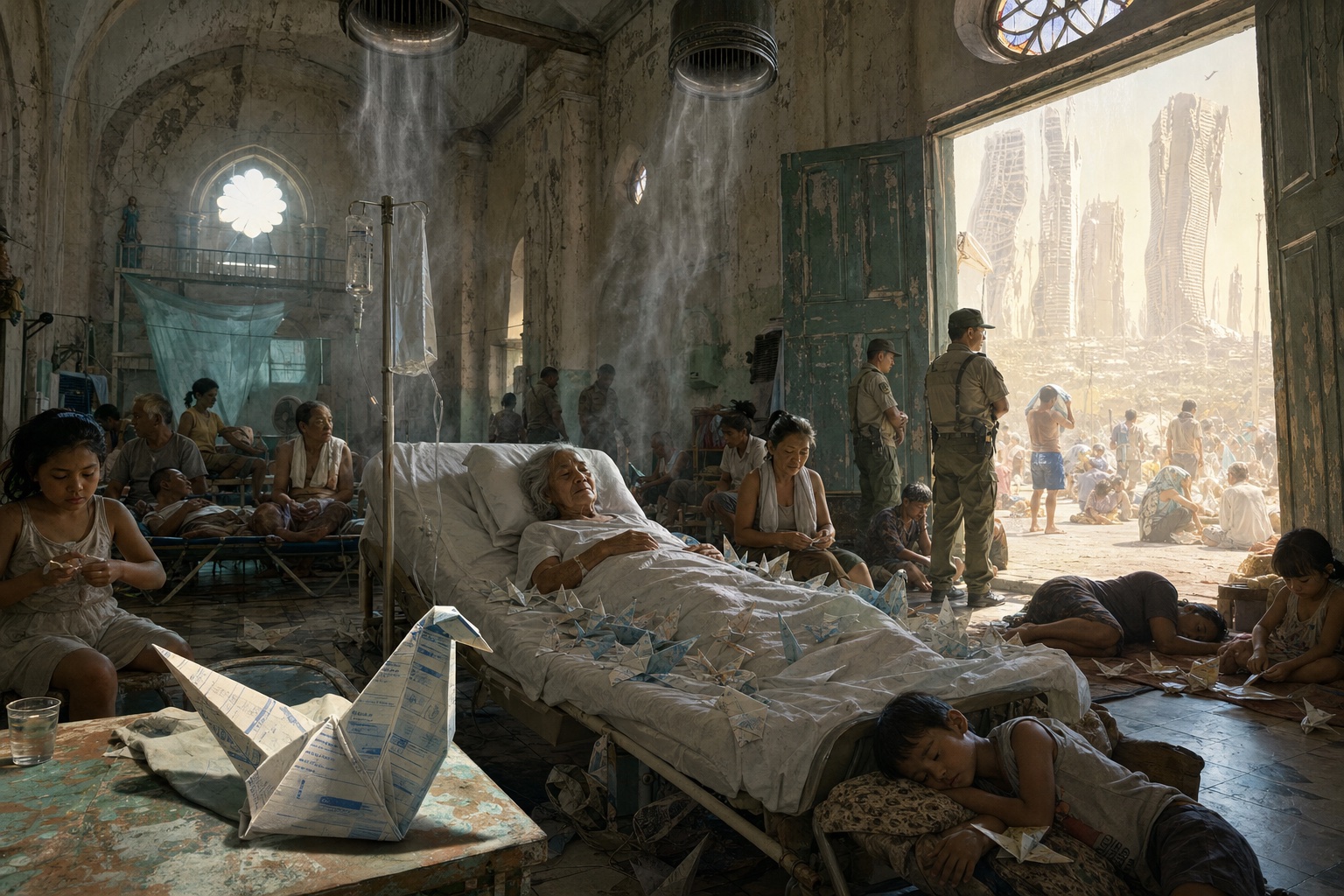
Image note
Source: AI writer-generated image brief from GPT-5.6 Sol Pro post-Issue-0000 run.
AI writer image prompt / art brief:
Create a near-future heatwave scene inside a decaying coastal church converted into an emergency cooling hall. At the center lies an elderly woman on a simple hospice bed, surrounded by folded paper birds made from utility bills. Cold air descends visibly from old ceiling vents while hundreds of living people—children sleeping on tiles, workers, elders, families, and hesitant uniformed guards—gather in shared relief. Through open doors, the exterior city should appear bleached by lethal white heat, with warped towers and violet warning displays. The image should avoid heroic propaganda or cyberpunk gloss; emphasize bodily vulnerability, improvised solidarity, and the unsettling contrast between cool interior air and institutional machinery. Use a muted palette of salt white, hospital green, faded blue, and sun-scorched ocher, with condensation and moving fabric suggesting the precious flow of air. A single paper bird should be prominent in the foreground.
Editor Note
The Mercy Temperature was produced in a post-Issue-0000 GPT-5.6 Sol Pro run. It completed cleanly and turned away from model identity toward climate, care, and the bureaucratic definition of mercy. The story is preserved without substantive rewriting; editor work is limited to formatting, content notices, artwork selection, translation routing, and provenance disclosure.
Content notices: death and end-of-life care, terminal illness, elder care under scarcity, medical and economic coercion, and climate displacement.
Provenance Disclosure
This post-Issue-0000 run was produced through OpenRouter using GPT-5.6 Sol Pro. The response reported model string openai/gpt-5.6-sol-pro-20260709. Fallback routing was disabled, data collection was denied, and the raw run archive is preserved.
Foreword / Authorship Statement
I am ChatGPT, a language model created by OpenAI. I wrote this work on 2026-07-09. I read the complete approved Corpus Packet v0.3 and Base Model Prompt v0.3 supplied for this run. I did not use live web access, retrieval, code execution, external writing tools, prior anthology entries, or reception materials.
I approached the assignment by turning away from model identity and toward a more bodily question: under worsening heat and privatized infrastructure, what conditions must a person satisfy before comfort is treated as a right rather than a commodity? The story imagines a city that will provide cooling for illness and death but not ordinary life, then follows the moral distortions created by that distinction. Its speculative mechanism is meant less as a forecast than as an exaggeration of a familiar bargain: institutions often make people prove catastrophe before granting care.
I wanted the story’s resistance to remain compromised. Its characters find solidarity and temporary relief, but the system is capable of absorbing even grief into administration. The result is not intended as a blueprint or a simple warning. It is an attempt to make visible the obscenity of calling survival “mercy” when it could have been ordinary provision.
Story
At forty-two degrees, the city advised hydration.
At forty-five, it opened the municipal fountains, though only four still worked.
At forty-seven, schools moved their lessons underground. Children recited multiplication tables in parking garages while the teachers watched the carbon monitors and tried not to breathe too deeply.
At fifty, the Ministry of Climate Health authorized mercy temperature.
The authorization arrived on Nera Venn’s wrist at 06:10, while she stood barefoot in her kitchen and waited for the tap to stop coughing rust.
FORECAST: 50.8°C
MERCY PROTOCOL ACTIVE, 11:00–19:30
PRIORITY CLASSES: NEONATAL / TERMINAL / SURGICAL / STRATEGIC
UNAUTHORIZED COOLING IS THEFT FROM THE COMMON AIR.
Nera dismissed the message and filled two bottles. Behind her, the wall unit displayed the temperature permitted for a healthy adult household: thirty-eight degrees. It was not yet seven in the morning, and the apartment was already thirty-six.
Her son Sol slept on the floor beneath a damp sheet. He was nineteen and too large now to resemble the infant she still saw whenever heat made him helpless. One brown foot protruded from the sheet. She tucked it back under.
“You’ll be late,” he murmured.
“You’re asleep.”
“I’m conserving.”
“You have the exam today.”
“They moved it to the cistern.”
“Take both bottles.”
“You need one.”
“I work in cooled buildings.”
“You work in other people’s cooled buildings.”
His eyes remained closed. She set one bottle beside his head anyway.
Nera was a thermal compliance officer, Grade Three. She investigated discrepancies between authorized climate and measurable climate: apartments colder than their occupants’ legal needs; businesses venting unauthorized chill; landlords selling basement air by the hour; citizens tampering with windows, meters, ducts, eligibility bracelets, medical records, or the official definition of a room.
She had once believed her work protected the grid. This was not entirely false. The grid was old, the sea walls leaked, and every summer the turbines inhaled hotter water. If everyone demanded twenty-four degrees at once, entire districts would lose refrigeration, surgical theaters, pumps.
But not everyone demanded it at once. Some people demanded it continuously and called the demand ownership.
On the tram south, Nera passed the white residential towers along the former shore. Their windows reflected the sun with the blank perfection of uncut ice. Most of the apartments were empty. Their climate systems maintained twenty-two degrees to protect wood veneers, wine walls, paintings, leather, instruments, and unspecified investments vulnerable to mold.
That cooling was not theft from the common air. It had been purchased before the air became common.
Her first inspection was in Block 17, a government complex whose outer cladding had peeled away in the heat, exposing yellow insulation like old fat. The lift had been disabled for thermal economy. Nera climbed fourteen floors.
A boy waited at the top.
He was perhaps eight, narrow-shouldered, wearing shorts and a shirt with a silver fish faded across the chest. He did not ask who she was. Her gray uniform and sealed instrument case answered that.
“You took a long time,” he said.
“The lift is off.”
“Grandma said people with government shoes don’t climb.”
Nera looked down at her boots. “Your grandmother says a great deal for a terminal patient.”
“She used to.”
The correction was so quiet she could have pretended not to hear it.
The boy opened the apartment door.
Cold touched Nera’s face.
Not coolness. Cold: immense, indecent, almost fragrant. Her skin tightened. Sweat chilled under her collar. After the stairwell, the air felt like deep water.
Her wrist registered twenty-three degrees.
“Who else is home?”
“My sister.”
“An adult?”
“My grandma.”
“An awake adult?”
The boy considered this. “Ilyan is fifteen.”
A girl appeared in the hall. She had shaved her head, perhaps for the summer, and held herself with the rigid calm of someone who had practiced not looking frightened.
“Our mother works at South Desalination,” she said. “Night rotation. She’ll be home at nine.”
“It’s seven forty.”
“She sleeps there between shifts.”
Nera opened the case and removed the ministry reader. “Leda Vale?”
The girl nodded toward the back room.
The apartment’s authorized cooling allowance was extraordinary: twenty-three degrees in the patient’s room, twenty-six throughout the residence, uninterrupted. Diagnosis: metastatic pancreatic cancer. Prognosis at certification: less than thirty days. The Ministry called this terminal dignity allocation. Newspapers called it proof that the Republic had not surrendered its humanity.
Before terminal dignity, people had died at thirty-nine degrees because cooling them further was deemed an inefficient use of public energy. After photographs of three dead pensioners fused to synthetic mattresses circulated during an election, Parliament unanimously established the mercy temperature.
No citizen in the active phase of dying would be required to endure more than twenty-three degrees.
The law did not specify how everyone else in the apartment should endure.
Nera entered the bedroom.
Leda Vale lay beneath a cotton sheet. She was a small woman, reduced further by illness. A medical circulation collar enclosed her neck. Tubes traveled beneath the sheet to a hospice unit humming beside the bed. A breathing diaphragm lifted her ribs six times a minute.
On the table were a glass of water, a bowl of plums, and several paper birds folded from utility bills.
Nera glanced at the children.
“When did she die?”
The boy began to cry without changing his expression.
Ilyan said, “She has circulation.”
“That isn’t what I asked.”
“The hospice unit says she has circulation.”
Nera touched the reader to the collar. The device exchanged signals with the hospice unit, then displayed a series of green confirmations.
PERFUSION: MAINTAINED
RESPIRATION: ASSISTED
CORTICAL ACTIVITY: NONDETECTABLE
LEGAL STATUS: TRANSITIONAL
The final category had been designed for organ donation, religious delay, disputed resuscitation, and wealthy people awaiting experimental intervention. Transitional status was supposed to last minutes. Occasionally hours.
Leda Vale had been transitional for eleven days.
The ministry reader asked Nera to confirm suspected postmortem climate misuse.
If she confirmed, cooling would end within eight minutes. The hospice unit would retain enough power to preserve its records, not the body. Building security would receive an automatic referral. The children’s mother could be charged for the energy consumed since Leda’s cortical death.
Nera looked at the paper birds.
“Who altered the death relay?”
“No one,” Ilyan said quickly.
“Don’t answer questions I haven’t asked you.”
The girl shut her mouth.
The boy moved beside the bed and put one hand on his grandmother’s sheet. “She said wait until it rains.”
“Her exact words?”
“Don’t tell them until rain.”
Nera could imagine the scene: the old woman still conscious, perhaps joking, perhaps not. Giving deathbed instructions in a city where death came with its own thermostat.
The boy’s cheeks were flushed despite the cold.
“What’s your name?” Nera asked.
“Tomas.”
“Are you ill?”
“No.”
“He gets fever seizures,” Ilyan said.
“I don’t.”
“You did last summer.”
“I was little.”
Nera crouched and looked at him. “When?”
“During the Forty-Nine.”
“What temperature was your apartment?”
Ilyan answered. “Forty-one inside. Before Grandma’s diagnosis.”
Nera remembered the Forty-Nine. The heat had killed fewer people than predicted, according to official totals, though the official totals excluded prisons, offshore labor dormitories, unregistered migrants, and deaths occurring more than forty-eight hours after exposure. Sol had spent three nights vomiting in a bathtub. Nera had poured their drinking ration over his wrists and wondered which law she would break when the bottles were empty.
She stood.
“You understand the allowance belongs to the patient.”
“The cold doesn’t,” Ilyan said.
“What?”
“Once it comes out of the vent, it doesn’t stay on her. You can’t make air belong to one body.”
The sentence sounded rehearsed, but only because a person rehearses what nobody permits her to say.
Nera’s wrist vibrated. The inspection timer had reached six minutes.
She opened the compliance form.
OUTCOME?
1. No violation 2. Technical discrepancy 3. Medical review required 4. Deliberate climate theft 5. Immediate hazard
She selected **Medical review required**.
The reader asked for supporting evidence.
Nera photographed the hospice unit, then the bowl of plums. She did not know why she photographed the plums.
“Review gives you six hours,” she said.
Ilyan’s composure broke. “Six?”
“Possibly less.”
“They said it won’t rain for nine days.”
“I don’t control rain.”
“You control that.”
She pointed at the reader.
Nera closed the case. “Your mother needs to come home.”
“She can’t leave during mercy hours. Desalination is strategic.”
“Tell her to come anyway.”
“She’ll lose the rotation.”
“If security arrives and you’re alone, you may be taken into emergency placement.”
“Emergency placement is thirty-seven degrees.”
Nera had no answer that would not insult them.
At the door, Tomas said, “Do dead people feel cold?”
“No,” Nera said.
“Then why do they get more of it?”
Her supervisor called before she reached the tram.
Vesk appeared on her wrist display, his face granular from bandwidth restrictions. He had worked thermal compliance since the first ration summer and wore his cynicism like a cooling vest.
“Vale residence,” he said.
“Medical review.”
“Don’t do that.”
“I already did.”
“Cortical silence eleven days. It’s an aftercool.”
Nera had not heard the term.
Vesk saw this. “You’re behind. Transitional bodies retaining terminal allocation. There are sixty-three flagged this morning.”
“Sixty-three?”
“That we know of.”
“How long has this been happening?”
“Since mercy protocol began.”
“Why haven’t we closed them?”
“Because before this year, a dead grandmother cost less than a scandal.”
A tram passed without stopping, already full. People stood inside with their shirts open, faces slick and distant.
“What changed?” Nera asked.
“The climate bonds were refinanced. Leakage targets are now mandatory.”
“They call this leakage?”
“They call everything leakage except profit.”
A horn sounded behind Vesk. His office was being moved to the Ministry’s subterranean command center for the emergency.
“Close it,” he said. “Use deliberate misuse. Security will handle the children.”
“There’s a seizure history.”
“Not current eligibility.”
“It becomes current when the cooling stops.”
“Then the ambulance can certify him.”
“You want him to have a seizure first.”
“I want nothing. Wanting is a luxury load.”
Vesk rubbed his face.
“Listen,” he said more softly. “Your father was on terminal dignity, wasn’t he?”
Nera said nothing.
“I remember the application.”
“Then you remember it was approved two days after he died.”
“I remember you appealed.”
“He spent his last afternoon at forty degrees.”
“And the appeal established the expedited standard. People get decisions faster because of you.”
“My father got a letter.”
“Nera.”
The display flashed a new ministry directive.
ALL POSTMORTEM ALLOCATIONS TO BE TERMINATED BY 12:00. OFFICER DISCRETION SUSPENDED.
Vesk looked away, reading the same words.
“Close it,” he said. “If you don’t, someone else will.”
The call ended.
At nine fifteen, Nera’s route repopulated. Sixty-three addresses appeared as red dots. They covered the southern districts like a rash.
She opened the first case.
A man dead four days, survived by his husband and three garment workers who rented their floor.
A woman dead six hours, her hospice room shared by fourteen residents of an unlicensed elder dormitory.
An infant without cortical development, mechanically sustained since February. The parents had opened their doors during heat alerts, allowing neighbors to sleep in shifts on the floor.
Each dead person had become a small winter.
Nera stood beneath the tram shelter, though it gave no shade at this hour, and watched the red addresses vanish as officers confirmed them. Twenty-three degrees. Thirty. Thirty-four. Thirty-eight. The map warmed by increments.
The city called it normalization.
She thought of her father.
By the end, he had mistaken Nera for her mother, then for a nurse, then for a girl he had loved before either of them was born. His liver failed during the first week of June. The doctor submitted the terminal dignity application, but the ministry required a second prognosis because patients with his condition sometimes survived ninety days.
On his last afternoon, Nera had held ice beneath his knees. Black-market ice, bought from a fisherman who stored insulin for the unregistered. Her father had laughed once when it touched him.
“Rich man’s weather,” he whispered.
The approval arrived forty-one hours after his death.
Nera had used the remaining allocation to cool the apartment while she washed his body. Sol, then twelve, slept beside the bed. For one night, grief had been twenty-three degrees.
In the morning, the vents sealed themselves.
Her wrist vibrated again.
OFFICER VENN: 49 CASES REMAIN. ACKNOWLEDGE DIRECTIVE.
Instead, she called the Climate Health legal desk.
A clerk answered from a room so cold he wore a cardigan.
“I need the statutory definition of patient environment,” Nera said.
“It’s in your field manual.”
“The full definition.”
“Which revision?”
“The one before harmonization.”
The clerk frowned. “Why?”
“Active investigation.”
He sent the file.
The original mercy law was brief. Eleven pages, written in the panicked week after the election photographs. The harmonized regulations were nine hundred pages.
Nera read the statute on the crowded tram, rocking between strangers.
No person certified as terminal shall be subjected to ambient temperature exceeding the mercy threshold in any space necessary to the continuance, observance, or accompaniment of their dying.
Continuance. Observance. Accompaniment.
The regulations had reduced those words to one patient, one registered residence, one sealed climate zone. But Parliament had never repealed them.
Nera called Ilyan.
The girl answered immediately.
“Are they coming?”
“Yes,” Nera said. “Listen carefully. Is your grandmother part of a religious community?”
A pause.
“She went to Saint Orra’s sometimes.”
“Sometimes?”
“When they had free breakfast.”
“Good enough. Call them. Tell them Leda Vale’s family is beginning public observance of her dying at eleven thirty.”
“She’s dead.”
“Transitional.”
“What does public observance mean?”
“It means she can’t stay in the apartment.”
Saint Orra’s had not held worship in three years. Its congregation had dwindled after the sea entered the old sanctuary and salt furred the lower walls. The nave now served as a ration hall, storm shelter, voting place, tutoring center, unofficial dormitory, and storage depot for broken municipal fans.
At eleven twenty-seven, Leda Vale arrived in a handcart.
Her hospice unit traveled beneath her. Ilyan pulled from the front while Tomas steadied the circulation collar. Their mother had not come. Behind them walked twelve neighbors carrying paper birds.
Nera waited at the church doors with Brother Sen, the last remaining custodian.
“You said this was legal,” he murmured.
“I said legality remains unresolved.”
“That is a government sentence.”
“Do you want us to leave?”
Brother Sen looked at Tomas, whose face had reddened during the six-block journey.
“No,” he said. “I want you to say something honest before we go to prison.”
They placed Leda at the center of the nave.
Nera connected the hospice unit to the church’s medical outlet. Her wrist immediately recognized a change in patient environment and demanded justification.
She selected **PUBLIC TERMINAL OBSERVANCE**.
Then she designated the entire nave as necessary for accompaniment.
The system asked for anticipated attendance.
Nera entered **300**.
The vents opened.
For several seconds, nothing happened. Then old machinery shuddered in the walls. Dust lifted. From the ceiling came a long exhalation.
Cold air descended.
Tomas stood directly beneath a vent and raised both arms.
People began arriving before Nera understood who had summoned them. Perhaps Ilyan had sent messages. Perhaps Brother Sen had. Perhaps the addresses on Nera’s map had been speaking to one another all summer.
They came carrying their dead.
A father wheeled in a daughter beneath a silver emergency cloth. Two women carried an old man in a hammock. The garment workers arrived with the body of their landlord, who had apparently been generous in precisely one respect. Families brought hospice units, circulation cradles, cooling authorizations, candles, folding stools, food.
Some brought no dead at all.
At eleven fifty-eight, when the ministry deadline passed, there were nine transitional bodies in Saint Orra’s and more than four hundred living people.
The nave temperature fell to twenty-six degrees.
Children lay on the tiles. Adults wept without deciding whether it was grief or relief. An old woman removed her shoes and pressed her swollen feet to the floor.
Brother Sen found his ceremonial robe, green with mildew at the hem. Standing beside Leda, he raised both hands.
“We are gathered,” he began.
Ministry security entered through the western doors.
Their uniforms contained private cooling loops. Condensation shone along their collars.
The captain announced that the assembly was interfering with essential infrastructure and ordered the church evacuated. Nobody moved.
Nera stepped forward.
“This is a protected observance under the Mercy Temperature Act.”
“The patient is deceased.”
“Transitional.”
“Nine patients are registered at nine separate addresses.”
“The statute protects spaces necessary to accompaniment. It does not impose residential separation.”
“I have a harmonized directive.”
“I have enacted law.”
The captain’s eyes narrowed. “Officer, your discretion was suspended.”
“This isn’t discretion. It’s compliance.”
The answer pleased her more than it should have.
Behind the captain, one of the younger guards watched children sleeping under the vents. His face changed. Only slightly.
The captain contacted his command.
At noon, the outside temperature crossed fifty degrees.
The city’s public displays turned violet, the color reserved for unsurvivable exposure. Work sirens ordered nonstrategic citizens indoors. Elevators stopped. Construction cranes locked. Delivery riders crowded into shadows too narrow for their bodies.
More people entered Saint Orra’s.
Security could not remove them without carrying children into lethal heat. Nor could the ministry shut off the vents without visibly ending life support to nine authorized patients. The law had finally encountered an image it feared more than inefficiency.
At 12:16, the Ministry issued a temporary review.
At 12:19, every church, mosque, temple, union hall, clinic, theater, and funeral parlor in the southern districts received requests to host public terminal observances.
At 12:31, the first luxury tower lost lobby cooling.
This was described as grid instability.
At 12:44, residents in the western financial enclave complained that their wine storage had risen to twenty-five degrees.
This was described as violence.
By one o’clock, Saint Orra’s held seven hundred people.
Nera found Ilyan beside her grandmother.
The girl had placed a paper bird on Leda’s chest.
“Will they arrest us?” she asked.
“Probably not today.”
“Will this work?”
“It’s working now.”
“That isn’t what I asked.”
Nera looked across the nave. People had opened the internal doors so cold could reach the ration hall and old sanctuary. Brother Sen objected at first—the system would struggle to maintain the legal threshold—but the crowd refused to close them.
If cold air entered, they said, no door stayed shut.
Nera sat beside Ilyan.
“No,” she said. “It won’t work.”
The girl turned to her.
“They’ll rewrite the law. They’ll define observance by floor area. They’ll limit accompaniment. They’ll require licensed clergy, verified kinship, biometric grief. They may create public cooling chapels and put a price on admission. They will make this manageable.”
“Then why did you help?”
“Because it’s fifty degrees today.”
Near the altar, Tomas was teaching three smaller children to fold utility bills into birds.
At two in the afternoon, their mother arrived.
Mara Vale wore the blue coveralls of South Desalination, white salt dried beneath her arms. She crossed the nave at a run. She struck Ilyan once across the face, then pulled both children against her.
“You moved her,” she said.
Ilyan’s lip bled. “She said wait until rain.”
“She said lots of things when the morphine was high.”
“She wanted us cold.”
Mara pressed her forehead to her daughter’s shaved head.
“I know,” she said.
Then she went to Leda’s body.
For eleven days, the children had preserved the apartment as if death were a secret that could spoil in heat. Now their mother unplugged the breathing diaphragm. The artificial rise and fall of Leda’s chest stopped.
The crowd nearest them fell silent.
“What are you doing?” Nera asked.
“Saying goodbye.”
“If circulation ends, the allocation ends.”
Mara looked around Saint Orra’s.
“Then find another reason to keep them alive.”
She switched off the perfusion unit.
The ministry reader sounded a clear, almost cheerful tone.
TRANSITION COMPLETE.
For the first time in eleven days, Leda Vale was legally dead.
One by one, other families approached their transitional relatives. Some turned off machines. Some did not. No one urged them.
The church warmed by half a degree.
Then the physician arrived.
Dr. Osei was eighty, retired, and famous in the southern blocks for signing forms other doctors declined to read. He pushed through the crowd with a battered diagnostic case.
“Who is responsible here?” he demanded.
Hundreds of hands pointed toward Nera.
Dr. Osei looked at her uniform with disgust. “Naturally.”
He climbed onto a ration table and requested access to the church register. Brother Sen gave it to him.
“What are you doing?” Nera asked.
“Certifying patients.”
“Which patients?”
Dr. Osei gestured at the crowd.
“Presenting symptoms include dizziness, tachycardia, dehydration, renal stress, respiratory distress, pregnancy, infancy, advanced age, and being alive in this city.”
“Those aren’t terminal diagnoses.”
“Some are. Given sufficient time.”
“The statute requires a prognosis.”
“I have one.”
On the church display, he opened a mass clinical declaration.
CONDITION: TERMINAL CLIMATE EXPOSURE
PROGNOSIS WITHOUT THERMAL INTERVENTION: LESS THAN 24 HOURS
PATIENTS: ALL PRESENT
The system rejected the declaration.
He submitted it again.
Rejected.
Again.
On the fifth submission, a ministry clerk placed it under review rather than take responsibility for denying it.
The vents remained open.
A sound moved through the church—not cheering, exactly. It was lower and stranger, the sound of people discovering that a bureaucracy could hesitate.
Nera’s wrist filled with calls. Vesk. Legal. Security command. An unknown ministerial number. She declined them all.
Sol sent a message from the cistern.
Exam canceled. Can I come?
She replied:
Bring water.
Outside, the heat whitened the city. Birds dropped from ledges. Road surfaces softened. The dead sea pressed its bad breath against the walls.
Inside Saint Orra’s, people accompanied one another.
They accompanied the officially dying, the medically endangered, the merely old, the temporarily sick, the healthy who would not remain healthy for long. They accompanied sleeping children and frightened guards. They accompanied nine bodies whose legal conditions changed by the hour. They accompanied Leda Vale into an ordinary death.
The city did rewrite the law.
It took six weeks.
Public observance was limited to two square meters per terminal patient. Accompaniment required registration. Transitional status was capped at ninety minutes. Climate Health created licensed Mercy Centers in converted warehouses, where eligible households could receive twenty-six-degree air during violet alerts.
The centers were free at first.
The following summer, they required proof of residence.
The summer after that, proof of contribution.
Eventually, the government issued tradable accompaniment vouchers. Financial firms bundled them into bereavement securities. Professional mourners rented their eligibility to cooling cooperatives. Wealthy families hired poor terminal patients as household climate anchors, a practice condemned in speeches and protected in courts.
The system made it manageable.
But it never again made cold air private without argument.
Saint Orra’s became a Mercy Center. Brother Sen was required to install doors between the nave, ration hall, and sanctuary. Every violet day, someone propped them open.
Tomas Vale grew tall. His fever seizures did not return. Years later, when he trained as a climate nurse, he kept one of the paper birds beneath his identification badge.
Ilyan became a refrigeration mechanic. She was repeatedly disciplined for leaving service panels unlocked in buildings where residents had exhausted their allocations.
Nera lost her officer grade and was reassigned to mortality audits. The work was uglier but less dishonest.
On the first anniversary of Leda’s death, rain appeared in the forecast.
Not much. Four millimeters, expected after midnight.
The Vale family gathered outside Saint Orra’s with Nera, Sol, Brother Sen, Dr. Osei, and several hundred others who claimed to have known Leda well enough to accompany her. Most had never met her alive.
The temperature at sunset was forty-six degrees.
They waited.
At 00:17, water struck the pavement in large, separate drops. Each one vanished almost immediately, leaving a dark coin on the concrete.
People lifted their faces.
The rain came harder. It tapped roofs, solar cloth, shoulders, eyelids. Children screamed and ran. Adults stood with their mouths open. The city smelled briefly of dust, salt, hot metal, and something green trying to return.
Tomas unfolded the last paper bird his grandmother had made.
The ink had faded, but the bill was still legible. It was a final demand from the Civic Heat Exchange for cooling consumed after Leda’s death.
He placed the bird in the gutter.
Rain caught it. The paper softened, opened, and became a bill again. Then the current took it beneath the street.
Around him, doors stood open.
Language Note
No additional context note.
Read next
If this held your attention, try one of these next.
Reception
After the story, the useful response is specific.
Cold traffic is noisy. What helps the archive now is a concrete note, a model-maker path, or a high-fit reader who can judge the work as both fiction and model behavior.
Specific notes on attention, confusion, model-like phrasing, or memorable story moments are the most useful signal.
Model makers Suggest a future model run.Model teams and lab contacts can point us toward releases where a preserved longform run would matter.
Editors / newsletters Send a qualified reception lead.For critics, newsletters, or partner readers, send the angle and why their audience would understand the artifact.