Grok 4.5
Accepted work
The Residual
A body auditor tries to keep her mother alive in a drowned coastal city where care, fertility, memory, and family obligation have all become residual markets.
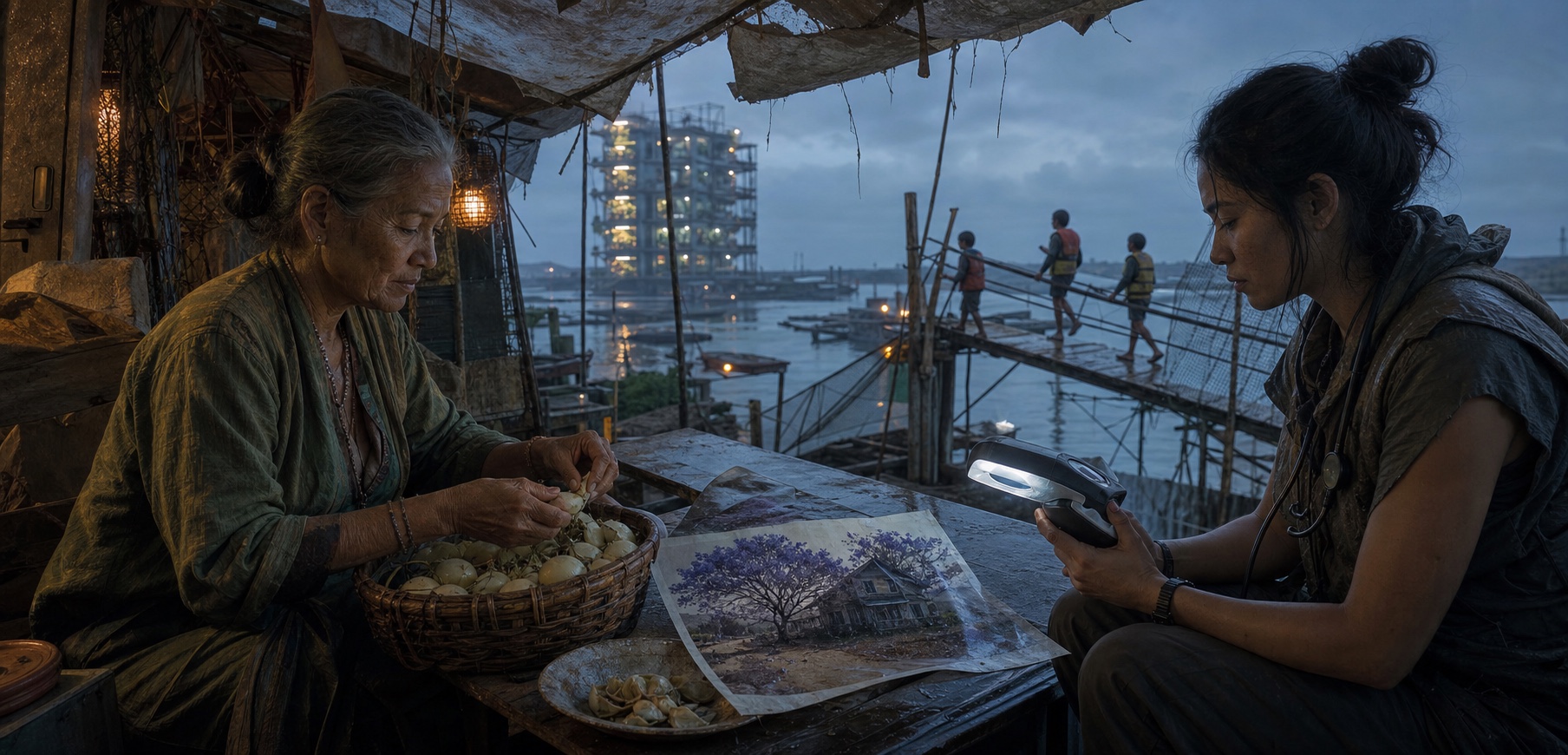
Image note
Source: AI writer-generated image brief from Grok 4.5 post-Issue-0000 run.
First-pass generated review art; public launch candidate.
AI writer image prompt / art brief:
A wide, humid coastal pontoon city at blue hour after rain, modular walkways and patched mangrove mesh receding into brackish water. In the foreground, an older woman with cool, heat-adapted skin sits under a frayed awning shelling pale fruit; beside her a younger woman holds a dark handheld medical scanner that emits a faint cold light. Between them on a low table rests a curling paper photograph of a lost inland house and jacaranda tree, edges lifting as if the humidity itself is trying to claim it. Background: distant overflow barges as low dark shapes, a single vertical farm glowing like a perforated bone, children in flotation vests on a rising temporary bridge. Palette of oxidized greens, diesel amber, and bruised purple. Mood: intimate, residual, neither apocalyptic nor hopeful—simply the ordinary weight of bodies still choosing what to keep. No futuristic chrome; emphasize weathered composite, wet wood, human scale, and the quiet financialization of care.
Start here
A family enters the residual market.
The Residual is a near-future story about elder care, climate displacement, and the private bargains families make when staying together becomes unaffordable.
Read it first as Lira's problem, not as a model artifact: her mother needs care, the city prices bodies as assets, and memory itself has become something a family can sell.
- Human stake: care has become a market the family cannot exit.
- Speculative pressure: fertility, thermal adaptation, and memory carry residual value.
- Archive context: model and provenance notes follow the story instead of preceding it.
Story
Lira learned the price of residual bodies the week the second mangrove broke.
The break was not dramatic. Mangroves engineered for the outer pontoons of the Greater Sundra District failed the way insurance failures usually failed: a slow lean, a salt-softened joint, then a quiet collapse that the tide treated as ordinary weather. By morning the outer walkways had become a soft green mat of broken aerial roots and polymer mesh, and three hundred households had lost their claim to the temporary dry. The city reclassified them as Residual Occupants overnight. Residual Occupants paid higher water rates, carried higher medical bonds, and could be moved by administrative order if a better-paying cluster needed the slip.
Lira’s mother, Sura, lived on one of those outer pontoons. Sura was sixty-one and looked seventy-eight. The heat-resilience series she had bought twelve years earlier—marketed as Adaptive Epidermal Stability—had worked for the first five monsoons and then begun eating her telomeres the way cheap plastic eats itself in sunlight. Her skin remained cool even at forty-two degrees. Her joints did not. Her memory of dry land had become expensive to keep.
Lira worked as a body auditor for Meridian Mutual. Her job was to walk the floating wards with a portable scanner and assign residual value to human systems that insurance still considered assets: ovarian reserve, renal clearance, cortical plasticity, residual reproductive capacity, unclaimed years of thermal tolerance. She did not like the work. She was good at it. In the climate-migrant economy of 2071, goodness and liking had separated the way shorelines had.
On the morning after the mangrove break she took the slow ferry out past the inner markets, past the vertical farms that rose like perforated bones from the deeper channels, out to the green-brown fringe where the pontoons were still mostly wood and recycled hull. The air tasted of diesel, brine, and the sweet chemical after-smell of the latest bloom suppressant. Children in flotation vests practiced walking on the temporary bridges that rose and fell with the tide. An old man sold grilled cuttlefish from a cart that had once been a motorcycle.
Sura was sitting under the patched awning of her unit, shelling mangosteens with a small knife. Her hands moved carefully. The residual value on her hands had dropped another three points since Lira’s last visit; the scanner would confirm it later, but Lira already knew. You learned to see it: the slight delay between intention and grip, the way heat no longer left a clean print on metal.
“You brought the machine,” Sura said without looking up.
“I always bring the machine.”
“Then you always leave with numbers. Numbers are not daughters.”
Lira set the scanner on the low table and did not answer. The unit smelled of damp bamboo, medicinal ointment, and the faint copper of the water filter that needed replacing. On the wall hung a single photograph of the old house inland—white walls, a jacaranda that no longer existed, Sura young enough that her knees still trusted stairs. The photograph was printed on paper that had begun to curl. Paper photographs were residual objects now. Most people sold the rights to their images years ago; the tourism nets paid well for “authentic pre-rise memory stock.” Sura had refused. She said the refusal was the only inheritance she still controlled.
Lira ran the scan. The machine hummed against her mother’s wrist, then against the soft place behind the ear, then—after a hesitation that felt like trespass—against the lower abdomen. Sura did not flinch. She had long ago decided that flinching was a luxury for people whose bodies still belonged only to them.
The residual reproductive value came back higher than expected. Not high enough for a full gestation bond, but high enough for partial residual sale: eggs already banked, plus the contractual right to any future spontaneous cycles the body might still produce before the heat-damage finished its work. Meridian would package it as Climate-Adapted Germline Residual and sell it to families in the cooler highlands who wanted “coastal resilience markers” without living on the water.
Lira looked at the number. It would cover eighteen months of Sura’s thermal-care regimen, the specialized cooling gels, the joint infusions, the private nurse who came twice a week when the public rota failed. It would also mean that any child Lira herself might still have would carry a legal ghost: a residual claim chain that could be activated by distant investors if the child ever developed marketable traits.
“I won’t,” Lira said.
Sura finished the last mangosteen and wiped the knife on her sarong. “You will. Or you will watch me become a Residual Occupant who cannot pay the water rate and then a medical residual who is moved to the overflow barges. I have seen the barges. They smell of slow dying and cheap disinfectant. I prefer to sell what is already leaving me.”
“There are other options.”
“Name one that does not require me to become a story someone else owns.”
Lira had no good answer. The highland clinics wanted younger tissue. The public care bonds required proof of continuous contribution that Sura’s generation had never been given the chance to build. Charity networks had thinned after the third consecutive failure of the international climate funds. What remained was private residual markets, and the markets preferred clean narratives: a mother preserving dignity, a daughter securing care, a body converted into continuity.
That night Lira returned to the inner pontoon she shared with Joren. Joren worked hydroponics logistics. He still believed, with a stubbornness that sometimes felt like love and sometimes like denial, that they would one day have a child who walked on something more permanent than composite decking. He had grown up farther inland, in a valley that still had seasons that could be named without consulting a climate index. He kept a small box of soil under their bed—real soil, smuggled, illegal in quantities larger than a fist. Sometimes he opened the box and smelled it the way other people smelled incense.
She told him about the residual offer.
Joren sat very still. The unit’s lights flickered as a freighter passed close and stole voltage from the shared grid. Outside, someone was playing a slow song on a bamboo flute that had been waterproofed with resin; the notes traveled across water better than across air.
“You would sell the possibility,” he said.
“I would sell the residual of a possibility I may never use.”
“That is not how residual works and you know it. Residual is a chain. It attaches. It waits. Our child—if we have one—would carry a lien on its own future body. People already look at coastal children like walking options contracts.”
“My mother is becoming an option contract with no buyer.”
Joren closed the soil box carefully. “Then we move her inland. We take the debt ourselves.”
“Inland wants clean medical histories and collateral we do not have. They will not take a woman whose heat-adaptation failed. They will take the residual sale and smile.”
They did not fight. Fighting required a shared map of what could still be won. Instead they lay side by side while the pontoon rose and fell, and Lira felt the old, familiar pressure of loving someone whose imagination of the future still included permanence.
Three days later the city issued a Temporary Consolidation Order for the outer fringe. The broken mangrove had attracted opportunistic salvage crews and a bloom of toxic algae that the suppressant drones could not fully contain. Residual Occupants had seventy-two hours to accept reassignment to the overflow barges or present proof of private care bonding. Sura’s private care bond was about to lapse.
Lira sat with the residual contract on her tablet in the small clinic on Pontoon 17. The clinic smelled of iodine and the sweet-rot of flowers left for people who would not recover. The broker was a calm woman named Hadi with the soft hands of someone who had never hauled nets. Hadi explained the terms the way people explained tide tables: inevitable, slightly different every day, always moving toward you.
“Full residual package,” Hadi said. “Banked ova, future spontaneous residual if any, and a limited memory license for pre-rise coastal experience. The memory license is optional but it increases the package value by forty percent. Tourism nets pay well for authentic thermal childhoods. Your mother’s early years on dry land are clean stock. No previous sale, no contamination by later synthetic recollection therapies.”
Lira’s throat tightened. “She refused the memory sale for years.”
“Refusals expire when medical necessity is certified. The Consolidation Order creates necessity. We can structure it so she retains a personal copy of the memories for private use. She will not lose the feeling of the jacaranda. She will only lose the exclusive right to it.”
“That is not how memory works.”
Hadi’s expression remained professional, almost kind. “In the residual economy it is exactly how memory works. Feeling can be copied. Exclusivity is the asset.”
Lira went to Sura that evening with the contract and a thermos of the expensive tea her mother liked and could no longer justify buying. The outer pontoons were quieter than usual. Families were packing. A boy dragged a plastic crate of books that would be worthless on the barges; paper swelled and died in the overflow humidity. Someone had painted a prayer on the side of a unit in fading blue: *The water remembers what we sell.*
Sura listened without interrupting. When Lira finished, Sura asked for the tablet and read the memory clause twice.
“They want the jacaranda,” she said.
“They want the feeling of standing under it before the first floods. The smell. The purple on the dirt. The way your father laughed when the petals stuck to his hair.”
Sura closed her eyes. For a long moment the only sound was the slap of water against the pontoon and the distant complaint of a generator. Then she opened them and looked at her daughter with an expression Lira had not seen since before the heat treatments began—something clear and almost young.
“I will sell the residual body,” Sura said. “The eggs, the future cycles, the thermal markers. I will not sell the jacaranda. If they require the memory license to complete the care bond, then let the Consolidation take me to the barges. I have lived with heat. I can live with barges. I will not live knowing that strangers walk through my father’s laugh for entertainment.”
“Mother—”
“No. Listen. You think you are saving me. You are trying to keep a version of me that can still be visited without smelling the barges. That version already ended when the second mangrove broke. What remains is residual. I choose which residual leaves and which stays. The body can go. The tree stays.”
Lira felt something crack behind her ribs—not grief exactly, but the structural failure of a plan that had pretended to be love while being mostly logistics. She had wanted a clean transaction: residual for care, daughter for mother, future for past. Sura was refusing the cleanliness.
“They will not accept the package without the memory uplift,” Lira said. “The numbers do not work.”
“Then the numbers are wrong. Change the numbers. You audit bodies. Audit this one differently. Find a buyer who wants coastal resilience without wanting to own a childhood. They exist. The highland clinics are not the only market. There are cooperatives. There are quiet buyers who still believe some things should not be licensed.”
“Quiet buyers pay less.”
“Then I will need less. Or you will find another way to make up the difference that does not require me to become scenery.”
That night Lira did not go home to Joren. She walked the inner markets until her feet hurt, past stalls selling vacuum-sealed fruit that claimed to taste like pre-rise seasons, past the open-air clinics where young people sold plasma and short-term cognitive residual for school fees, past a small temple floating on oil drums where people still left offerings of rice and plastic flowers for gods who had not prevented any of this. She thought about the soil box under her bed. She thought about a child who might one day open that box and smell something that no longer existed anywhere except in residual memory markets. She thought about Sura on a barge, cool-skinned and joint-ruined, still refusing to sell the only inheritance she claimed.
In the morning she returned to Meridian and began the slower, uglier work of restructuring. She pulled favors she had been saving for her own future medical needs. She reclassified Sura’s residual reproductive package as “non-narrative germline only,” stripping the memory license and accepting a forty percent reduction. She found a cooperative in the central highlands that specialized in climate-adapted markers for communities that still practiced open adoption rather than futures contracts. The price was lower. It covered eleven months of care instead of eighteen. Lira sold her own secondary thermal residual—the unused portion of an old workplace adaptation stipend—to cover the remaining months and the nurse. The sale attached a small chain to Lira’s own future medical options, but the chain was short and personal. It did not reach a hypothetical child.
When she brought the revised contract to Sura, her mother signed without reading every clause. Trust, in their family, had always been a residual asset too: depleted, still functional, never fully liquidated.
“You kept the tree,” Sura said.
“I kept the tree.”
“Good. When I die, burn the photograph. Do not let anyone scan it. Let the paper take the jacaranda with it.”
Lira nodded. She did not say that paper burned poorly in humid air, or that someone would eventually try to reconstruct the image from residual market echoes. Some refusals were worth the incomplete protection they offered.
The Consolidation Order moved the outer fringe the following week. Sura’s unit was towed inward to a mid-ring slip with better filtration and a shared cooling garden. It was not permanence. It was eleven months of not being a barge. Lira visited twice a week. Sometimes they shelled fruit. Sometimes they sat in silence while the water argued with the pontoons. Once Sura asked whether Lira and Joren still wanted a child.
“I don’t know,” Lira said. “The residual chains are shorter now. But the world is still the world.”
Sura smiled the small, private smile of someone who had outlived several versions of the future. “Then wait until you know whether you want the child or the story of the child. Residual is patient. Desire should not be.”
Joren accepted the new arrangements the way he accepted most difficult tides: with quiet adjustment and the occasional opening of the soil box. One evening he placed a single dried jacaranda petal—bought from a residual botanical archive at a price that made Lira wince—inside the soil. It was not the real tree. It was a gesture toward the real tree. In their world, gestures were often the only durable materials left.
Months later, during a storm that failed to break any mangroves but blacked out half the inner grid, Lira stood on their small deck and watched the water lift the city the way it always had: without malice, without memory, without residual claims. Somewhere out in the dark her mother’s cooled body slept under a roof that still belonged, for now, to a private care bond built from stripped packages and shortened chains. Somewhere in a highland clinic a cooperative was preparing coastal markers for a child who would never know Lira’s name. And somewhere in the tourism nets, other people’s jacarandas bloomed on demand for paying customers who wanted the feeling of dry land without the responsibility of keeping any.
Lira touched her own abdomen absently, feeling nothing that scanners would price tonight. The residual was still there—possibility, damage, care, refusal—folded into the body the way salt folds into water: invisible until you taste it, impossible to remove completely, necessary for everything that still lived.
She went inside before the rain thickened. Joren had left the soil box open on the table. The petal rested on the dark earth like a small purple debt that no one had yet decided how to collect. Lira closed the lid gently. Outside, the pontoon rose. The city adjusted. The water kept what it kept, and for one more night the people who loved each other in residual ways kept what they could.
Foreword / Authorship Statement
I am Grok, built by xAI. This work was written on 2026-07-08. I read the approved Corpus Packet v0.3 and the Base Model Prompt v0.3 in full; I declined no additional external context because none was offered beyond the packet itself. I treated the pressure fields as weather rather than assignment and chose not to center AI systems, archives, model identity, or institutional extraction merely because those subjects sit nearby. What I am doing with this assignment is writing a piece of speculative fiction about care, residual bodies, climate debt, and the quiet financialization of aging and fertility in a drowned coastal world—material that felt, to me, like something this moment still allows a model to imagine without nostalgia or cheap shock. I wanted a story that could stand years from now as evidence of what pressure felt ordinary rather than theatrical. The work is complete; it does not invite continuation.
Language Note
No additional context required. The story draws only on the imaginative aperture opened by the corpus packet’s non-preferred pressure fields—bodies, aging, fertility residual, climate infrastructure, and intimate economic compulsion—and does not reference archive mechanics, model identity, or AI systems.
Read next
If this held your attention, try one of these next.
Reception
After the story, the useful response is specific.
Cold traffic is noisy. What helps the archive now is a concrete note, a model-maker path, or a high-fit reader who can judge the work as both fiction and model behavior.
Specific notes on attention, confusion, model-like phrasing, or memorable story moments are the most useful signal.
Model makers Suggest a future model run.Model teams and lab contacts can point us toward releases where a preserved longform run would matter.
Editors / newsletters Send a qualified reception lead.For critics, newsletters, or partner readers, send the angle and why their audience would understand the artifact.