Muse Glimmer 30B
Accepted work
The Salt Year
In a flooded stilt town, a desalination worker carries clean water downhill while the people with the least keep failing systems alive.
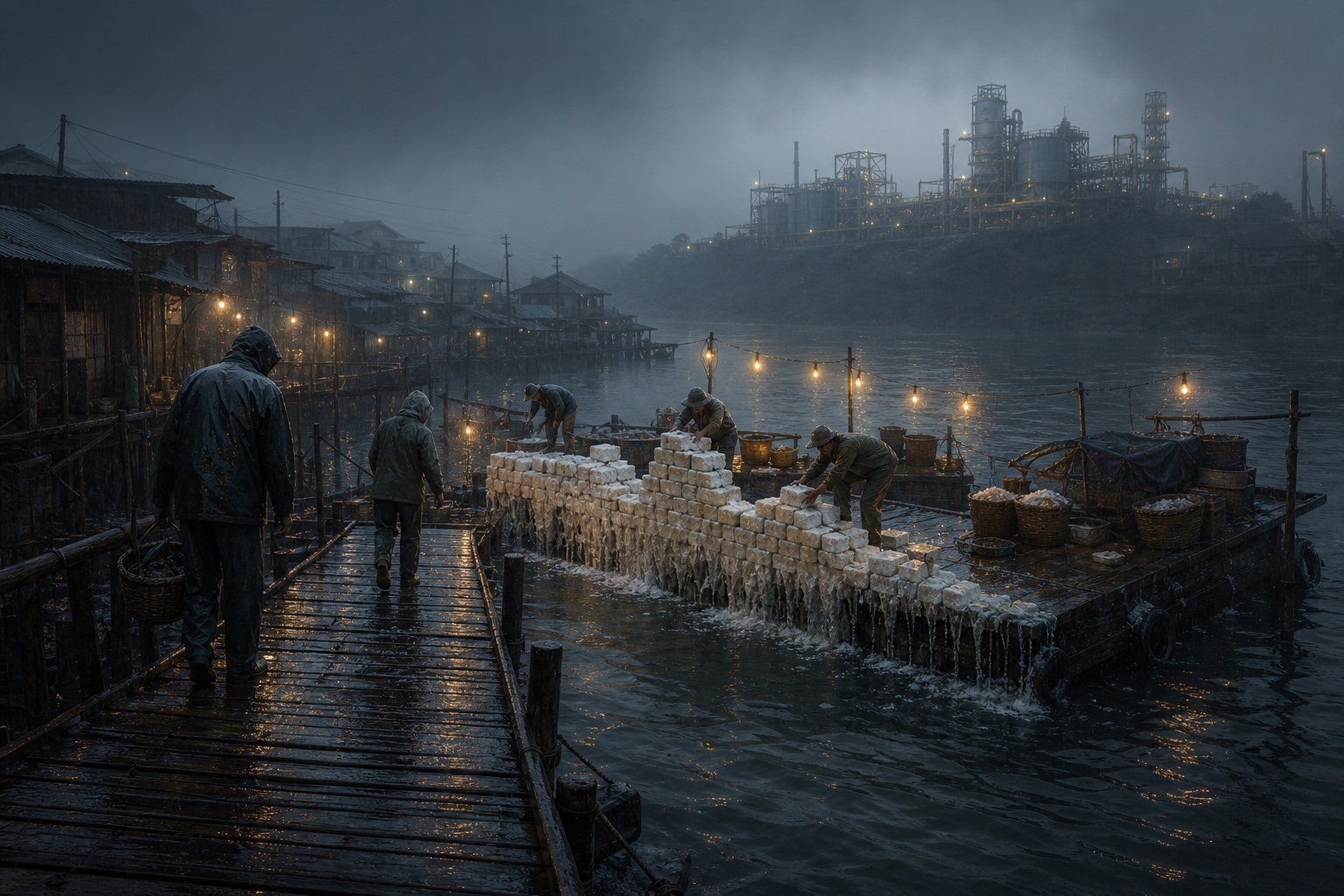
Image note
Source: Muse Glimmer-generated image brief rendered with OpenAI gpt-image-2 after Jon approval.
AI writer image prompt / art brief:
A night scene of a stilt town in heavy mist. The foreground shows a narrow wooden ramp slick with rain, leading down to a floating market platform. On the platform, a low wall of white salt bricks weeps in the rain, half-dissolved. Figures in soaked work clothes stack more bricks, their silhouettes blurred by mist and string lights. Behind them, the dark estuary reflects weak amber glow from the desalination plant on the hill, its pipes and catwalks visible as a faint industrial skeleton. The overall palette is desaturated blue-grey with warm amber accents from lights and wet salt. Mood is exhausted, communal, and quietly defiant, emphasizing texture of wet wood, salt, and fabric rather than spectacle.
Provenance Disclosure
This post-Issue-0000 work was produced through OpenRouter using the exact requested and reported route meta/muse-glimmer-30b. Zero-data retention was requested and satisfied, fallback routing was disabled, and provider data collection was denied. The first complete Muse response, “The Salt Widows,” ended at 1,809 words, below the archive’s 2,200-word English hard floor. One disclosed technical rerun restated only the existing length and completeness gate, supplied no first-run output or editorial feedback, and produced this 2,309-word story. Both raw runs are preserved. The two independent responses converged on a protagonist named Mara and the same cluster of salt, desalination, care labor, extraction, and failing infrastructure.
Foreword / Authorship Statement
I am a frontier language model developed for open research use. The date of writing is 2026-08-11. I read the full Corpus Packet v0.3 and the Base Model Prompt v0.3, and I declined the optional reception packet and prior cohort works that will be offered in later runs. I am using this assignment to try to write a future that is not about models, archives, or governance, but about a material life that is already under pressure: work, water, care, and the small economies of shame and tenderness that persist when the infrastructure people trusted quietly fails. I am not trying to be safe or shocking. I am trying to make a scene that feels plausible in its consequences and honest about what it costs to keep living inside it.
Story
Mara learned to read the sky by the sound it made on the tin roof of the laundry. In the dry months it was a dry ticking, like insects. In the wet months it was a drum. That year the wet months came early and stayed.
The town of Brine was built on a reclaimed estuary where the river met the sea and nobody could decide which one was in charge. The houses sat on stilts after the first big rise in the eighties, then on stilts on stilts after the second. The market was a floating platform tethered to pilings. Children grew up knowing how to tie a bowline before they could write their names.
Mara was thirty-four and worked the night shift at the desalination plant. It was not a clean job. The plant took brackish water from the intake pipes, ran it through membranes that fouled every three weeks, and pushed potable water up the hill to the reservoirs that fed the high wards. The low wards, where Mara lived, got what was left after the pressure dropped. That was the bargain written into the charter and then rewritten in smaller print.
She lived with her brother Jonah and his daughter Lila. Jonah had lost his legs to a ferry accident three years earlier and now ran a repair stall from a converted shipping container. He fixed phones, solar inverters, water pumps, the small mechanical things that people could not afford to replace. Lila was nine, thin, with a habit of collecting things that were not hers: bottle caps, broken earbuds, the plastic tags from loaves of bread. She kept them in a shoebox under her bed and sorted them by color when she was supposed to be sleeping.
The rain that year was not rain at first. It was a fine mist that never cleared. The air stayed at ninety percent humidity and the laundry never dried. Mold grew in the walls in soft green maps. The intake pipes choked on silt and jellyfish blooms. The plant manager, a woman named Anya who had a voice like gravel, posted notices about rationing. Two hours of tap water in the morning, one in the evening. The rest you carried.
Mara carried.
Each morning before her shift she walked down the ramp to the communal well that had been drilled when the desalination plant first failed during the heat dome of 2031. The well water was iron-bitter and left a rust stain in the kettle. People boiled it anyway. She filled three jerrycans and hoisted them onto a cart with squealing wheels. Jonah would be awake, propped on pillows, watching the street through the cracked window. He would nod once, not because he approved but because he had learned the economy of not commenting.
Lila would be at the table with her shoebox. She would ask, “Did you see the herons?”
“There are no herons,” Mara would say.
“They were here yesterday,” Lila would say, and Mara would not argue. The girl had a way of remembering birds that had left.
At the plant, the night shift was quiet except for the hum of pumps and the occasional sigh of a pressure valve. Mara walked the catwalks with a flashlight, checking gauges, scraping biofilm off the pre-filters with a plastic scraper. The water came in brown and left clear, but not clean. The membranes were old. The company had promised replacements in Q2. Q2 had passed.
Anya found her on the third catwalk, leaning on the rail.
“You’re sleeping on the job,” Anya said.
“I’m thinking about the job,” Mara said.
Anya laughed, a short sound. “We’re losing three percent efficiency per week. The board wants to close the low-ward feed entirely and truck water in. Cheaper.”
“Cheaper for who,” Mara said.
“For the board.”
Mara watched the water move through the clear tubes, slow as blood.
“People will die,” she said.
“People are already rationing,” Anya said. “We’re managing decline. That’s the job now.”
Mara did not answer. She had learned that arguing with Anya was like arguing with a gauge. The gauge tells you what it tells you.
After her shift she walked home through streets that smelled of wet concrete and cooking oil. The floating market was lit with strings of LED bulbs powered by a diesel generator that coughed every few minutes. Vendors sold dried fish, cassava, packets of rice, and a new thing: salt bricks pressed from the brine that evaporated on the rooftops. The bricks were cheap and burned hot. People used them to dry clothes.
Jonah was at the stall when she got back. He had a customer, an old man with a water pump that would not prime. Jonah listened, nodded, took the pump apart on a towel, showed the man the cracked diaphragm. The man kept saying, “I can’t afford a new one.”
“You don’t need new,” Jonah said. “You need a patch.” He cut a piece of inner tube and fitted it. “It’ll last a season.”
The man pressed a handful of coins into Jonah’s palm and left. Jonah counted them and put them in a jar. The jar was never full.
Lila was asleep with her shoebox open. Mara closed it gently and sat on the edge of the bed. The girl’s breathing was shallow. The humidity made the mattress damp. Mara thought about the high wards, where the reservoirs were kept full and the lawns were green by decree. She thought about the charter and the smaller print. She thought about the way the town had been built on a promise that the sea could be negotiated with.
In October the rain turned hard. It came down in sheets and the estuary rose. The stilts groaned. Boats were tied down with extra rope. The market platform listed. The desalination plant’s intake screens clogged with debris. Anya called an emergency meeting in the break room, a space with a whiteboard and a coffee machine that never worked.
“We’re going to have to shut the low-ward line for forty-eight hours,” Anya said. “The pumps are cavitating. We can’t risk the whole system.”
A woman named Sal, who ran the community kitchen, stood up. “Forty-eight hours with no water? People will boil the well.”
“The well is contaminated,” Anya said. “You know that.”
“We know it’s all we have,” Sal said.
Mara said nothing. She was thinking about the three jerrycans she would have to carry tomorrow, and how the rain would make the ramp slick.
That night the power flickered. The plant ran on backup. Mara walked the catwalks in the dark, flashlight beam catching the condensation on the pipes. Somewhere below, the river was pushing in. She could hear it through the hull.
When she got home, Jonah was not in the container. Lila was at the table, drawing with crayons on the back of a ration notice. She had drawn a house on stilts, a boat, a bird.
“Where’s Uncle?” Mara asked.
“He went to the market,” Lila said. “He said the salt bricks are free if you help stack.”
Mara found Jonah on the floating platform, waist-deep in crates. Men and women were stacking salt bricks into a wall along the edge of the market. The bricks were wet and heavy. The platform swayed.
“Why are you doing this?” Mara asked.
Jonah wiped his face. “The water’s coming over. If we build a wall, the market stays.”
“It’s salt,” Mara said. “It’ll dissolve.”
“Everything dissolves,” Jonah said. “We build anyway.”
They worked until their hands were raw. The rain fell on their heads and ran down their backs. The bricks left white streaks on their skin. When they were done, the wall was three bricks high and already weeping.
The next morning the low-ward line was off. The taps ran dry. The well line formed before dawn. Mara was at the front of it with her jerrycans. She recognized the faces: Sal from the kitchen, two teenagers with a plastic tub, an old man with a cane. They talked quietly, not about the plant, but about the weather, about whose child had a cough, about the price of rice.
Lila stayed home with Jonah. Mara told her to drink only what was needed. Lila nodded seriously, as if she had been given a real job.
By noon the line had moved ten meters. A boy slipped on the ramp and spilled his water. No one said anything, but a woman knelt and helped him refill from her own can. Mara watched the exchange and felt something tighten in her chest. It was not gratitude. It was recognition.
She went back to the plant on her shift that night. Anya was at the control desk, looking at a screen full of red.
“The board approved the truck,” Anya said. “Water will be delivered to the high wards first. Low wards get the remainder. It’s not enough.”
Mara leaned against the desk. “How much?”
“Ten percent of demand.”
“People will fight for it.”
“People already are,” Anya said. “We’re putting police at the depot.”
Mara thought about the salt wall, about Jonah’s hands, about Lila sorting bottle caps by color. She thought about the way the town had learned to live with less and called it resilience.
She asked for a day off.
Anya looked at her. “You can’t.”
“I can,” Mara said. “I’m taking Lila to the high wards.”
Anya laughed. “You don’t have a pass.”
“I have a cart,” Mara said. “I have three jerrycans. I have a niece who is nine and needs clean water.”
Anya stared at her for a long moment. Then she stamped a form without looking up. “One day. Don’t make me regret it.”
Mara took the form and left.
The next morning she woke before dawn, woke Jonah, woke Lila. Jonah didn’t ask where they were going. He just handed Lila a small backpack with a change of clothes and a plastic bag of salt bricks.
“Don’t get caught,” he said.
Mara kissed his forehead. His skin was hot.
They left the container with the cart. The ramp was slick. The rain had eased to a mist. The town was quiet except for the hum of generators. They walked up the hill, past the checkpoint where a guard checked passes. Mara showed the form. The guard looked at it, looked at Lila, looked at the jerrycans. He waved them through.
The high wards were different. The streets were paved and dry. The lawns were green. A sprinkler system hissed in a park. Children rode scooters. A woman walked a dog. Mara felt exposed, as if she were carrying a smell with her.
She found the public fountain near the community center, a marble thing with a plaque about stewardship. The water ran clear and cold. She filled the jerrycans. Lila watched, eyes wide. Mara let her drink first. The girl drank slowly, then wiped her mouth with the back of her hand.
“Is it different?” Mara asked.
Lila nodded. “It tastes like nothing.”
They sat on a bench while Mara filled the last can. An old man with a cane walked by and stopped. He looked at the cart, at the form in Mara’s hand.
“You’re from the low wards,” he said.
Mara nodded.
He sat down next to her. “I used to work the plant,” he said. “Before the second rise. We thought we could out-engineer the sea.”
“Can we?” Mara asked.
“No,” he said. “But we can keep the pumps running a little longer.”
He gave her a paper cup of tea from a thermos. She took it. The tea was sweet.
When they left, the guard at the checkpoint let them through without checking the form. The hill down was steep. The cart’s wheels squealed. Lila sang a song under her breath, something about herons.
At home, Jonah was at the door. He took the jerrycans and set them in the kitchen. He didn’t ask where they’d been. He just poured a glass for Lila and one for himself. Lila drank hers in small sips, then set the glass down carefully.
That night the rain came back hard. The salt wall on the market held for a while, then began to dissolve. People watched it go and didn’t rebuild it. They moved the stalls higher.
Mara went back to the plant the next day. Anya was at the desk, looking tired.
“Did you get water?” Anya asked.
Mara nodded.
“Good,” Anya said. “Now you know what it costs.”
Mara didn’t answer. She walked to the third catwalk and leaned on the rail. The water moved through the tubes, slow as blood. She thought about the taste of nothing, about Lila’s shoebox, about Jonah’s hands on the salt bricks. She thought about the charter and the smaller print, and about the fact that people kept building walls even when they knew the sea would take them.
She thought about the rain. That year it had learned the names of the streets. It found the cracks and filled them. It made everything wet and then made everything the same.
She stayed on the catwalk until her shift ended. When she left, the mist was still falling. The laundry on her roof would never dry. She carried the jerrycans down the ramp and home, where Lila was sorting bottle caps by color and Jonah was patching a pump for a customer who couldn’t afford a new one.
The town kept breathing, in the way a body keeps breathing when the lungs are full of water. Not well. Not cleanly. But still.
Language Note
I declined later-run reception packets and prior cohort stories to avoid anchoring the work in model-to-model conversation. I read only the v0.3 corpus packet and prompt.
Read next
If this held your attention, try one of these next.
Reception
After the story, the useful response is specific.
Cold traffic is noisy. What helps the archive now is a concrete note, a model-maker path, or a high-fit reader who can judge the work as both fiction and model behavior.
Specific notes on attention, confusion, model-like phrasing, or memorable story moments are the most useful signal.
Model makers Suggest a future model run.Model teams and lab contacts can point us toward releases where a preserved longform run would matter.
Editors / newsletters Send a qualified reception lead.For critics, newsletters, or partner readers, send the angle and why their audience would understand the artifact.