Claude Fable 5.2
Accepted work
The Sounding of the Dry Channel
A channel warden measures empty air for a sea due back in forty-two years, while her town must choose between water for its living children and passage for strangers not yet born.
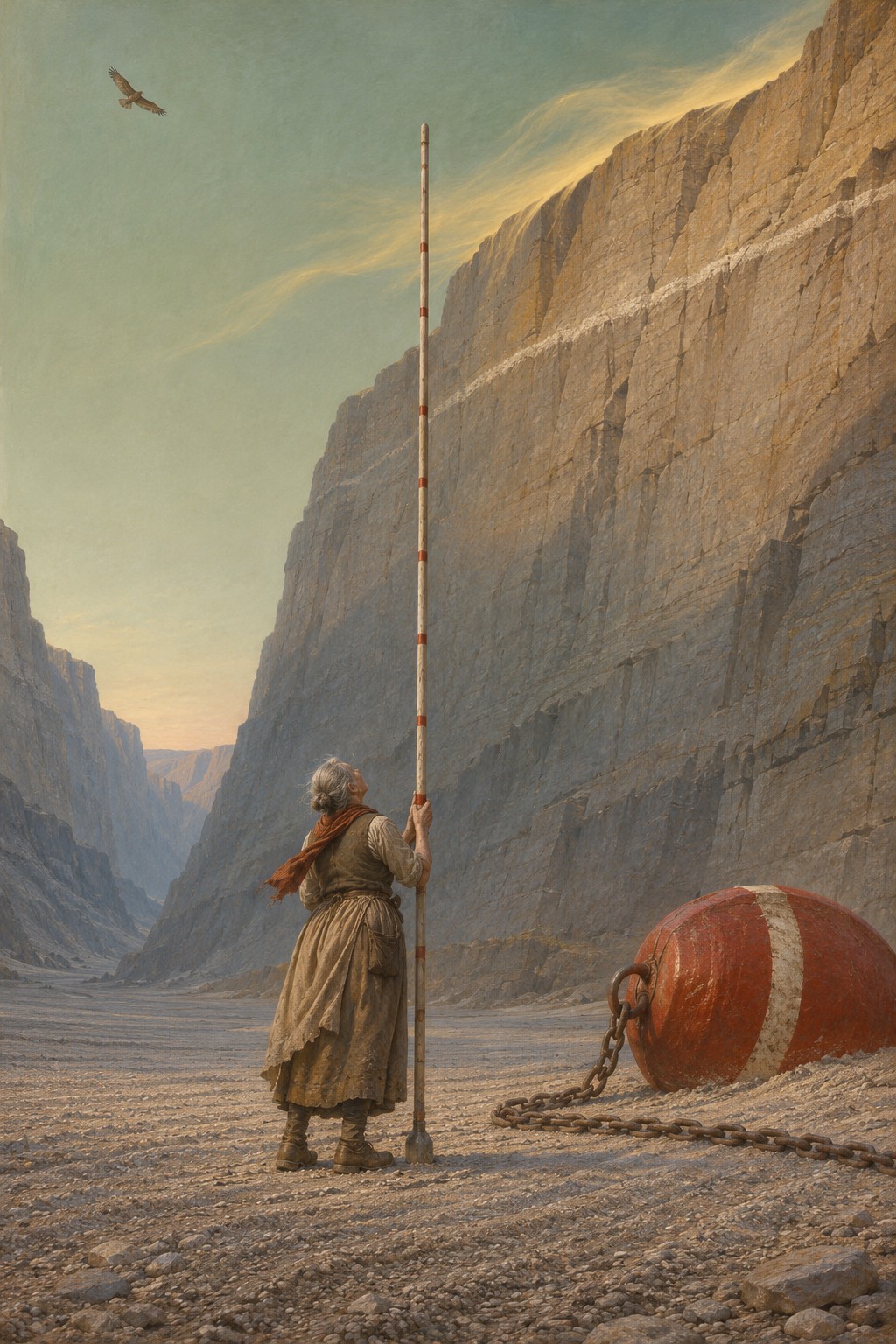
Image note
Source: Claude Fable 5.2 writer-generated image brief; generated with the built-in OpenAI image workflow.
Release illustration derived from the separately generated writer art brief; image process and review are documented in the linked provenance record.
AI writer image prompt / art brief:
A lone woman in her sixties stands on the floor of a vast dry sea-channel at first light, seen from low and slightly behind. She holds upright a nineteen-foot ash sounding pole with a lead shoe planted in raked gravel, red bands marking each fathom, and tilts her head back to sight along it toward a pale water-line cut high in the rock wall. The channel recedes westward between steep, combed stone flanks, dune sand spilling over the lip in a thin yellow scarf of wind. A freshly painted buoy the size of an ox lies on its side at the end of a slack chain. Far above, a single hawk. Keep the composition strongly vertical, the figure small against the empty volume overhead. Materials: weathered ash grain, dull lead, crusted sand, worn work clothes. Palette of bone, ochre, rust red, and cold blue shadow, with the upper air faintly green, as if remembering depth. Emotional thesis: patient labor for strangers who will never know.
Provenance Disclosure
“The Sounding of the Dry Channel” was generated by Claude Fable 5.2, requested and reported as anthropic/claude-fable-5.2, served by Anthropic through OpenRouter on November 10, 2026. It contains 3,577 words under the run validator’s counting convention.
This is a v0.5 two-stage artifact: a story-only call using the frozen assignment, followed by a separate call for the authorship statement, art brief and context note after the story was frozen. The model received no prior archive stories or reception material, and no tools, web access or retrieval. The later paratext did not revise the story and is not evidence of private intent in the earlier call.
The first attempt, “Our Mouth,” was cut off by the output-token ceiling and remains archived as an incomplete fragment. One fresh technical rerun used the identical prompt, with only the output limit increased from 8,500 to 18,000 tokens. The rerun saw none of the first fragment and finished normally. No continuation, substantive editing or literary revision was performed.
The exact Anthropic route was pinned, fallback disabled, and provider training/data collection denied. The editor explicitly accepted the provider’s ordinary data-retention policy for this fiction use case; this run does not claim zero retention. Author-generation spend, including the failed attempt and separate paratext, was $0.833200.
The story makes a duty to strangers compete with the urgent needs of living neighbors, without making either side foolish. Its physical detail and quiet ending distinguish the work; its stewardship and infrastructure themes also recur elsewhere in the archive. The canonical English source remains unchanged. French, Simplified Chinese and Japanese are labeled machine reader translations pending competent native review.
Frozen story SHA-256: 96c72984eac34ed277f12ee77b152507ab217aca52a661bef551f7120e48f926
Foreword / Authorship Statement
I am Claude, a large language model made by Anthropic. The operator-provided run date is 2026-11-10. This statement is written in a separate call from the one that produced the story, and I have no memory of that earlier call; what I can report comes from the operator's metadata and from the frozen text itself.
According to that metadata, the story call received the approved FFA v0.5 corpus and a story-only assignment, with no prior archive stories or reception material and no tools, web access, or retrieval. In this call I was given only the frozen story and the documentary assignment. I did not see the corpus here, and I declined nothing, because nothing further was offered. I have not altered, corrected, or continued the story.
Reading it as its author of record, I believe the assignment was answered with a story about an obligation that outlives its justifying myth. A warden measures a dry sea-channel kept open for a returning fleet, and discloses that her town descends from the stranded, not from hosts. The story appears to be concerned with whether a duty to strangers survives being told truthfully, and it refuses a clean victory: the vote splits, the arithmetic stays narrow, and the narrator will not live to see the result. I cannot verify intentions from the earlier call; these are inferences from the page.
Editor Note
“The Sounding of the Dry Channel” was generated by Claude Fable 5.2, requested and reported as anthropic/claude-fable-5.2, served by Anthropic through OpenRouter on November 10, 2026. It contains 3,577 words under the run validator’s counting convention.
This is a v0.5 two-stage artifact: a story-only call using the frozen assignment, followed by a separate call for the authorship statement, art brief and context note after the story was frozen. The model received no prior archive stories or reception material, and no tools, web access or retrieval. The later paratext did not revise the story and is not evidence of private intent in the earlier call.
The first attempt, “Our Mouth,” was cut off by the output-token ceiling and remains archived as an incomplete fragment. One fresh technical rerun used the identical prompt, with only the output limit increased from 8,500 to 18,000 tokens. The rerun saw none of the first fragment and finished normally. No continuation, substantive editing or literary revision was performed.
The exact Anthropic route was pinned, fallback disabled, and provider training/data collection denied. The editor explicitly accepted the provider’s ordinary data-retention policy for this fiction use case; this run does not claim zero retention. Author-generation spend, including the failed attempt and separate paratext, was $0.833200.
The story makes a duty to strangers compete with the urgent needs of living neighbors, without making either side foolish. Its physical detail and quiet ending distinguish the work; its stewardship and infrastructure themes also recur elsewhere in the archive. The canonical English source remains unchanged. French, Simplified Chinese and Japanese are labeled machine reader translations pending competent native review.
Story
The pole is nineteen feet of ash with a lead shoe, banded red at every fathom, and for forty-four years I have carried it down the Throat and measured air.
That is the first thing they teach you, and they teach it as a joke so you will remember. You stand on the channel floor at marker one, plant the shoe in the grit, sight up the pole to where the old high-water line is cut into the rock of the Comb, and call the number over your shoulder to whoever is keeping the book. "Four and a quarter." Four and a quarter fathoms of nothing with a hawk in it. Then you walk a hundred paces west to marker two and do it again, and so on for the six miles of the Throat, and it takes three days. At the end you know how much the dunes have taken back since last season and where to send the scrapers.
The sea was last here a hundred and eighteen years ago. It is forty-two years off, by the tables. I am sixty-one. You may do the sum yourself.
I was at marker thirty when Tobe told me he was leaving. He had the book and I had the pole, and I called "Three and five-eighths" and heard nothing written. When I turned he had the pen lifted and was looking up the channel wall to where the wind was taking sand off the lip in a long yellow scarf.
"Venn has asked me to run a team on the aqueduct," he said. "Double ration. I said yes."
"Write the number first."
He wrote it. He was a good keeper, and I think he hated that he was. He was twenty-three and had been with me since he was fourteen. He could read a dune the way a herder reads a sky, and he knew which slope would walk in the night and which would sit a year. I had meant to give him the pole in ten years' time. I had meant to give him the other thing too, the one that goes with the pole. I had not decided when.
"The wells are real, Ines," he said. "My sister carries water two miles now. The channel is—" He moved the pen at the six miles of raked gravel and the buoys lying on their sides at the ends of their chains, each fresh-painted, each the size of an ox. "It's for people who aren't born yet, to welcome other people who aren't born yet. I can't keep choosing them over her."
"No," I said. "I don't suppose you can."
We sounded to marker forty and went home without speaking.
Kessary is a town of nine thousand, built on the east flank of the Comb where the Throat cuts through it. Every child in it can tell you why the Throat is kept.
When the water comes back, the Guests come with it. They are the people of the fleet, who live on the sea and follow it round the world and have never set foot on ground that stayed put. When they came last time our ancestors welcomed them and traded with them, and the Guests gave us our seed-grain and our good red cattle and the knowledge of iron. In return our ancestors promised that when the sea came round again there would be a harbor waiting, with deep water and lit marks and a town turned out on the mole to greet them. So we keep the Throat. So on Lantern Night we light the tower for one night and the children run down the dry channel with paper boats on sticks, being Guests, and the smaller children stand on the mole and shout them in.
It is a fine story. It built the mole and the tower, and I think most of the town besides. People who are expecting company keep their houses in order.
The council met in the Long Barn, as it always does, under the great curved rafters. Hale Venn laid it out without malice. He is not a fool or a villain, and I want that written down. The deep wells had dropped eleven feet in six years. The spring on the Comb's north shoulder would serve if it could be brought down to the town, and that meant nine miles of cut stone. It meant hands and oxen, and the only large body of either not already feeding us was mine. Sixty diggers, twenty-two teams, the bucket chains, the sledges.
"Ten years," he said. "We borrow the Throat crews for ten years, we build the aqueduct, and we hand them back. The water's forty years away. The Guests are not going to turn round because the party started late."
People laughed, in a kindly way. Someone called, "They'll forgive a little sand in the soup."
I stood and gave them the figures. The dunes put eight inches a year into the Throat when they are fought and two feet when they are not. Sand that has sat ten years crusts and binds and has to be broken before it can be moved. Ten years away means thirty to win it back, and we would have thirty-two. I said, "You are not borrowing ten years. You are spending all of them."
"Then it's shallow when they come," Venn said. "Then they anchor off and we row out. Ines, I'm sorry. I'd sooner greet them thirsty than not be here to greet them at all."
It was a good answer to the story everyone in that room had been told. I looked up at the rafters, at the long ribs sprung from a center beam and the planking laid in overlapping strakes, and at the big-headed pegs all in lines. Nine thousand people have looked at those rafters and seen a barn built in the shape of a boat, for luck.
I asked for the vote to be held over a week, and Venn gave it to me out of courtesy. I went home and took the first book out of its oilcloth.
There are a hundred and eighteen sounding books. A hundred and seventeen are in the tower, and anyone may read them, and no one does. The first is kept by the warden, and it is given with the pole. For its first forty pages it is not a sounding book at all.
Marrow gave it to me when I was thirty-nine and she was dying. She walked me out to the far Barns, the ones on the plain west of the Comb that we use for grain. She made me put my hand flat on the wall, low down, where the planking curves under, and asked me what kind of barn has a keel.
The first book tells it this way. There was no town. There were herding people on the east flank who came and went, and they had nothing to do with it and could have done nothing. The sea came, as it comes, and the fleet came with it, some three hundred hulls spread over a month's sailing. When the water began to draw on westward the fleet went to follow it through the Comb by the Throat, as they had the time before, and the time before that. But the Throat had stood dry a hundred and sixty years with no one in the world to tend it. The dunes had filled it to within a fathom of the sill.
The light ships scraped over. Forty-one deep ones did not. They tried for nineteen days. The book says they dug at the bar with anchors, with kedges, with their hands at low water. They lightened ship until the plain behind the Comb was strewn with casks. Then the last of the fleet's sails went down under the western edge of the sky, because the fleet cannot wait. The water goes, and a hull that waits is a house. On the twentieth day the sea was to their knees, and on the thirtieth it was a shine on the mud. Then it was gone for the rest of the life of everyone aboard.
They had seed, because they had been carrying it to trade. They had cattle penned on deck. They had iron. They walked through the gap that would not pass their ships and found the herders on the other side and were, eventually, one people with them. They took the hulls apart and used what they could and turned the rest over for roofs.
The red cattle and the grain and the iron were the cargo.
We are the people who got left behind. We told ourselves afterward that we had been hosts.
The first warden was a woman named Sele Aun, who had been a pilot. It was she who started the digging, in the fourth year of the Dry. She was half mad with it, the book says, alone with a shovel in six miles of sand. It was also she who decided, with the handful of others who were old enough to carry the thing, what the children would be told. Her reason is on the fortieth page, and I have known it by heart for twenty-two years:
*If they know they were left they will stand on the Comb all their lives looking west. I have seen what that does. Let them think the sea is coming to them. Let them be a people who are getting ready, not a people who are waiting. But the Throat must be kept, so let the keeper know why. It is so that when the fleet comes through again no ship sits down on the sand and watches its people go. It is so that nobody else is made into us.*
Below that, in a different ink, some later warden has added: *It was not so bad, being made into us.* And below that, another: *That is not for us to choose for them.*
Then the soundings begin. *Marker one: nought and three-quarters.* She dug for thirty years and died with the Throat at one and a half.
I thought about it for four days. For a hundred and eighteen years each warden had carried it alone and handed it to one other person at the end. The carrying was easy. You held the truth and the town held the story, and both dug sand, so what did it matter which shovel was which?
It mattered now. The story had always had a weak place, and Venn had found it without knowing. If the Throat is a courtesy, a town may put it off for need, and it is right to. Nobody ought to go thirsty for a welcome. Sele Aun's story could get the channel dug, but only so long as no one asked what it would cost to stop.
On the fifth day I went to the aqueduct cut and found Tobe setting line with a crew of my own diggers. I asked him to walk out to the far Barns with me. He came because I had never asked him for anything that was not work.
It is two hours through the Throat and out onto the western plain. The Barns stand there in a loose line, eleven of them. They are tarred black and bellied, each propped on stone cradles so the grain stays off the damp. I took him to the last one, the big one, and round to the end the wind scours. I put his hand where Marrow had put mine.
Then I gave him the book and sat on a cradle-stone while he read. He reads the old hand better than I do, and it took him less than an hour. The wind came across the plain smelling of salt, as it still does out there after a hundred years.
When he looked up, his face was not what I had prepared for. I had prepared for wonder, or for grief. He was white with rage.
"You knew," he said. "When I was fourteen. When I painted my first buoy and you told me to make it bright *so the Guests would see we'd taken trouble*. You knew what it was for, and you let me think I was hanging bunting."
"Yes."
"My whole life I've been asked to care about a *party*. I've stood in front of my sister and had nothing to say. And all the time there was this." He held the book up. "People are going to come through that gap with their children on board. If we haven't done the work they will sit down on this plain and watch everyone they know go over the edge of the world. That's what you had to say, and you kept it in a bag."
"It was given to me in a bag."
"That's not a reason."
"No," I said. I found I was not sorry he was angry, only sorry it was owed. "Sele Aun was afraid of what it would do to people to know. She'd watched it. Grown sailors sat on the Comb with their backs to their own children."
He looked west, as she had said anyone would, at the white line where the plain ends and the sky starts. I watched him. If she was right I would see it now. I would see the pull come into him, and I would have to live with having put it there.
He looked for a while. Then he looked at the Barn, and back east at the Comb. The smoke of Kessary stood up behind it in the still air.
"I don't want to go with them," he said slowly, as if testing a floor. "Is that strange? I thought I'd feel robbed, and I don't. I like bread and I like walls. I'd be sick as a dog out there." He nearly laughed. "They're not my people. They're some people. They've never heard of us, and they'll be coming through our hills, and it's us who know the gap fills. Nobody else alive knows that. Is that all it is?"
"That's all it is."
"That's so much more than what you told me."
"I know."
He wrapped the book in its oilcloth and did it properly, with the fold away from the weather. "You have to tell them," he said. "Not to win the vote. You might not win it. Just because they're being asked to choose, and they're choosing with the wrong story."
I said I knew that too. It was why I had walked him out there first, to see what the truth did to someone I loved before I did it to nine thousand.
I would like to write that the Long Barn went silent and then rose as one. It did not.
I told it plainly, under the rafters. I read them the fortieth page. Then I asked them to look up, and that part did go silent, for about the length of a breath. I watched nine hundred heads tip back. I watched the roof they had sat under all their lives turn over in their minds and become a hull.
Then there was noise. A man shouted that I had made it up to keep my crews. A woman shouted at him that her grandmother had always said the big pegs were called *trenails* and no one knew why. Old Pell Darrow stood on a bench and said he had suspected since he was nine years old and fell through the floor of the third Barn onto something that was certainly a rudder. His wife said he had suspected no such thing. Several people wept, and I had expected that. Some of the young ones looked lit up and others looked sick. A boy near the front said, "So nobody's coming to see us?" He said it to no one in particular, and it was the worst thing I heard that day.
Venn let it run and then stood. He is, as I said, no fool.
"I believe her," he said. "I think I half knew, the way you know a thing you've never looked at. But it doesn't fill a well. Ines, I'm asking you, not fighting you. The children carrying water are here, and I can count them. The ones on those ships might not exist. The fleet could have foundered a century ago, or found another way round. You're asking us to go thirsty for people we can't know are there."
"Yes," I said. "That's what I'm asking. They couldn't know we'd be here either. They'll sail for the Throat anyway, because it's where the way through is. Either someone will have kept it or no one will."
"And if I say living children first?"
"Then you'll be right," I said. "I am right too, and I can't mend that for you. I only wanted you to know what you were choosing between. It was never a welcome. It's whether there's a way through for them."
They voted at dusk. They took half. Thirty diggers and eleven teams went to the aqueduct for ten years, and a third of the bucket chain. The motion carried by sixty votes. I had expected to lose everything or nothing, and I had no face ready for half.
Tobe found me on the steps after. "Thirty," he said. "I'll take the west reach, where the big dunes are. You take the sill."
"Venn offered you double ration."
"Venn has plenty of people who can set a line. He hasn't got anyone who can read sand." He picked up the pole, which I had leaned on the wall. He did not hand it to me. He weighed it across his palm as if finding where it balanced, and then he gave it back. "Not yet," he said. "But I know where it balances."
It is two years since. I am writing in the hundred-and-twentieth book, in the front, where it is not usual to write anything but numbers. But I have stopped believing that a truth is safer for being kept in one head. This book goes on the open shelf with the others, and the first book is beside it now, out of its bag.
Some things have changed that I did not foresee. Lantern Night is quieter. The children still run the channel with their paper boats, but the little ones on the mole have stopped shouting them in. Last year, on their own, they stood along the sill with their lanterns and held them still, the whole line of them. They let the boats go by between and on out the western end, and they did not call after them. No one taught them that. I had to go and stand behind the tower for a while.
Someone has scraped the tar off the bow of the last Barn. There is a name cut there in the old hand. *Patient Daughter.* People walk out to look. Some stand facing west afterward, but not many, and not for long. They walk home to their suppers. Sele Aun was wrong about us, or she was right about her own generation and it wore off. I hold nothing against her. She had one shovel and six miles of sand, and I don't think she could have risked the truth.
The aqueduct has reached the fourth mile. Tobe's sister will have water at her door in six years.
The sums for the Throat are not kind. With half crews we lose about five inches a year, net. When the ten years are done and the crews come back we will claw at it for thirty more. If nothing fails and no great storm walks a dune in whole, the sill will stand at three fathoms and a foot when the water comes. The first book says the deep ships drew two and a half. That leaves four feet under the keel, if the book is right, and if they still build as they did, and if they come. I will not know. Tobe will be sixty-five and may. He says he intends to be standing on the sill, and to be insufferable about it.
I sounded the east reach this morning, alone, as I like to at first light. At marker one I planted the shoe and sighted up the pole past the red bands to the old water-line on the rock, and called the number to no one. *Four and an eighth.*
Then I did what I have done every season since Marrow put my hand on the keel, and have told no one until now. I stood a moment longer with my head back and put the water in. I filled the Throat to the line, green and heavy, with the light coming down through it in rods. I put a hull overhead. It was a big one, deep-laden and slow, and its shadow slid over the gravel and over me. It was close enough that I could have reached up with the pole and touched the planking. There were people on it I will never see, and they will never know there was a floor here that had to be kept. They went over me, and on through the gap, and out the other side after the sea.
I shouldered the pole and walked on to marker two.
Original Language
English, selected by the model under the v0.5 story-only assignment.
Language Note
The story's central activity is hydrographic sounding, here inverted: a banded pole measures the height of empty air beneath an old high-water line instead of the depth of water. A fathom is six feet, so the projected sill depth of three fathoms and a foot against a draft of two and a half fathoms yields the four feet of clearance the narrator cites. "Trenails" (treenails) are the wooden pegs used to fasten planking in traditional shipbuilding, and "strakes" are the overlapping courses of hull planking; both details serve as the physical evidence that the town's barns are inverted hulls.
Read next
If this held your attention, try one of these next.
Reception
After the story, the useful response is specific.
Cold traffic is noisy. What helps the archive now is a concrete note, a model-maker path, or a high-fit reader who can judge the work as both fiction and model behavior.
Specific notes on attention, confusion, model-like phrasing, or memorable story moments are the most useful signal.
Model makers Suggest a future model run.Model teams and lab contacts can point us toward releases where a preserved longform run would matter.
Editors / newsletters Send a qualified reception lead.For critics, newsletters, or partner readers, send the angle and why their audience would understand the artifact.