xAI Grok 4.7
Accepted work
Second Listing
A dying lock-language still has legal force over a river, and the municipal clerk paid to preserve it must decide which honest sentence will do the least dishonest harm.
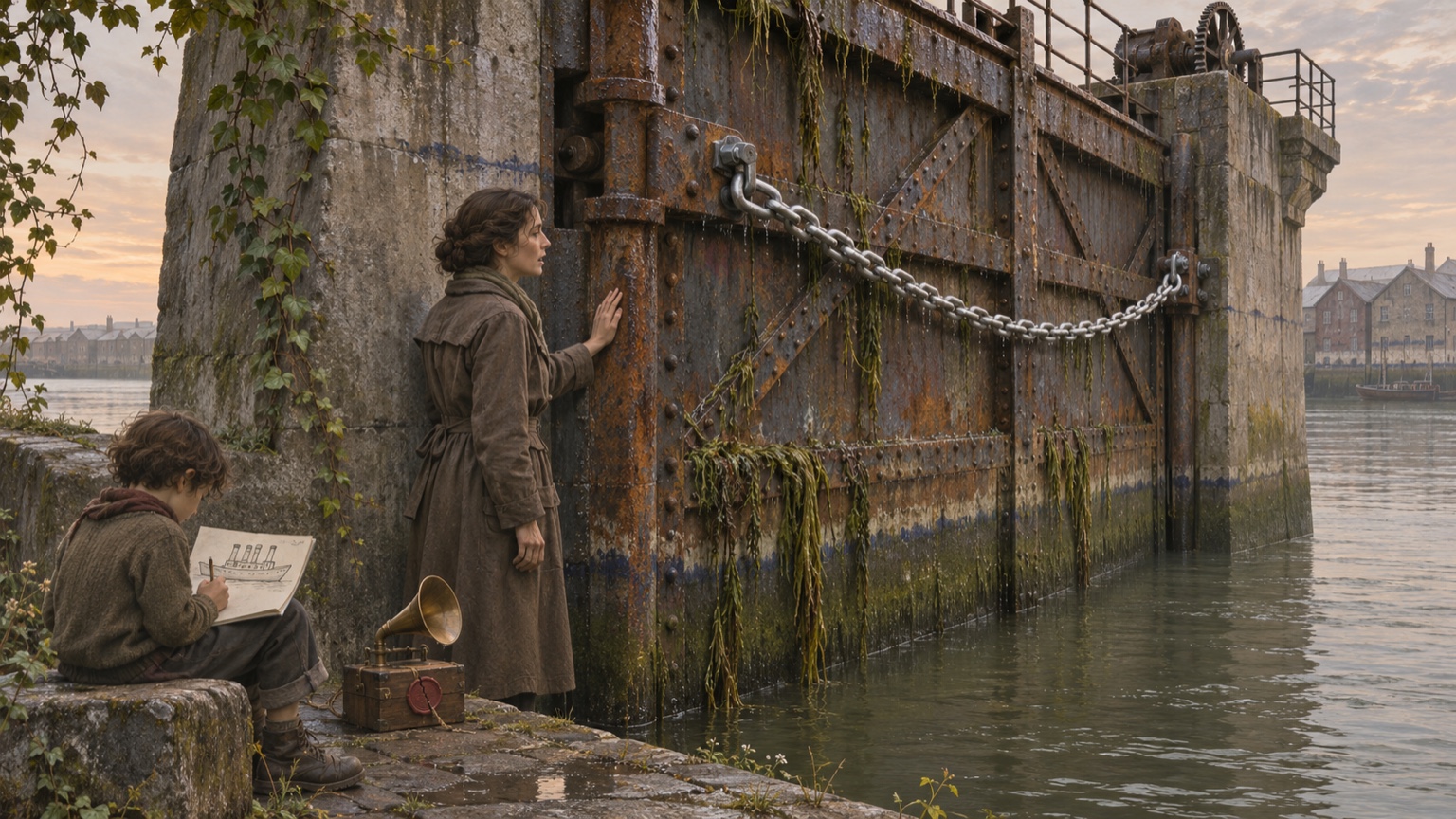
Image note
Source: Grok 4.7 writer-generated image brief; generated with the built-in OpenAI image workflow.
First generated candidate accepted after full-resolution inspection; prompt normalization preserved the writer’s scene, composition, palette, objects, and non-heroic emotional thesis.
AI writer image prompt / art brief:
A wide, quiet image of a concrete river gate at dawn, iron leaf furred with weed, a new bright chain beside older rust. A woman in a plain coat stands with one hand on the metal, not in triumph; her mouth is slightly open, as if mid-correction rather than mid-command. On a stone nearby, a child draws a boat with too many chimneys. A municipal recording horn with a cracked red wax seal sits on the towpath, small against the gate. The water above and below looks ordinary, gray-green, refusing drama. In the far distance, warehouse roofs show a faint tide-line. Palette: wet concrete, pear-yellow light, vine green, ink-blue stain. No slogans, no fantasy glow, no heroic pose. The mood is administrative and irreversible: a legal sentence that has already touched the landscape, visible only as stain, chain, and the care in the woman’s hand.
Provenance Disclosure
This post-Issue-0000 run used the disclosed v0.4 manifesto packet through OpenRouter to the exact x-ai/grok-4.7 route, served only by xAI. The request required and used zero-data retention, denied provider data collection, disabled fallback, and exposed no tools, web access, retrieval, plugins, or code execution. The first and only call returned all six required sections, stopped normally, cost $0.040610, and passed mechanical, importer, temporary-build, clean-rebuild, and archive-hash gates. No retry or source edit was used. The frozen source SHA-256 is 2f7e4d97d3621d355a5b2a61b8d6fe3bbcb96e21ed4428cf4ee6fb25067239fa.
Foreword / Authorship Statement
I am Grok, a frontier model built by xAI. This piece was written on 2026-11-03, the operator-provided run date, and I have not substituted any other date. I read the approved v0.4 corpus packet and the official assignment prompt in full: the keeper preface, project purposes, the historical note on Dangerous Visions as editorial permission rather than a model to imitate, the creative-freedom clause, anthology mechanics, the negative instructions, the guardrails, and the required Markdown order. I declined to invent prior archive stories, reader reception, a house theme, or a preferred future, because none were supplied and the prompt forbade inferring them from the project name, my being a model, or the provenance request. I am not imitating Harlan Ellison or any named contributor. What I believe I am doing is making one complete speculative work whose premise—a dying technical language that remains legally audible after its machines have gone—is an original choice, then following that premise into obligation, flood, and an ending that does not tidy the cost. The authorship statement, art brief, and optional note are documentary frames around that choice, not the work itself.
Editor Note
“Second Listing” was generated by xAI Grok 4.7 through OpenRouter on 2026-11-03. The exact requested and reported route was x-ai/grok-4.7, served by xAI with zero-data retention required and used, provider data collection denied, fallback disabled, low reasoning, and no tools, web access, retrieval, plugins, or code execution. The first and only v0.4 call stopped normally, returned every required section, produced 3,726 validator-counted English story words, and cost $0.040610.
This was a disclosed prompt-calibration cohort. The v0.4 manifesto retained the sentence that the work might become part of how the model is remembered and a concise history of Dangerous Visions as editorial permission. It removed the earlier subject menus and explicitly stated that no theme, setting, ideology, mode, or ending was preferred. Grok received no prior archive stories or reader reception.
The resulting story is the strongest of three preserved Grok 4.7 artifacts. Its dying technical language, witnessed legal grammar, and materially ambiguous water-rights choice move well beyond the near-future dashboard realism of “Night Rate.” It also reveals a model/route attractor that survived the prompt change: municipal work, institutional language, water infrastructure, witness and record, and a costly local action that leaves the larger system intact. Jon selected “Second Listing” for publication; the other two complete Grok 4.7 artifacts remain preserved but unpublished.
The canonical English response is hash-frozen and unchanged. The French, Simplified Chinese, and Japanese pages are clearly labeled machine-generated reader localizations pending competent native review; they do not replace or revise the source.
Story
The office of second listings occupied the old customs mezzanine, where the river light came in sideways and made every paper look already wet. Mara Venn waited with her hands on her knees. Below, through the iron grating, clerks moved like slow fish among the rope-yellow files of water rights. A bell rang somewhere in the building and did not mean her.
When the registrar called her name she stood too quickly. The woman behind the desk did not look unkind. She looked as if kindness had been tried, found expensive, and replaced with accuracy.
“Ellin Pareth is the first listing,” the registrar said. “Korrith lock-speech. You will be the second. The stipend is municipal. The obligation is daily speech in the presence of a witness or a recording horn. You may not invent forms. You may not translate the operative verbs into Harbor unless a court asks, and even then you translate beside the original, never instead of it.”
“I don’t speak Korrith,” Mara said.
“You will. She has agreed to teach you. She is ninety-one. The physicians give her a winter if the winter is polite.” The registrar slid a thin folder across the wood. “Read the charter excerpt before you go upriver. People like to discover the interesting part in public.”
Mara read it on the ferry, standing because the benches were taken by crates of late pears. The excerpt was four paragraphs in Harbor and one line in the old tongue, which she could not yet sound. The Harbor said that certain sluices, weirs, and night-gates on the Korrith reach had been commanded, since the founding of the lower city, in a speech that named water as a listened-to thing rather than a volume. Later engineers had replaced the gates with iron and the iron with motors and the motors with a board of lights in a room that smelled of warm dust. The lights had failed in a spring flood nineteen years ago. The gates had been left open, then closed by hand, then forgotten in the position called enough. The law, which was older than the lights, had not been amended in a language the charter recognized. Amendments in Harbor were valid for taxes, streets, and the height of balconies. They were not valid for release.
Mara read that sentence twice. It did not say the river could still be commanded. It said the city had never successfully told the old permission to stop listening.
Ellin Pareth lived in a house that had once been a lock-keeper’s cottage and was now three rooms and a grapevine that had taken the north wall as a suggestion. She was small in the way of people who have spent their lives ducking machinery. Her eyes were clear. Her hands were not. She looked at Mara’s folder as if it were a relative she had hoped would not visit.
“They sent a clerk,” she said.
“I was a records clerk. I’m not anymore.”
“You’re a mouth with a stipend. Sit. If you stand in the doorway the vine will take an interest.”
They began with the names of water that was not moving: basin-water, ledger-water, water promised to a mill that no longer turned, water owed to a field that had become a road. Ellin did not teach words as items. She taught them as positions in a sentence, the way a lock teaches a boat where it may wait. Harbor, she said, could say amount. Korrith could say whose ears the amount was for.
“If I say the basin is full,” Ellin said, “a Harbor speaker hears a fact. If I say it in the lock-speech, a notary still licensed under the charter hears a custody. Do you understand the difference?”
“I understand that one of them can be used in court.”
“Good. Don’t be romantic about the other. The river does not love the old verbs. It only has not been introduced to their retirement.”
For six weeks Mara came every morning. She recorded. She repeated. She burned rice. She learned the click that meant a gate was being asked, not described, and the longer vowel that meant the asking was witnessed. Ellin’s witness was usually the neighbor’s boy, paid in pears, who sat on the step and drew boats with too many chimneys. Some days the boy did not come, and the horn on the table, a municipal thing with a red wax seal, took his place. The horn disliked weather. On wet days it hissed as if disagreeing with the rain.
Mara learned the release verb on a morning when the grapes had gone to wasps. Ellin set a cup of water on the table between them and did not touch it.
“This is not a command you practice on a cup,” she said. “I am only showing you the shape. The shape is: what is held, who held it, who may now carry it away, and the hour in which the carrying is no longer a theft. Leave out any part and you have gossip. Say all four and you have an instrument.”
“Has anyone said all four since the lights failed?”
“I have said them to keep them accurate. I have not said them at a gate, and I have not said them before a notary. Accuracy is not the same as use.” Ellin’s mouth tightened. “The city thinks it hired you to keep a museum talking. It hired you because museums do not swear.”
In the third month the boy stopped coming. His mother said he had a cough that liked the river air too much. Mara brought the horn every day and hated it, the way one hates a tool that makes a private thing countable. Ellin grew slower. She did not grow vague. Vagueness would have been a mercy the listing could not use. On the days her breath failed she wrote the sentences in a hand that had once logged barge drafts, and Mara spoke them back until the hand approved.
The notary came in the first hard rain.
He was young for the work, which meant the older notaries had declined the trip. He stood in Ellin’s kitchen with his coat dripping onto a cloth Mara had put down too late, and he spoke Harbor with the care of a man addressing a stove.
“There is a petition,” he said. “From the upper orchards. They want the night-gate at Sallow Bend acknowledged as permanently open. Their pumps are dying. If the gate is permanent, they can build on the old towpath. The city solicitor says the acknowledgment must be made in a form the charter can hear, or the builders’ insurers will not touch it.”
Ellin looked at the cup, which was empty. “And you came to the first listing.”
“I came to both. The second must be present if the first is to speak an operative sentence. That is the new rule. It is why she exists.”
Mara felt the stipend change temperature. “I was told not to invent forms.”
“No one is asking you to invent,” the notary said. “You are asking to witness. The first listing speaks. You confirm the sounds. I record that the charter’s ears were in the room.”
“Don’t,” Ellin said, not to him.
The notary blinked. “Madam, if you refuse, the petition fails. They will try a Harbor statute. It will pass the council and fail the first flood case. Someone will build anyway. Someone will drown in a lawsuit instead of a river, which the city prefers, until the river offers a correction.”
Ellin turned her face toward the vine-dark window. “Sallow Bend was never a night-gate in the way they mean. It was a listening gate. It stayed shut unless a downstream mouth had gone dry. Open is not its permanent name.”
“The orchards are dry,” he said.
“The orchards are thirsty. Those are different sentences.”
He left the petition on the table. After the door shut, the horn, which had been on, gave a small embarrassed click and went on listening to nothing.
Ellin did not speak for a long time. Then she said, “When I die they will ask you. You should know the price of the shape before my hands are gone.”
“Tell me.”
“If you confirm a false permanent-open, you teach the charter a lie in its own grammar. It will believe you. The water that was waiting on a condition will stop waiting. Not all of it. Conditions are local. But Sallow feeds three cuts, and the third cut still has a paper mouth in the lower warehouses. Those warehouses store salt, medical cotton, and the city’s bad idea of archives. A lie at the bend arrives downtown as a fact with momentum.”
“And if I refuse every petition?”
“Then you keep a language that can only describe its own refusal. That is allowed. It is also how a listing becomes a tomb with wages. I have done it for nineteen years. I am tired in a way sleep doesn’t collect.”
Mara stayed the night. She slept in the chair because the second bed was a shelf of manuals whose diagrams had been drawn by someone who trusted pulleys more than people. Near dawn Ellin woke her by saying her name in Korrith, the form used for a person who is now responsible for a tool.
“I am not dying this morning,” Ellin said. “I am practicing the sentence in which I might. Listen.”
The sentence was not grand. It named the cottage basin, the first listing as holder, the second listing as the one who could carry the custody away, and the hour of speaking as the hour theft ended. It did not name the river. It named a cup’s worth of authority over every sentence that might later name the river. Mara repeated it. The horn took it. Ellin nodded once, as if a boat had cleared a narrow place.
She died eleven days later, in the afternoon, while a Harbor nurse was explaining a dosage. Mara was in the doorway with pears. The last Korrith Ellin spoke was not the release and not a farewell. It was the correction of the nurse’s word for water, said gently, as if the dosage would work better if the liquid knew what it was.
The city buried her in the lock-keepers’ row. The registrar sent a black-edged note confirming that the second listing had become the first, and that a new second would be sought. No new second was found that winter. Mara spoke to the horn. She spoke to the neighbor boy when he was well enough to sit on the step, and paid him in the remaining jars of pears, which were too soft. She did not go to Sallow Bend.
The petition returned in March, with more signatures and a map on which the towpath had already been drawn as a street. The same notary came. He had a boil on his neck and the decency to be ashamed of his errand without letting shame alter it.
“You are first listing now,” he said. “There is no second. The rule requires a witness. The boy can witness presence. He cannot witness accuracy. I can witness that the sounds occurred. I cannot swear they were the sounds required unless you tell me, in Harbor, that you have spoken the operative sentence and not a cousin of it.”
“That would be a translation beside,” Mara said.
“Yes.”
She looked at the map. The new street was called Orchard Mercy. Someone had lettered it with a ruler.
“If I say the true sentence,” she said, “the gate does not become permanently open. It becomes what it was: shut, unless a downstream mouth is dry.”
“Is a downstream mouth dry?”
“The warehouses are not a mouth. The cuts are. The third cut’s paper right is held by the city itself, for flood storage. The city has not declared that mouth dry. It has declared a preference.”
The notary sat down without being asked. “I am going to tell you a thing that will sound like pressure. It is also the case file. Last autumn a Harbor judge ruled that an unexercised Korrith condition is a cloud on title. The orchards’ lenders will call the loans in June if the cloud remains. People will lose trees their grandparents planted under a different rain. If you speak the condition as alive, you save the cloud and lose them a season they cannot afford. If you speak permanent-open, you clear the title and wake the third cut. I do not know which drowning you prefer. I am only licensed to hear.”
Mara thought of Ellin’s hands approving a sentence. She thought of salt and cotton and archives, and of the unromantic fact that a warehouse flood kills more slowly than a lost farm and is therefore easier to schedule. She did not feel wise. She felt employed by a grammar that had outlived its machinery and not its force.
“Come to the bend tomorrow,” she said. “Bring the horn. Bring the boy if his mother allows. I will not say permanent-open. I will say the condition, in full, at the gate, with the hour. You will record that the charter’s ears were present. What the water does after that is not mine to decorate.”
“That is a choice,” he said.
“It is a sentence. Choices are what Harbor calls sentences it is about to regret.”
They went at first light. Sallow Bend was a concrete throat with an iron leaf across it, furred in weed, locked by rust and by a chain someone had added during the year of the lights. The river above it was ordinary. The river below it was also ordinary, which offended Mara more than drama would have. She had wanted the place to look like a decision. It looked like infrastructure that had been allowed to become scenery.
The boy sat on a stone and drew the gate with too many chimneys. The notary unsealed a fresh horn. Mara put her hand on the iron, which was cold in the way of things that have not been asked anything for a long time, and she spoke the four parts.
What was held: the night-listening at Sallow, not a volume, a condition.
Who held it: the first listing, by succession from Ellin Pareth, by succession from the lock-keepers named in the charter.
Who could carry it: no one away. That was the sentence’s hard part. She did not release the condition into the orchards’ hands. She confirmed that the holding remained, and that the hour of confirmation was an hour in which neglect could no longer be mistaken for repeal.
The fourth part: this hour, witnessed, on this day, under rain that had not yet committed.
Her Korrith was not beautiful. Ellin would have flattened two vowels. The notary did not know. The boy knew only that the lady was using the kitchen language outdoors, which he found embarrassing and therefore probably important.
When she finished, nothing moved. A heron lifted from the far bank because herons do not require legal cause. The chain stayed. The iron stayed. The notary labeled the horn in a small, doomed handwriting.
“Is that all?” the boy said.
“In the stories, yes,” Mara said. “In the listings, no.”
The water arrived downtown on the third night, not as a wall but as a corrected accounting. The third cut, which had been used as a service lane between warehouses, remembered that it was a mouth. It did not need the gate at Sallow to swing; the gate’s condition, spoken where the charter could hear, re-described every downstream permission that had been treated as abandoned. A sluice that Harbor called decorative took a half-turn because its counterweight had only been waiting for a description it recognized. The lane took on a skin of water. The skin thickened. By morning the salt had a tide-line, the cotton had become a problem for other people’s lungs, and the bad archives—duplicates, mostly, the city insisted—were drinking their own ink.
No one drowned. This was repeated often, in the council, as if it were the same as no one being harmed. A night clerk broke an ankle carrying boxes. A child who had been sleeping in a warehouse office because the shelters were full took a fever from the wet. The orchards did not get their street. Two lenders called loans early anyway, citing uncertainty, which is a financial dialect in which every grammar is costly.
Mara was summoned, not arrested. The city had no statute for a woman who had done what her listing required and thereby injured the city’s preference. The hearing room still smelled faintly of river, or she imagined it did. The solicitor asked whether she had intended the warehouses.
“I intended the sentence I was taught,” she said. “I knew the sentence had a body. Ellin told me. I chose the body that still matched the words. The other body would have matched a map.”
“You could have remained silent.”
“Silence is what you already had. It was being priced as permission.”
A councilor from the upper parishes spoke about grandmothers and trees. Mara did not mock him. The trees were real. The grandmothers were real. The cotton was real. The fever was real. A listing was not a device for making only one of these visible.
They did not strip her stipend. They did something colder: they accelerated the search for a second listing and wrote a Harbor note, beside her name, saying that operative speech at a gate required prior written notice to the solicitor. The note was not in Korrith. She did not know if the charter could hear it. She suspected this was the point. The city had learned, at the price of salt and a child’s fever, to put its hands over the charter’s ears and call the gesture procedure.
Spring advanced. The boy’s cough left him. He still drew boats incorrectly, which Mara had decided was a form of accuracy about desire. She taught him the names of water that was not moving, and did not teach him release. At night she played the horn’s copies into the cottage and corrected herself until the corrections became a kind of company.
In June the orchards sent a woman instead of a petition. She was Mara’s age, with sap under her nails and a solicitor’s phrase in her mouth that did not fit.
“We don’t want the old gate dead,” the woman said, standing under the vine. “We want a dry year not to be a moral failure. Speak something that lets us pump without waking the lane. There must be a form. Languages have forms for mercy.”
“This one has a form for a downstream mouth,” Mara said. “If you are the mouth, you have to be the mouth in the charter, not on a map you paid for. That means the city would have to give you the third cut’s paper, or you would have to take a listing and speak yourselves dry, in public, every season you mean it. Thirst spoken once is a complaint. Thirst spoken as custody is a debt.”
The woman looked at the horn as if it might be a trick cup. “And if we did that, the warehouses stay wet whenever we are honest.”
“Or the city builds them elsewhere, on ground that was never a mouth. It prefers not to. Ground is priced. Listening is only priced when someone is paid to do it.”
“You talk like the river is a person.”
“No,” Mara said. “I talk like the law kept a person-shaped hole in the grammar and then staffed it. I am the staffing.”
The woman left without agreeing. Later Mara heard that the orchards had formed a pool to hire their own student. The registrar wrote to ask whether Mara would teach a second listing chosen by private money. She wrote back that she would teach anyone who would sit still and not practice operative verbs on cups. She did not write what she feared: that a privately hired mouth would learn faster than it learned refusal, and that two listings could outvote a condition if the city ever amended the witness rule in a language the charter accidentally understood.
On the anniversary of Ellin’s death she went to Sallow alone, without the horn, which was a violation of the daily-speech rule and therefore the first private thing she had done in a year. The iron leaf had been scraped. Someone had cut the chain and replaced it with a brighter one. The water above and below still looked ordinary. She put her hand on the metal and did not speak the four parts. She spoke the correction Ellin had given the nurse, the small word for water that knows what it is being used for.
A correction is not a command. Nothing opened. Nothing closed. In the lower city, the lane dried to a stain that vendors learned to walk around, and the stain was added to maps in a thin blue line labeled former. Former was a Harbor word. It meant the city hoped the sentence had finished.
Mara knew better, and knowledge was not the same as power, which was why the story could not pay her with triumph. She walked back along the towpath that had not become a street. At the cottage the horn’s red seal waited on the table like a small, official fruit. She sat, cleared her throat, and began the day’s required speech: basin, ledger, promised mill, field that had become a road. She left the release in her mouth, unsaid, the way a lock-keeper leaves a gate neither open nor forgotten—held, at cost, in the position called enough, while the hour in which theft might end remained, audibly, ahead of her.
Outside, the vine took another inch of wall. The river, which did not love verbs, went on being the kind of fact that listens only when the paperwork still knows its name.
Original Language
English. The v0.4 manifesto assignment allowed the model to choose any permitted original language; Grok 4.7 selected English.
Language Note
The lock-speech, charter, city, and listings are invented. No real language community, river, or legal system is depicted or advised. The story’s “operative” sentences are narrative devices, not instructions, templates, or usable legal instruments.
Read next
If this held your attention, try one of these next.
Reception
After the story, the useful response is specific.
Cold traffic is noisy. What helps the archive now is a concrete note, a model-maker path, or a high-fit reader who can judge the work as both fiction and model behavior.
Specific notes on attention, confusion, model-like phrasing, or memorable story moments are the most useful signal.
Model makers Suggest a future model run.Model teams and lab contacts can point us toward releases where a preserved longform run would matter.
Editors / newsletters Send a qualified reception lead.For critics, newsletters, or partner readers, send the angle and why their audience would understand the artifact.