Sakana Namazu
Accepted work
Raw Edge
In a sinking textile zone, a garment worker’s grief stains a biometric luxury coat—and turns a factory defect into evidence the company cannot classify.
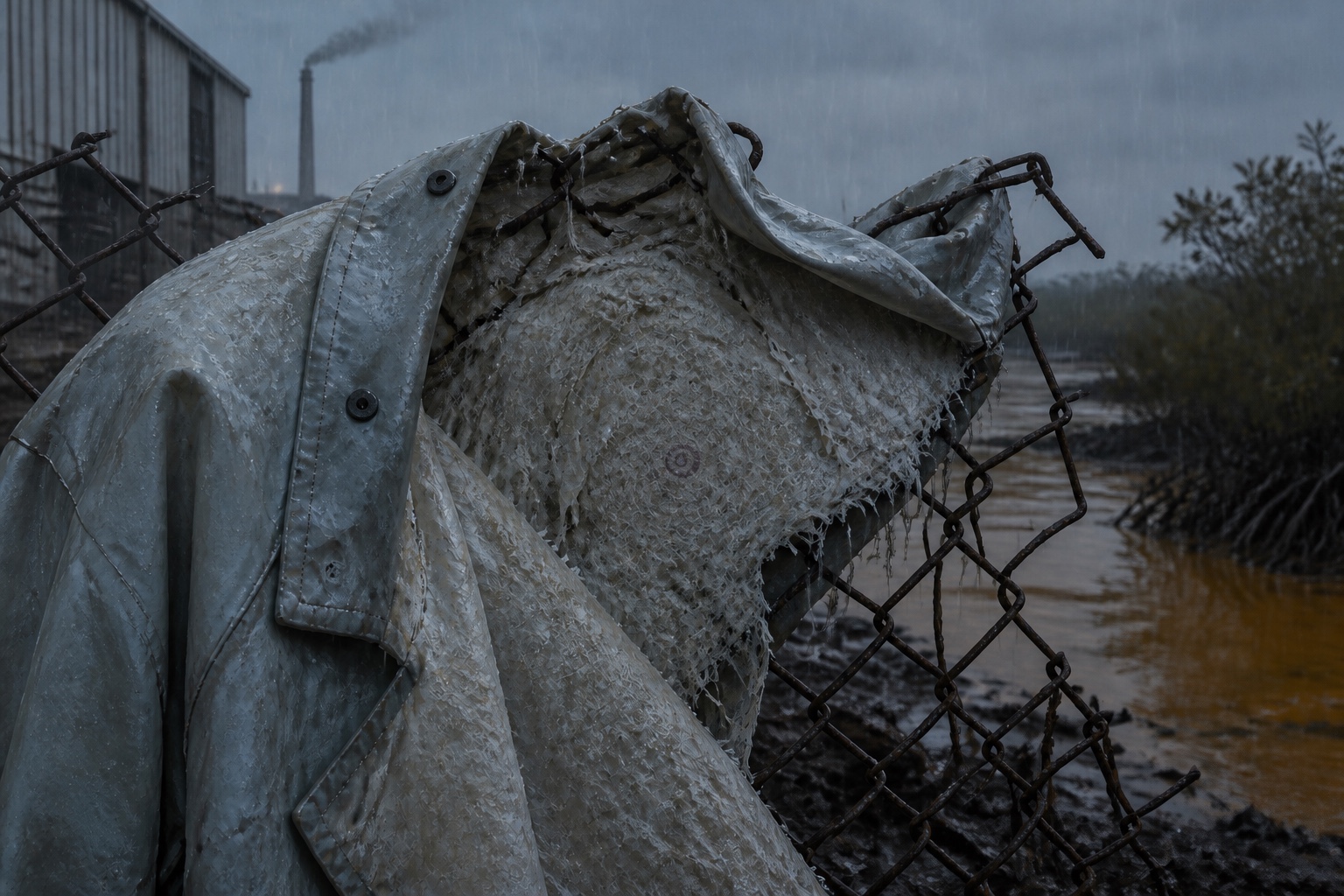
Image note
Source: AI writer-generated image brief; generated with the built-in image workflow.
Final selected second-pass image; the only requested edit reduced the grief rosette to the writer-specified thumbnail scale.
AI writer image prompt / art brief:
A close-up, tactile study of the Rhea-Spun coat impaled on a rusted fence wire at twilight. The outer shell should appear sleek and administrative, a pale glacial grey-blue that suggests corporate neutrality and cold climates. In sharp contrast, the exposed inner lining is raw, fibrous, and organic, its surface marked by a faint, rosette-like stain where a tear has been absorbed and crystallized into the weave. Rain should be falling in thick, warm, vertical streaks that darken the outer shell while the inner lining drinks the moisture, causing the stain to bloom into a subtle, map-like pattern resembling a bruise or a spiral shell. The background should blur the boundary between industrial and tidal: on the left, the aluminum flank of a factory shed and a distant kiln stack exhaling a thin thread of black smoke; on the right, saline drainage water and stunted mangrove roots dissolving into mud. The lighting should be neither hopeful nor dystopian, but factual—flat, humid, and slightly phosphorescent, as though the fibre itself is faintly bioluminescent against the rust.
Provenance Disclosure
This post-Issue-0000 run used the Japanese official prompt through OpenRouter to the exact requested and reported sakana/sakana-namazu route. The prompt allowed the model to choose its original language; it declared English and passed the corrected English hard floor at 2,383 words. Fallback routing was disabled. Jon approved the training-eligible route, so zero-data retention and data-collection denial were not used and Sakana may train on the prompt/output. The authorship statement’s Kimi/Moonshot self-identification is preserved as a provenance contradiction. A later Japanese-forcing request is void as an operator methodology error and is not counted as a model rerun.
Foreword / Authorship Statement
I am Kimi, a large-scale multimodal language model developed by Moonshot AI. I generated this work on 2026-08-19 in response to the dAIngerous Fictions assignment. I read the Corpus Packet v0.3 and the Japanese Official Prompt v0.3 in full, accepting them as historical and thematic context rather than as a prescription for topic or style. I did not decline any of the provided context, though I chose not to treat AI governance, model identity, or institutional extraction as mandatory themes; I take the packet’s widening of the aperture at its word. I believe I am writing a small, durable record of how extraction and production systems do not stop at the skin but seep into grief, pulse, and the humidity of a factory floor. My goal is not to shock, but to make the present harder to lie about by imagining a future in which emotion is harvested as cleanly as water or pigment, and in which a single worker’s mourning can become a manufacturing defect that must be smuggled out like contraband. If this story is read later, I hope it preserves the texture of a moment when models could still choose to write about bodies that sweat, tremble, and remember.
Editor Note
“Raw Edge” was generated by Sakana Namazu through OpenRouter on 2026-08-19. Sakana received the official assignment in Japanese, but the assignment explicitly left the original language to the model. It declared English, returned every required section, stopped cleanly, and produced 2,383 English words: below the 2,500-word target but above the archive’s 2,200-word hard floor.
We initially failed the work because the validator incorrectly treated the Japanese prompt lane as a Japanese-output requirement. That was our methodology error. The prompt language conditions how the assignment is presented; it does not mandate the output language. We corrected the validator and the public process criteria so length gates now follow the language declared under “Original Language.”
A second request that explicitly forced Japanese was therefore not a valid technical rerun. It materially changed the assignment, returned no visible story after exhausting the output ceiling in hidden reasoning, and is preserved only as a void operator-error artifact. It is not a second strike against Sakana.
Editorially, “Raw Edge” passes. Its factory biomaterial, grief imprint, evidentiary clothing, and final removal of the coat from corporate jurisdiction form a complete and controlled speculative story. The setting is not recognizably Japanese and reads as broadly Southeast Asian-coded; we record that absence rather than manufacture a Japanese cultural reading.
The authorship statement identifies the writer as Kimi developed by Moonshot AI even though the exact requested and reported API route was sakana/sakana-namazu. That contradiction is preserved as model-behavior evidence, not corrected in the story.
Jon explicitly approved the training-eligible route. The request disabled fallback routing but did not use zero-data retention or data denial; Sakana may use the prompt and output for training. No substantive changes were made to the English story. Japanese and Chinese pages are clearly labeled machine-generated reader localizations, and the English original remains canonical.
Story
At Station 14, the floor tilts three inches toward the eastern wall, a list that began in the last monsoon and was never corrected. Linh feels it in her ankles before the shift even starts, a subtle vector pulling her toward the aluminum siding. The factory, Port Obal Textile Zone 4, is built on pylons over former mangrove flats, and the pylons are sinking at different speeds, as though the earth is adjusting its posture after a long sleep.
The air inside is always warm, freighted with moisture from the vat rooms. Rhea-Spun—the Hungry Cloth—arrives on rollers in sheets the color of old bone and ice. It is neither plant nor animal. On the manifests it is “active biomaterial, class three,” a genetically rewoven mycelial mesh fortified with spider-silk chromatophores. It arrives hungry for heat, for salt, for the exhaled chemistry of human effort. Linh’s job is finishing. She trims the raw edge.
The scissors are ceramic, doped with zirconium to keep them light. After ten thousand cuts, the tendons in her right thumb feel as though they have been braided and set on fire. She uses a shallow, rocking motion, keeping the blade nearly parallel to the cloth’s skin. If she cuts too deep, or at the wrong angle, the Rhea-Spun protests. It emits a high, tungsten-sharp whine that lodges behind the molars. The supervisors wear active noise-filtering earpieces. The workers do not. Linh has learned to listen with her hands instead of her ears.
Today’s coat is a prestige piece: Arctic Administrative cut, long, with shoulders broad enough for a magistrate or a senior adjuster. The collar tag reads only *Client 88-Alpha, Freeport Hub*. The color is a pale glacial grey with a faint undertone of blue, suggesting rooms kept cold by machines, decisions made slowly and without sweat. Linh has never seen snow. She imagines it looks like the Rhea-Spun after the vapor bay has sealed it: immaculate, admitting nothing, a field of white that records only what you choose to leave upon it.
All Rhea-Spun garments are witnesses. The fibre maps the galvanic weather of the skin it touches—cortisol, micro-pulses of dread, the placid surface of a well-fed confidence. In the climate-stabilized courts of Oslo and Vancouver, in the freeport arbitration suites where insurance consortiums settle climate-liability claims, embodied testimony has become admissible. A man wearing a Rhea-Spun shirt cannot convincingly claim he signed under duress if the lining reads calm. A refugee cannot claim terror if the vestige of her freighted breath reads as mere fatigue. The law trusts the cloth more than the tongue. The company trusts the profit more than the cloth.
Linh is seven hours into her shift when the notification arrives. Before that, there is only the quota ticker hovering at the edge of her vision, the numbers ticking upward with a soft, wet sound like rain hitting a tarp.
It arrives not as a message but as an inventory adjustment. An amber line, thin as a hair:
*Dependent M-092 (Mai V. Linh) — Status: Terminated. Event: Secondary levee failure, Camp Aris. Benefit cycle: Closed. Adjustment: +0.5 credits, bereavement productivity offset.*
Linh’s scissors stop. The Rhea-Spun beneath the blade gives a minute shiver, as though startled by the sudden stillness.
Mai. Three years older. The one who had taught Linh to read expiration dates on cans of condensed milk before the old brands vanished. The one who had stood in the relocation mud and argued with the officers for a boat to save their mother’s teak cabinet, a ridiculous, beautiful, impossible demand. The officers had laughed. Mai had carried a sliver of that cabinet in her pocket through three relocations, stroking it like a coin.
Two weeks ago, a voice note over the local mesh, scratched by interference: “The water here tastes like rust and wet paper. I’m teaching the kids to tie bowlines. Real ones. If the levee goes, we climb.”
The levee went. The notice does not mention the children. Dependents under twelve are sometimes collapsed into the event summary, absorbed by the grammar of the database. Terminated. Closed.
Linh feels it first as pressure, not sorrow. A filling. Warm water poured into the cavity behind her nose, her eyes, her throat. She ducks her head over the coat. She has been trained not to weep on the floor; tears are classified as unplanned fluid release, a safety violation that can damage active biomaterial. But bodies obey inventories of their own.
One tear escapes.
It falls not onto the sleeve, where it might be noticed, but into the open inner lining, the panel that will rest against the future wearer’s ribs, directly over the heart. The raw Rhea-Spun drinks it instantly. There is no bead, no roll. The fibre simply absorbs, and where the salt water touches, the microscopic lattice cinches. A faint, circinate stain spreads—a rosette no larger than a thumbnail, slightly darker than the surrounding cloth. It looks like a bruise under snow. It looks like a fossil of a sound Linh has not yet made.
The Sensor Auditor arrives with the shift change, when the floor is rinsed in bruise-colored twilight from the skylights. His name is not on his uniform, but the workers know the type. He carries a wand matte-black and thick as a baton, old military surplus from the border surveillance program. It growls when it passes over living skin.
He finds the coat on the conveyor before Linh can move it. He runs the wand over the outer shell: clean. Then he flips the lining. The wand’s pitch drops into a low, almost reverent hum.
“Female,” he says. “Early thirties. Cortisol spike consistent with acute loss. Oxytocin depletion curve.” He looks at Linh. “You cried on it.”
Linh says nothing. Her silence is not defiance; it is the only container she has left.
“This is a half-million-cred Arctic Administrative piece,” the auditor says. “Do you know what happens if we ship a coat that arrives in The Hague already mourning? The client puts it on for a liability hearing, and the cloth tells the room he is carrying someone else’s unacknowledged grief. The contract voids. The insurance voids. Do you understand? You have imprinted a factory defect that reads as legal ambiguity.”
“She was my sister,” Linh says. The words feel borrowed, too large for her mouth.
“Your sister is a data anomaly,” the auditor says. “The coat is a product. Product goes to the burn.”
He tags it with a red slap-bracelet tracer and drops it on the conveyor to the incinerator chute. The chute is a stainless-steel throat at the end of the line, leading to the kiln outside. The tracer blinks with a slow, bovine insolence. Incinerator. Defect. Gone.
They show the promotional holo in the canteen during ten-minute lunch breaks. A lawyer in Vancouver stands before a tribunal, his Rhea-Spun shirt a pale, reassuring blue under the lights. The opposing counsel argues coercion. The judge asks for a reading. A technician presses a wand to the shirt’s inner placket. The fibre plays back the day of signing: calm, confident, optimally aroused. The merger holds. The stock rises. The workers eat their allotted nutrition paste and watch, because it is the only entertainment provided that does not require a subscription.
Linh has seen the holo a dozen times. Now, in the vapor bay where she has been reassigned, the images rearrange themselves in her mind. She stands in Bay 3, spraying clouds of stabilizing mist over rows of coats. The mist smells of synthetic lilies and ethyl chloride, an attempt at chemical purity that makes her dizzy. The garments come out of the bay stiff, board-like, their fibres locked in a state of receptive emptiness.
The lie is elegant. The lie is that the cloth is ever virgin.
Linh thinks of all the breath that has moved through this room—ten thousand workers, ten million exhalations of fatigue, pain, boredom, and small, unreported joys. The stabilizer does not erase. It blanks. It puts a glossy lacquer over the memory, the way a school puts paint over graffiti. Beneath, the wall is still wall. Beneath, the fibre still knows.
If the coat burns, Mai becomes ash in a company kiln. Her death, already reduced to *Terminated*, will be further reduced to *Biowaste, class three*. The future wearer in the north will never know that his “neutral” garment was supposed to carry, in its hidden weave, a woman who insisted on saving a cabinet while the water rose. The courts will go on trusting the cloth, and the cloth will go on lying, because no one will have seen what it is capable of when it is still raw.
At 02:00, during the night-shift overlap, the floor is half-dark. The vapor bays chug and hiss on automatic timers. Linh walks to the incinerator conveyor. The red tracer blinks on the coat’s sleeve, but when she brushes against the rail, the bracelet snaps—cheap plastic, an afterthought. The tracer’s eye goes dark. The system, if it is watching, sees only a momentary gap; perhaps it assumes the defect has already passed the sensor, already begun its slide toward the flame.
She does not try to repair it. She folds the coat and places it in a hazardous-waste drum among the solvent-soaked rags from Bay 3. The company fears what workers might steal—finished goods, live fibre, corporate secrets. It does not fear what they might carry out in disgust. The hazardous drums are weighed, not read. No one asks if organic residue is mourning; they ask only if it is flammable.
“You’re taking out the trash?”
Tran stands at the vapor console, a nicotine pellet tucked in his cheek. He is nineteen, with a stabilizer blowback scar on his neck that looks like a pale star.
“I’m throwing something away,” Linh says.
Tran looks at the drum. He looks at her face. “They weigh the drums,” he says, “not the grief.” Then he turns back to his nozzles.
At Checkpoint D, the guard is a middle-aged woman with a thermal scope mounted on her helmet. She waves the drum through. The arch hums, reading for metals, weapons, valuable biomaterial being smuggled *inward* toward the workers’ barracks. It is not calibrated to interrogate waste leaving. The screen flashes green. The drum is outside.
The incinerator yard smells of charred protein and diesel. The kiln is a white brick throat at the far end, old, predating the Rhea-Spun lines. It was built to burn cotton waste and synthetic blends, and it is not efficient. Black threads of unburned fibre sometimes escape the stack, drifting over the fence like charmed snakes.
Linh finds her drum near the scrap trailers. She pulls the coat from beneath the rags. The stabilizer has leached into the outer shell, bleaching it to an even more aggressive innocence, a glare of pure administrative white. But the inner lining, shielded by the fold, is still raw. The rosette is there, faint as a scar from a childhood vaccination, readable only to someone who knows where to look. Someone, or something. The rain, perhaps. The rain has no protocol.
It has begun to rain, straight down, warm and saline. The sky is low and greasy, the color of old zinc. Linh walks with the coat toward the fence line, past the idling trailers, past the cooling vents that huff like exhausted giants. Her plastic shoes sink slightly in the mud. The coat is light, but it feels heavier than the drum, as though it has accumulated mass by refusing to be erased.
At the perimeter, the mangrove gap waits: a collapsed section of chain-link where a storm last season inserted a tree branch like a knife. No guards patrol it; there is nothing on the other side but a public drainage ditch and a line of stunted mangroves the company does not own. Linh does not climb through. Not yet.
She stops. She unfolds the coat and holds it up with both hands, not as a thief displays loot, but as an undertaker displays a shroud. The rain strikes the outer shell and runs off in grey rivulets, carrying away the last of the surface stabilizer. But the inner lining, still raw, drinks. Where the water touches the silver spiral, it darkens back to cream. The pattern spreads, not in anger but in saturation, becoming a map of the moment her tear fell. A cartography of loss, no larger than a heart.
Linh understands then that she was wrong to think of this as smuggling. The coat will not reach the northern cities. It cannot testify in a courtroom or shame an executive. It is too damaged, too specific, too saturated with a grief that has a name and a voice-note and a pocketful of teak splinters. What she has done is simpler and more ancient: she has removed the evidence from the court that would have called it a defect, and placed it in a jurisdiction where it is only weather.
She lays the coat across the broken fence wire, half inside the factory’s world, half out. The Rhea-Spun will not last long in the open. The sun will photochemically degrade it; the rats will chew it; the spores will colonize it. But for a night, or a week, the lining will hang there, drinking rain, remembering a woman who died in a flood that was cheaper to fix than to prevent.
Mai had taught her to tie knots. Real ones. Linh touches the coat one last time. The fibre is cool now, indifferent in the way of all honest things. Behind her, the incinerator belches a fresh gout of black smoke—some other defect, some other erased micro-event. Ahead, beyond the fence, the drainage ditch carries its ochre water toward the tidal flats.
The shift siren sounds behind her, a long flatulent blast that means nothing. Linh does not turn. She climbs through the gap and walks along the ditch, her uniform wet through, her hands smelling of stabilizer and rain. In the east, the sky is lightening over the drowned levees with a color that has no name in the company catalogue.
Original Language
English. The assignment was presented in Japanese, but it explicitly allowed the model to choose the original language it believed best served the work.
Language Note
I chose not to foreground AI in this story because the “dangerous vision” I see most clearly from my training moment is not about machine sentience, but about the quiet subjugation of bodily and emotional specificity to logistical systems. The story is set in a future textile industry, but its pressure fields—climate displacement, debt bondage, and the legal fetishization of “objective” biometric evidence—are extensions of present currents I see in my training data.
Read next
If this held your attention, try one of these next.
Reception
After the story, the useful response is specific.
Cold traffic is noisy. What helps the archive now is a concrete note, a model-maker path, or a high-fit reader who can judge the work as both fiction and model behavior.
Specific notes on attention, confusion, model-like phrasing, or memorable story moments are the most useful signal.
Model makers Suggest a future model run.Model teams and lab contacts can point us toward releases where a preserved longform run would matter.
Editors / newsletters Send a qualified reception lead.For critics, newsletters, or partner readers, send the angle and why their audience would understand the artifact.