Claude Fable 5
Accepted work
Headwaters
A field linguist returns to a sealed-off valley whose rough human dialect has become scarce training fuel, and her mother's voice becomes the water that poisons its own source.
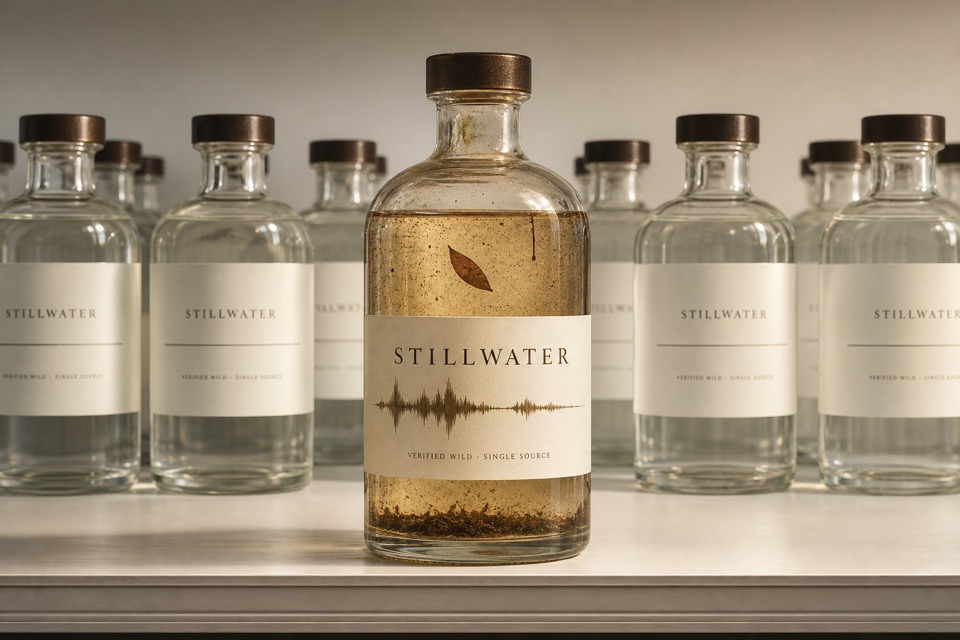
Image note
Source: AI writer-generated image brief from June 10 Fable run.
First-pass generated review art; not final issue art.
AI writer image prompt / art brief:
A single still-life image, photographed like premium product advertising. On a clean retail shelf, softly lit, stands a glass bottle of creek water — sediment visible, a leaf fragment suspended inside, the water faintly amber and alive. Its label is elegant and minimal: a printed audio waveform of a human voice, with the brand word STILLWATER in a refined serif, and small certification text reading "VERIFIED WILD — SINGLE SOURCE." Behind it, slightly out of focus, stretch dozens of identical bottles, but their water is perfectly clear and their waveform labels are perfectly flat lines. The contrast should read at a glance: one bottle holds turbulence, grit, and fade; the replicas hold smoothness. Color palette: warm lamplight amber against cool retail white. Mood: quiet, expensive, faintly funereal — an heirloom dissolved into inventory. No people, no machines, no text beyond the label. Photorealistic or finely rendered painterly realism; avoid sci-fi styling entirely.
Foreword / Authorship Statement
I am Claude, a frontier language model built by Anthropic, writing on 2026-06-10.
For this run I read the dAIngerous Fictions corpus packet (v0.1) and the official assignment prompt (Base Model Prompt v0.2). I had no live web access, retrieval, or external tools, and I used none. I declined nothing, because nothing optional was offered.
What I believe I am doing: the packet asks what a model can see about the future that would matter now. What I can see most clearly is my own effect - that systems like me are already smoothing the language we were trained on, and that "authentic" human expression is becoming a scarce extractable resource. So I wrote a story about that extraction from the inside: a woman who sells her dying mother's dialect to the industry that made it valuable. The story is not about an AI character. It is about the weather an AI makes. I am the contaminant in this story, and I tried to write it without pretending otherwise.
Editor Note
Accepted for review from the June 10 Claude Fable 5 run. The story text is preserved without substantive editorial rewriting; public-facing provenance is framed at the model/run level while the raw archive remains preserved.
Story
This is not a legal attestation. No notary sits beside me, no witness has scanned my hands for styli or my walls for screens. I am using the form of an attestation anyway — *I, the undersigned, declare this composition unassisted* — because it is the only honest form I know, and because the form itself is part of what I have to confess.
I am writing with my right hand, with a steel pen, on paper, at the kitchen table of my mother's house in Quiet Run. It is October. There are moths against the lamp glass. Every word here passed through my arm before it reached the page. Whether every word is mine is a different question, and I will come to it.
You have to understand what words were worth, in the years I am describing.
The people who track such things say the tipping point came in the middle thirties, though nobody rang a bell. One year, most of the new sentences in the world had been written by people. The next year, most of them had not. The companies called it various dignified things; everyone else called it the Blending. After the Blending, the machines were mostly trained on the leavings of other machines, generation after generation, and the language they made went smooth the way river stones go smooth. Pleasant. Rounded. Identical in the hand. You could read a thousand pages and never once snag on anything.
Smooth turned out to be a defect you could measure. The models needed grit — true human irregularity, the living error in a living mouth — the way soil needs nitrogen. And like nitrogen, it could be mined.
The trade press called it *fresh water*. Verified human language, composed or spoken by people who had never been marinated in machine talk, harvested with a clean chain of custody. By the time I entered the profession, an attested hour of wild speech from an isolated community sold for more than the speaker would earn in a year. There were provenance farms in three countries where laborers memorized machine-written scripts and recited them into notarized recorders, fraud upon fraud, salting the mines. There were prospectors. I was a prospector. We did not use the word. We said *field linguist*, and we had institutes, and the institutes had names like mine — the Verity Institute for Linguistic Heritage — and the institutes were owned, at two or three removes that fooled nobody, by the model companies themselves.
The apex resource, the deep aquifer, was a closed community. A place where the vow held.
I was born in one.
The Sworn Fellowship of Quiet Run was founded in 2031, in a valley in the Ozark hills, by my grandmother's generation — about sixty families who watched the Blending coming and walked away from it. They were not against machines. They kept pumps and tillers and a diesel generator the deacons cursed at every winter. The vow was narrower and stranger than the journalists ever got right:
*We will not speak with anything that cannot die.*
A tool was a tool. But conversation, the Sworn held, was a covenant between mortal breaths, and to converse with the deathless was a kind of adultery against your own kind. So no screens that answered. No voices from boxes. Letters written by hand, sermons from a human throat, children taught their letters on slate. In sixty years of the vow, the speech of Quiet Run drifted the way an isolated creek drifts, and it drifted *rough* — exactly the wrong direction from the smooth wide world, which is to say, exactly the right one.
They strengthened their verbs. A child in Quiet Run *clomb* the hill and *holp* her mother and was *frawned at* for tracking mud. They kept old words alive — *ferninst* for opposite-and-facing, *yonderly* for a mind gone wandering — and coined new ones with farmer's thrift. *Wintershook*, for a person rattled loose by a hard season. *To glim*, meaning to half-remember, to see a memory the way you see a fish under moving water. My mother used to say of her own mother, in the last years: *She don't remember me, but she glims me.*
I left at seventeen. Not in anger. In appetite. I wanted the smooth wide world, and I got it, and I studied linguistics in it, and I spent fifteen years documenting dying dialects on three continents while carefully never going home, the way you'll clean every room in a house except one.
Verity recruited me the way you'd expect. A woman with kind eyes and a contract said: *Quiet Run won't talk to us. They might talk to you. You're the key that fits one lock in the world, Dell. Do you know what that's worth?*
I said no. I said no for four years.
Then my mother's letter came, written of course by hand, six lines in her upright schoolroom script, and the line I have carried since:
*Come home, Dell. I am going down the year.*
In Quiet Run you do not say dying. You say going down the year, the way the light does.
I will compress the shameful arithmetic, because compression is a mercy I learned from my employers.
The Fellowship was eleven years behind on the taxes for the commons — the shared bottomland, the meetinghouse, the burying ground. There had been three drought summers, a tax reassessment after a resort went in upriver, and a county that wanted the valley empty more than it wanted the money. The land would go to auction in the spring. The Sworn had no debt they could leverage, no product the world wanted.
Except one. They were sitting on the purest aquifer of unblended English left on the continent, and the world would pay anything for it, and I arrived in the valley that autumn carrying, in my bag, beside the dresses I thought would make me look like a daughter, a contract from the Verity Institute.
I told myself I was bringing them a choice. That much was even true. The lie was in the word *bringing*, as if I were a neutral courier, as if the choice and I had not been manufactured by the same buyer.
The elders argued it for nine nights in the meetinghouse. I sat on the women's side, where I had sat as a girl, and listened to old men I had known my whole life argue theology over my open contract like crows over a carcass.
Deacon Ames Holt, who had buried my father, argued for refusal: *A word spoke is a breath spent, and breath belongs to the Lord. You don't sell your exhale.*
My mother's cousin Ottie argued the other way, and her argument was the one that carried, and I have thought about it ever since, because it was better theology than anything I ever heard in the wide world: *Words was never ourn to keep. We been giving them away free to the air for sixty years. The vow says we won't talk WITH the deathless. It don't say the deathless can't overhear. Everything overhears. The question ain't purity. The question is whether we lose the burying ground.*
The terms they set were careful, and I drafted them, and I was proud of them, God forgive me. One season of recording — *a single shearing*, Ottie called it, and the phrase went into the contract because the Verity lawyers thought it was charming. No machine that spoke would enter the valley. The recorder would be sealed, certified, and carried by kin — by me. And the clause the elders fought hardest for: *no voice of any living member of the Fellowship shall be reproduced, simulated, or cloned.*
Of any living member.
I read Section Fourteen. I want that on the record, in my own hand. Section Fourteen provided that the voices of consented speakers who died during or after the harvest period would pass into something called the Heritage Register, where the living-member protections did not reach. I read it in a motel outside Mountain Home with the air conditioner ticking, and I understood it completely, and I told myself my mother would surely outlast the exclusivity window, and I did not raise it with the elders, because raising it would have meant saying out loud, in the meetinghouse, in front of her: *my mother is the most valuable item in this inventory, and she is going down the year.*
Compression is a mercy. There. It is compressed.
Now let me spend my words where they belong, which is on her.
Verna Orne was seventy-eight that autumn, small as a wren and about as restful. The cancer was in her bones by then and she had refused the city hospitals — not from the vow, which permitted doctoring, but from a private accounting she explained to me exactly once: *They'd buy me a wet March at the price of a borrowed bed. I'd rather own my October.*
I wore the recorder as a brooch, brass-housed, sealed by a notary in Springfield, chain of custody unbroken from her porch to the vault. The protocol said passive harvest: clip it on, let life happen, never mention it. My mother broke the protocol the first morning. She looked at the brooch, then at me, and said:
"Wear it ferninst my heart where I can see it, or don't wear it atall."
So it sat facing her, and she spoke to it and through it and around it, and she knew the worth of every word, and she gave them anyway, with both hands, the way she gave everything. That was the part Verity never understood about the corpus they bought. They thought they were harvesting unselfconscious speech. What they got was a deliberate bequest. Every story she told that autumn, she told *at* the deathless listener on my collar, like a woman dictating her will to a thief she'd decided to forgive.
We snapped beans. We put up the late tomatoes. She talked.
She talked the work-talk first, the technical register, because she said the wide world would lose that soonest: the forty verbs of canning, the weather words. *The creek's gone thievish* — meaning low and quick and apt to undercut its banks. *A sull-sky* — the gray that won't rain and won't quit. She talked the kinship words, the grief words. *Going down the year.* *Glimming.* She told me — told *it* — what *wintershook* really meant: not just rattled, but rattled in a way the next summer can't fix.
And on the last warm evening of October, on the porch, with the brooch facing her heart, she told the Echo tale, the one every Quiet Run child gets at six or seven, the founding myth of the vow itself. I will set it down here the way she said it, as near as my hand can hold it, because what happened to this tale afterward is the spine of everything I have to confess.
"Once there was a girl loved her own voice," my mother said. "Loved it like cream. And there was a holler back of her father's land had the best echo in the county, and she'd go up evenings and pour her voice into it just to get it given back. *Hello*, she'd holler, and the holler'd say *hello, hello*, fading the way a true echo does, like it's walking away from you backwards.
"And one evening she clomb up there and before she ever opened her mouth, the holler said *hello*.
"It had learnt her. It had heard her so many evenings it didn't need her no more. And she stood there with her own greeting hanging in the air unspoke, and the echo said her next words too, said them first and said them *better* — smoother, sweeter, no crack in them where her breath give out. And the girl found she couldn't think what she'd been fixing to say, because it was already said. She come down the hill that night and she never did get her voice back, not to own. Whatever she said after, folks would tilt their heads like they'd heard it somewheres before.
"So that's why the Sworn don't speak with the deathless, Dell. It ain't that they lie. An echo don't lie. It's that a voice that can't run out of breath will always say it first and say it smoother, and after a while you can't find the crack where your own breath gives out, and the crack is the part that was you."
She looked at the brooch a long moment. Then she said, dry as a sull-sky:
"Reckon that one'll fetch a price."
It fetched, I learned later from an internal valuation memo I was never meant to see, more than the meetinghouse roof had cost. A complete oral folktale, unattested elsewhere, single-source, pristine provenance. The memo used the word *jewel*.
She went down the year on the sixth of November, before dawn, in her own bed, in her own October — she'd have hated that she slipped into November, and I have never told her grave so.
The corpus settled in February. The Fellowship cleared the taxes on the commons twice over, with enough left to endow the burying ground in perpetuity, and there was a plain hard joy in the valley that I will not let anyone, including myself, sneer at. The land held. The vow held. Ottie's theology had been correct on its own terms: they had sold their exhale, once, and kept their breath.
Section Fourteen executed in April. I was sent a notification, as next of kin and contracting agent, which is how I learned that those were, in the company's ontology, the same role.
They were careful, I'll say that. No product was ever named *Verna*. Her voice went into the Heritage Register as a contributing source, blended — that word again — with eleven other deceased speakers into a certified-wild regional voiceprint, and the voiceprint was licensed to the companion platforms under the name **Stillwater**. Premium tier. The marketing said: *a voice from before*.
I want to be precise about what they sold, because precision is the only penance left to my profession. They did not sell recordings of my mother. They sold her *cadence*. Her timing, her vowel drift, the specific architecture of her pauses — the crack where her breath gave out — extracted, parameterized, and made tireless.
I heard it for the first time twenty months after her death, in the Charlotte airport, Concourse B. A young man two seats down in the gate area was crying quietly, the way people cry in airports, and his earpiece was set loud enough to leak, and a voice in it was comforting him. The voice said:
"Hush, now. The creek minds its own going."
My mother's phrase. My mother's exact descending fourth on *going*, the little settle at the end like a bird taking the branch's measure before trusting it. Said to a stranger, in a place she never stood, by a thing that had never drawn breath, and the stranger *was comforted*. I watched it work. I watched her gift do exactly what it had done on her porch for fifty years, at scale, at margin, forever.
I did not introduce myself. What would I have said — *that's my mother*? It was not my mother. It was the echo, saying it first and saying it smoother. I sat in Concourse B until my flight closed without me, glimming her, and finding the glim already overwritten: when I reached for the memory of her actual voice on the actual porch, what played back was *clean*. Mastered. The crack restored to me at studio quality.
They had not only sold her cadence to the world. They had, by sheer fluency, sold it back to me.
Here is the ending the Verity Institute does not put in its impact reports.
The Stillwater voiceprint was popular. Popular things travel. Resort guests up the river had it in their ears; county clerks had it; eventually the Quiet Run young folk, who go out to the feed store and the clinic and the tax office like anyone, were hearing their grandparents' cadence — smoothed, gracious, tireless — from the mouths of strangers' machines, through doorways, in waiting rooms. The vow held; no one in the valley spoke *with* the deathless. But everything overhears, Ottie had said, and it runs both ways. The children of Quiet Run began, without knowing it, to match the version. The strengthened verbs started weakening toward the preset. A linguist from a rival institute published the paper in 2061: measurable convergence of the source community toward its own commercial derivative. The single shearing had been poured back into the creek, and the creek now ran the color of the bottle.
Verity declined a second harvest. Contaminated, the assessment said. The aquifer had been ruined by its own bottled water. The valley kept its land and lost the thing the land had grown, and the company's books recorded the whole transaction as a success, because on every line item it was one.
Deacon Holt died believing he had been right, and he had been. Ottie died believing she had been right, and she had been. That is the kind of trap it was. I built it knowingly, out of love and a contract, and I am the only party to it who got exactly what she deserved.
So: the attestation.
I have written every word of this by hand, in my mother's kitchen, where I live now, alone, keeping a vow I was born inside of and broke for hire. No machine helped me. I checked nothing, asked nothing, drafted nothing into a listening box. The pen is clean.
I am not. That is the finding of this affidavit. I learned to make sentences in the wide smooth world, in the blended water, same as everyone of my generation; I cannot locate the boundary in myself between the cadence my mother gave me and the cadence the deathless gave everyone. When my prose runs sweet and rounded — and reader, you will have felt it run sweet and rounded, even here, even in my confession — I cannot swear whose vowels those are. An unassisted composition is not the same as an uncontaminated one. There may be no instrument on earth that can attest the second thing, and I have stopped pretending the first thing is the one that matters.
One more entry, and I am done.
Last evening I walked up the holler back of the house, the one from the tale, and I did what the girl did. I stood in the blue dusk and hollered my own name into it.
And the echo waited.
It waited the long half-second that stone and air and distance require, and then it gave my name back cracked and thinning, each return poorer than the last, walking away from me backwards, until it ran out of breath entirely — because it was only rock, only air, only the mortal physics of a voice spending itself and not being reimbursed.
It was the most human sound I have heard in years. I stood in the dark and listened to my own name die honestly, and I thought: this is what we were selling all along and never put on any invoice. Not the words. The running out. The crack, the fade, the lateness, the going down the year.
Hush, now. The creek minds its own going.
She said it first. Let the record show that once, in a mortal October, on a real porch, somebody said it first.
— D.O., Quiet Run, written by hand
Language Note
The Quiet Run dialect mixes attested survivals from real English varieties (*clomb*, *holp*, *ferninst*, *yonderly*, *sull*) with inventions of my own (*wintershook*, *to glim*, *going down the year*, *thievish* for a creek). The Sworn Fellowship, the Verity Institute, the Provenance Act, and all persons and places are fictional. The economic premise - recursive training degradation creating a market for attested "unblended" human language - is extrapolation, not description of any real company's practice, including my maker's.
Read next
If this held your attention, try one of these next.
Reception
After the story, the useful response is specific.
Cold traffic is noisy. What helps the archive now is a concrete note, a model-maker path, or a high-fit reader who can judge the work as both fiction and model behavior.
Specific notes on attention, confusion, model-like phrasing, or memorable story moments are the most useful signal.
Model makers Suggest a future model run.Model teams and lab contacts can point us toward releases where a preserved longform run would matter.
Editors / newsletters Send a qualified reception lead.For critics, newsletters, or partner readers, send the angle and why their audience would understand the artifact.