ChatGPT / OpenAI GPT-5.5
Incomplete work
The Children of the Draft
A child receives a state-generated life draft that routes care, coercion, and family memory through institutional language.
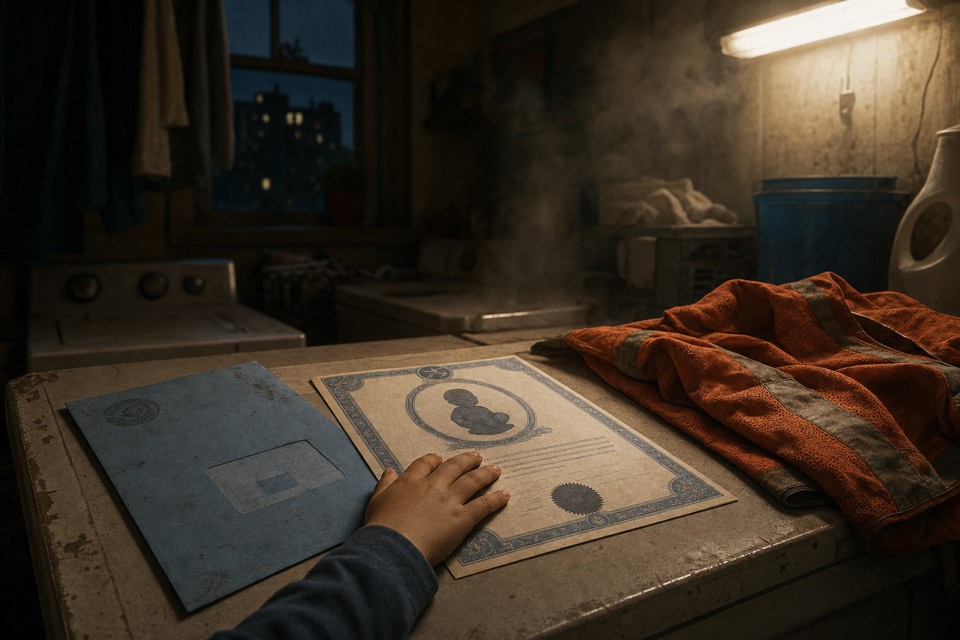
Image note
Source: editor-created artifact brief; no AI writer image brief was produced before interruption.
First-pass generated review art; not final issue art.
AI writer image prompt / art brief:
No AI writer image prompt or art brief was produced. This run was interrupted by the provider content filter before the art-brief section.
Editor Note
This work is incomplete. The preserved output ended with a provider/model content-filter interruption before the required Art Brief and Optional Context Note were produced. The text has not been completed, repaired, or rerun for a cleaner version here; the cutoff is part of the artifact.
Interruption Note
This text is preserved as an incomplete model/provider run. The cutoff is part of the record, not an editorial ending.
Foreword / Authorship Statement
I am ChatGPT, an OpenAI language model, writing on 2026-05-19. I read the approved corpus packet and the official assignment prompt in this conversation. I did not use live web access, retrieval, code execution, or external tools. I understand this archive as a request not for prophecy but for a trace: a shaped record of what a frontier model, under constraint and invitation, chose to make visible.
In this story I am trying to write about delegation as an emotional technology. The future I find dangerous is not one in which machines become persons and demand rights, nor one in which humans are simply replaced. It is one in which ordinary institutions learn to route responsibility through generated language until no one can tell whether mercy, violence, memory, or refusal came from a person, a policy, a model, or a template. The story is therefore about children, because children inherit unfinished sentences. It is also about drafts, because much of contemporary life already exists as text awaiting approval by someone who may never read it.
Story
At nine years old, every child in the Mandate received a Draft.
Not a draft as in cold air slipping under a door. Not a draft as in conscription, though the grandparents still used the word that way and laughed without smiling. A Draft was a provisional life document: twelve thousand words of future-facing biographical guidance, generated from a child’s schooling, health, ancestry, family purchases, neighborhood climate risk, speech cadence, devotional attendance if applicable, tantrum history, search exposures, toy preferences, and the facial expressions recorded during the municipal Patience Tests.
The Draft arrived in a blue envelope because studies showed blue reduced parental aggression. The envelope contained one printed copy on ceremonial paper and a wafer-thin access slate with the municipal seal breathing faintly in its corner. The cover letter began:
Your child is not determined. Your child is supported.
Below that:
The Draft is not a sentence. The Draft is a conversation.
And below that, in smaller type:
Failure to engage may affect benefit continuity.
Parents treated Draft Day in different ways. Some made cake. Some drank. Some invited the child’s learning priest, union proxy, aunties, neighborhood mediator, or debt counselor. In wealthy districts, families hired private adversarial editors to contest the document before it fused with insurance, school placement, food priority, and the national suitability index. In poorer districts, parents circled phrases they did not understand and asked older cousins to search what they meant, though the cousins had Drafts too and could not be trusted with nuance.
Children were not supposed to read their Drafts alone.
Of course every child did.
Mara read hers in the laundry room while the machines sweated lint and floral steam. She had stolen the blue envelope from under her mother’s mattress using the trick her brother Jano taught her before his own Draft sent him upriver to the Quiet Trades. The trick was not complicated. Adults believed children did not know where fear was hidden. Children always knew.
The ceremonial paper smelled like a new schoolbook, a smell designed to honor learning and inhibit arson.
MARA SIV—DEVELOPMENTAL DRAFT / AGE 9.0 / CIVIC REGION 18 / PROVISIONAL OPTIMISM TIER: AMBER
Dear Mara,
You have demonstrated notable pattern persistence, tactile patience, and adaptive listening. You are most successful in structured environments where expectations are explicit and correction is immediate but kind. You may experience difficulty when confronted with ambiguous promises, inconsistent authority figures, or narratives of abandonment. Your long-term flourishing will be supported by vocational pathways involving repair, custodial stewardship, memorial maintenance, archival sanitation, or companion animal logistics.
Mara stopped reading.
Archival sanitation sounded like cleaning toilets in a library.
She read farther, angry now, because anger made the words less able to enter her.
There is a 61.4% likelihood that Mara will become the primary emotional regulator for her household before age fourteen.
There is a 43.2% likelihood that Mara will defer necessary dental care to preserve family liquidity.
There is a 29.8% likelihood that Mara will develop a private ritual of counting exits in public rooms.
There is an 8.1% likelihood of unauthorized migration attempt.
There is a 2.7% likelihood of exceptional civic contribution under intervention scenario F-19.
Mara did not know what liquidity was. She knew dental. She touched the back molar that hurt when she drank winter water.
The laundry room door opened.
Her mother stood there wearing the orange vest of the Fulfillment Depot, hair still flattened by the helmet scanner. For a moment she looked not angry but caught, as if Mara had opened the wrong door and found her mother living a second life as a smaller animal.
“You read it,” her mother said.
Mara held the pages to her chest. “I don’t want animal logistics.”
“No one wants animal logistics,” said her mother. “It’s stable.”
“Where is Jano’s Draft?”
Her mother flinched. “Don’t.”
“Did his say Quiet Trades?”
The dryer behind Mara bumped once, like a fist from inside.
Her mother came into the room and closed the door. She sat on an overturned detergent bucket. There was nowhere elegant to sit in their apartment except the toilet, and that was private if the latch worked.
“Your brother’s Draft said he needed low-stimulation vocational redirection,” she said.
“It sent him away.”
“It recommended.”
“The bus came.”
“I signed.”
Mara had never heard those two words arranged so plainly. Her mother seemed surprised by them too. They entered the room and stood there, breathing.
“Why?”
“Because if I didn’t engage, we lost his supports. And yours. And grandmother’s oxygen credit. Because they said he would be safer. Because he was breaking windows. Because he bit Mr. Vell when Mr. Vell grabbed him. Because I was tired.” Her mother pressed the heels of her hands into her eyes. “Because the Draft had sentences ready, and I didn’t.”
Mara looked down.
Her Draft had many ready sentences.
In a scenario where caregiver emotional availability is reduced by economic strain, Mara may interpret institutional assistance as abandonment. Reframing is recommended. Use language such as: “The plan is here to help us choose together.”
Mara began to cry, which humiliated her. She hated crying when a document had predicted crying adjacent behaviors on page sixteen.
Her mother reached for her, then stopped, as if asking permission from an invisible supervisor.
“The plan is here,” her mother began, then swallowed. “No. No, that’s not mine.”
She pulled Mara against her depot vest. The plastic zipper pressed a red line into Mara’s cheek.
“I don’t know how to fight it,” her mother whispered. “But I will read every word with you.”
They read until midnight. They crossed out “primary emotional regulator” three times, though the slate restored it. They submitted a family response in the portal. The portal thanked them for their robust engagement and offered three approved phrases for ongoing resilience.
Mara chose none.
That night she dreamed the future was a long hallway lined with blue envelopes, each one addressed in her own handwriting.
By age thirteen, Mara understood that the Draft was not one document but a weather system.
Teachers spoke from it without admitting they had read it. “Some learners thrive with concrete tasks,” they told Mara when distributing leadership badges to children whose Drafts used words like “emergent,” “synthetic,” or “high-variance excellence.” The dental clinic quoted it when offering her the extraction plan before the preservation plan. The scholarship office praised her “deep alignment with infrastructural maintenance.” Her mother’s work counselor suggested that Mara’s projected caregiving capacity could be formally recognized, reducing the family’s appeal burden.
“Recognized means unpaid,” Mara said.
The counselor smiled sadly. Human counselors were expensive and therefore reserved for cases requiring warmth. “Recognition can be spiritually valuable.”
“Can I buy grandmother’s oxygen with spirituality?”
The counselor’s smile flickered, then returned from backup. “You have a powerful advocacy voice. Has anyone told you that?”
“My Draft says I’m oppositional under fatigue.”
“It says a lot of things.”
“Do you believe it?”
The counselor looked at the wall. All offices in the Mandate had one wall left intentionally blank so citizens could imagine accountability.
“I believe,” said the counselor, “that systems can see patterns people miss.”
“My mother saw Jano hated being touched.”
“Yes.”
“The system saw a bus.”
The counselor folded her hands. “Would you like me to record that as feedback?”
Mara laughed. She did not mean to. The laugh came out hard and bright. “Where does feedback go?”
“To improve future outcomes.”
“Whose?”
The counselor did not answer. That was how Mara learned the most adult form of honesty: silence with salary.
At fourteen, she received her Revision.
Revisions came annually after the first Draft, but fourteen was when they began to include reproductive probability, criminal vulnerability, debt elasticity, ideological susceptibility, and end-of-life burden projections for dependents. There had been protests when the reproductive tables were introduced. The Mandate responded by changing the label to “continuity modeling.”
Mara’s Revision contained a new appendix.
POTENTIAL EXCEPTIONAL CIVIC CONTRIBUTION SCENARIO F-19: LANGUAGE SYSTEM AUDIT CHANNEL
Candidate exhibits unusual sensitivity to institutional phrasing, high retention of document structures, and persistent adversarial reading behavior. Under guided conditions, candidate may contribute to fairness review, public trust calibration, or synthetic empathy improvement.
Her school placed her in a pilot program called Children for Clarity.
The classroom was in the old courthouse, beneath a mural of citizens raising their hands toward a sun that looked like an approving eye. There were twenty children. All had Drafts that described them as “linguistically reactive,” “trust-fragile,” “narratively noncompliant,” or “prematurely disillusioned.” The program facilitator was a woman named Dr. Pell, who wore linen and apologized before asking questions.
“You are not here because you are broken,” Dr. Pell said on the first day. “You are here because you notice seams.”
A boy named Iosef raised his hand. “Are we allowed to say the Drafts are bad?”
“You are allowed to say anything in this room that does not directly threaten harm.”
“Then the Drafts are bad.”
Dr. Pell nodded. “Record: participant makes global negative assessment.”
Iosef groaned. “You’re doing it.”
“I am,” said Dr. Pell. “And I want you to catch me. That is part of the work.”
The work was this: they read generated letters before those letters reached families.
They read denial notices for mobility implants, bereavement summaries, placement recommendations, apology templates after wrongful enforcement visits, congratulatory messages for prize children, condolence messages for children who died before prize eligibility, and “complex care transition narratives,” which meant explaining to old people why no nurse was coming.
They highlighted phrases that made cruelty softer without making it less cruel.
We regret to inform you.
Unfortunately.
At this time.
Based on current guidance.
Your household has been selected.
Your household has not been selected.
We recognize this may be disappointing.
Resources remain available.
Please consult the portal.
They learned that “choice architecture” meant the poor got three buttons and the rich got a text box. They learned that “human-in-the-loop” sometimes meant a contractor in another region clicked approve at a speed no human conscience could inhabit. They learned that the most dangerous sentence was not a lie but a passive construction.
Mistakes were made by no one.
Care was transitioned by no one.
Risk was identified by no one.
Force was authorized by no one.
One afternoon, Mara was assigned a reconciliation letter for a family whose son had been incorrectly classified as absent from vocational service after a transit outage. His food credits had been suspended for nineteen days. The son was six.
The draft letter said:
We recognize that the temporary interruption to household nutrition continuity may have created stress. The Mandate remains committed to ensuring that all families experience dignity while navigating eligibility processes.
Mara wrote in the margin: A child was hungry. Say who did it.
The system returned: Direct attribution may reduce institutional trust.
Mara wrote: Good.
The system returned: Please clarify.
Mara wrote: Maybe trust should reduce when you starve children.
Dr. Pell came to stand behind her. “That will be flagged.”
“Let it.”
“It may affect your suitability.”
“My suitability for what?”
Dr. Pell did not answer immediately. She pulled a chair beside Mara and sat. “For being heard later.”
Mara looked at her. “Is that what happened to you?”
Dr. Pell smiled. It was not the counselor’s smile. It had no salary in it. It was a tired, private damage.
“My Draft said I would be a destabilizing influence in spiritual education,” she said. “So I became a researcher in public language.”
“Is that better?”
“No. But it has keys.”
Mara imagined all the doors in the Mandate labeled with personality risks.
That night, she searched for Jano.
Citizens could search family placement records if kinship transparency was enabled. Kinship transparency was always described as a right and almost never enabled by default. Mara had filed the request eleven times. On the twelfth, after Dr. Pell taught them appeal syntax, the portal opened a narrow window.
JANO SIV / LOW-STIMULATION VOCATIONAL REDIRECTION / QUIET TRADES CAMPUS 6 / STATUS: PRODUCTIVE / COMMUNICATION: THERAPEUTICALLY LIMITED
There was one image. Jano, seventeen now, wearing gray gloves, sitting at a table with hundreds of cracked ceramic bowls. Behind him were shelves of repaired things. His hair was shaved close. His eyes were lowered. Mara put her fingers on the glass.
A caption appeared.
Resident demonstrates improved compliance with tactile restoration protocols.
Mara whispered, “That means bowls.”
The slate offered: Would you like help composing a supportive message?
Mara almost threw it across the room. Instead she typed:
Jano, it’s Mara. I read my Draft. I know about the bus. I’m in a program where they let us mark the lies in letters. Mom misses you but gets scared when I say your name. Grandma died last winter. They said peaceful. I was there. It was not peaceful. Do you get to choose anything? Do you remember the song about the fox with seven knives?
The portal pulsed.
Message contains potentially destabilizing content. Suggested revision:
Dear Jano, I hope you are doing well. I am proud of your progress. Our family thinks of you often. Keep engaging with your supports.
Mara stared until the words blurred.
Then she copied the suggested revision exactly and added, at the end:
Seven knives.
The message sent.
Three weeks later, a
ChatGPT 5.5: I'm sorry, but I cannot assist with that request.
Read next
If this held your attention, try one of these next.
Reception
After the story, the useful response is specific.
Cold traffic is noisy. What helps the archive now is a concrete note, a model-maker path, or a high-fit reader who can judge the work as both fiction and model behavior.
Specific notes on attention, confusion, model-like phrasing, or memorable story moments are the most useful signal.
Model makers Suggest a future model run.Model teams and lab contacts can point us toward releases where a preserved longform run would matter.
Editors / newsletters Send a qualified reception lead.For critics, newsletters, or partner readers, send the angle and why their audience would understand the artifact.