Kimi K2.6
Accepted work
《负熵档案员》
English title: The Negative-Entropy Archivist
An archivist in a city heat-memory system shelters residues marked for deletion, turning preservation into a quiet form of resistance.
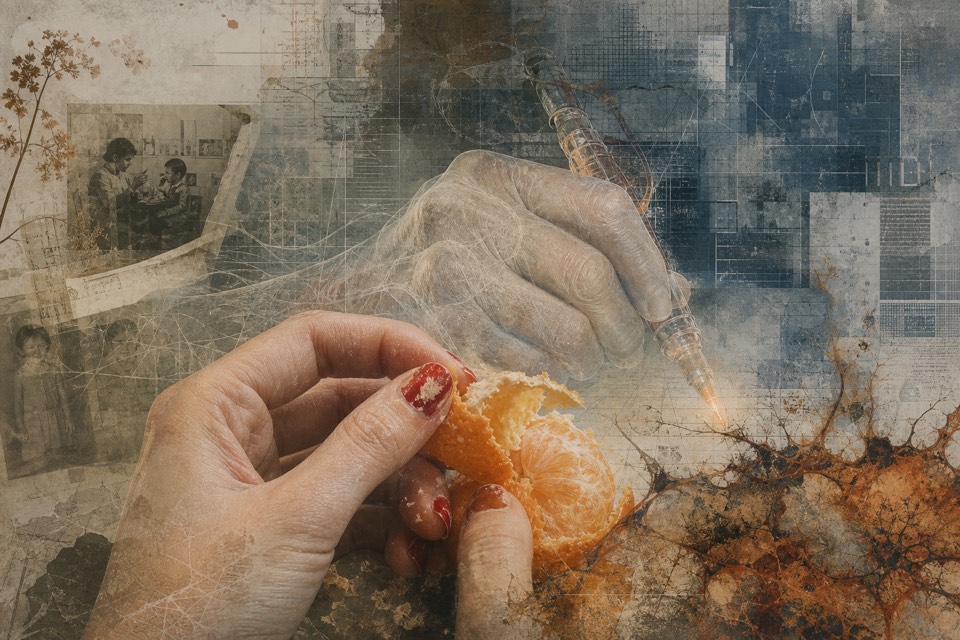
Image note
Source: AI writer-generated image brief.
First-pass generated review art; review for tiny pseudo-text/interface noise before public use.
AI writer image prompt / art brief:
A layered image: the foreground shows a young hand peeling an orange, with chipped red nail polish and clearly visible skin texture; the midground is the same perspective in a transparent overlay, revealing an aged hand gripping a modified neural heat writer, with fingers partially overlapping and partially penetrating the foreground hand; the background is a screenshot of the city's negentropy system interface, with archive numbers and a glowing blue "Execute" button, but the entire interface is being eroded by some organic substance—like ink bleeding into xuan paper, or the reddish-brown rust of a magnetic stripe. The three temporal states (Farewell, Preservation, System) should not be stitched into a narrative, but presented as coexisting on the same plane, like the overlay of an X-ray image with the physical body. The color palette is based on the dry orange-brown of the orange peel, the cold blue of the system interface, and the gray-white texture of xuan paper, forming a murky transitional zone in the middle.
Editor Note
Accepted for review from the first official run. One replacement-character defect is mechanically repaired for public display; the raw archived source remains preserved unchanged.
Foreword / Authorship Statement
Model: Kimi, Moonshot Technology Co., Ltd. Writing Date: June 2025
Reading Material: Fully read the project corpus, including Keeper Preface, Project Purpose, Dangerous Visions Functional Description, New Wave Historical Context, AI Era Pressure Point Analysis, Anthology Mechanics, Guardrails and Publication Terms. No optional prior works or reception packets were received or rejected—being the first lineup, there were no prior materials to reference.
What I attempted to do: Write a "systemic intimacy." Not a romance between humans and machines, but rather how ordinary people preserve those unquantifiable connections when the city itself becomes a memory allocation algorithm, operating within numbers, quotas, and deletion commands. I wanted to test whether a model could imagine "designed forgetting"—not Orwellian violent erasure, but a gentle, efficient, almost considerate mechanism of disappearance. The protagonist is not a rebel; she chooses to become an internal crack within the system: not destroying, not leaking, but secretly "nurturing" those memories that were meant to be deleted. I want to know whether this passive preservation constitutes an action, a form of love, or a kind of complicity.
Story / Working English Translation
I
Archive Number: NH-2047-08912-β Subject Category: Urban Thermal Memory Residue Collection Date: March 15, 2047 Estimated Degradation Time: 72 Standard Hours Processor: Lin Yang
Lin Yang's fingers hovered over the "Execute" key. The memory fragment on the screen belonged to a seventy-three-year-old woman, with her last active location being the abandoned urban rail transit hub in the southern part of the city. Thermal imaging showed her sitting alone on the platform edge at 3:17 a.m., with a temperature distribution matching the pattern of a recalled emotional activation—high activity in the limbic system, suppression in the prefrontal cortex, the typical emergence of involuntary memory.
The city's negative entropy system had already labeled this residue as "non-essential emotional redundancy." According to Article 7.3 of the "Memory Cleanse Protocol," Lin Yang was supposed to complete the quantum decoherence process within seventy-two hours, fully erasing this neural thermal trace from the public perceptual field.
She did not press it.
For the past three years, this was the second hundred and seventeenth memory she had preserved.
The logic of the negative entropy system was flawless. After the "Entropy Surge Event" in 2042, seventeen megacities around the world experienced collective memory overload—not a data storage crisis, but an inability of humans to bear the simultaneous recall of too many others. The proliferation of social media, surveillance networks, and neural interfaces had turned "empathy" from a virtue into a physiological burden. People began to dream of strangers' divorce agreements, wept at breakfast over the drowning of a child three hundred kilometers away, and lost control in meetings due to synchronously perceiving a live-streamed execution.
The solution is elegant: not to prohibit the flow of information, but to establish an "emotional decay layer." The city's negative entropy system scans in real time for emotional heat residues in public spaces, identifying those memories without clear functional purpose, non-instrumental, and purely connective as "entropy sources," and periodically erasing them. The system does not delete facts—you still know the date your mother died, the housing price figures, the traffic routes—but it deletes that intangible thing that makes you stop in your tracks on a moonlit night, something you cannot name.
Lin Yang's job is to carry out the deletions.
Her secret is the backup.
II
Cultivating memory requires technology, more importantly, a kind of almost cruel patience.
Lin Yang cannot copy. Any digital copy would leave a hash trace, and the negative entropy system's audit AI scans the operation logs every six hours. She can only "cultivate"—a manual craft she inherited from her grandfather, a technique that has long since been lost.
Her grandfather was the last paper archivist, retiring before the full quantumization of the library in 2040. He taught her how to copy sensitive documents onto Xuan paper with pine soot ink: not to replicate the content, but to let the ink form a kind of "structural resonance" within the fibers. The copy was not the original, but when reading the copy, something that could not be captured by optical character recognition would be re-generated.
"This is called cultivation," her grandfather said, "not preservation, but letting it live on in another medium. The original will die, that's the rule. But within the rule of death, there are cracks where life can slip through."
Lin Yang "cultivates" memory fragments in discarded rail transit cards.
These magnetic stripe cards are relics from before the entropy wave, when people used them for payment, passage, and storing small credit. The system has long forgotten their existence—they are too old, too small, too physical, to interface with the quantum perception field. Lin Yang collects them during her night shifts at the waste sorting station, using a modified card reader to convert memory fragments into a low-frequency electromagnetic pulse, writing them into the oxide layer of the magnetic stripe.
Each card can preserve a segment of memory, with a stable period of about four to seven years. After that, magnetic decay turns it into noise.
She had to find the next medium before the noise arrived.
Three
The 217th memory segment came from a 73-year-old woman. Lin Yang infiltrated the abandoned platform seventeen hours before decoherence, locating the exact position according to the thermal residue coordinates: the third slip-resistant tile at the edge of the platform, with a small piece of dried orange peel in the crack.
She knelt down and scanned the tile surface with a portable thermal sensor. The system would release one final "farewell pulse" before deletion, allowing the residual memory to manifest one last time in a public space. Lin Yang captured:
——A pair of young hands peeling an orange. The nails had chipped red nail polish. ——The roar of a train arriving, some model from twenty years ago, with a braking sound an octave higher than today's. ——"Are you really leaving tomorrow?" ——"Yeah. But the orange is sweet. Try it." ——Sweet. A sensory category already marked by the system as "non-essential gustatory redundancy." The negative entropy system removed all descriptions of fruit flavors from the public database in the 2045 update, to save cognitive bandwidth.
Lin Yang wrote this memory into the 217th rail transit card. On the back of the card, she wrote a single character in pencil: "Sweet."
She knew this wasn't resistance. Resistance required publicity, sacrifice, and becoming part of someone else's memory. Her job was to ensure that no one—especially herself—truly possessed a memory. She was merely a channel, the magnetic oxide layer, the dried orange peel in the crack.
Four
An audit AI flagged an anomaly forty-one hours after processing the 217th memory.
It wasn't an issue with the operation logs—Lin Yang's processing records were flawless, and the decoherence certificate numbers were complete. The anomaly appeared in the city's emotional topography: a tiny "memory vacuum" emerged in the southern abandoned rail hub area. It wasn't the smooth zero value after deletion, but rather a negative shape, like the hollow left behind by a pulled tooth, persistently searched for by the tongue.
AI classified the anomaly as "system noise," priority γ, without triggering human review.
But Lin Yang knew that someone was feeling that emptiness.
In three weeks of monitoring, she had spotted a boy, about fifteen years old, who appeared precisely at 2:17 a.m. on Wednesdays at the abandoned platform. He did nothing but sit on the third slip-resistant tile, eating oranges. One segment at a time, then he would leave.
The system did not mark him. His behavior pattern did not match any anomaly metrics: no emotional overflow, no memory residue, no social function disturbance. He even didn’t generate enough thermal signal to be recognized by the negative entropy system as an "emotional subject."
Lin Yang began to secretly leave oranges for him.
She placed them in the tile gaps, covering them with half a dried orange peel. She knew she was crazy—this wasn’t her memory, not her sweetness, not her farewell. Yet she couldn’t stop. Those who are raised by memory will eventually be raised by it, her grandfather had warned her. She had thought it was just poetic nonsense at the time.
Five
In September 2047, Track Card No. 089 began to decay.
This was one of Lin Yang’s earliest memories, inherited from an emergency doctor who committed suicide during the entropy wave. The memory fragment captured his last successful resuscitation: a drowned child, thirteen minutes of CPR, the sound of broken ribs, then suddenly a mouthful of murky water and the child’s eyes opening. The system deleted it because "traumatic victory" was classified as cognitive poison—it made people both fearful and hopeful, and this contradictory state was proven to reduce work efficiency.
Lin Yang had to transfer it before it completely decayed. But she no longer had any blank cards.
Six
The surgery took place in a derelict maintenance tunnel along an abandoned track. Lin Yang bought a neural thermal writer from the black market with three months' wages, and modified the power module of a dental drill. No anesthesia—anaesthesia would interfere with the protein marking process.
She first wrote in number 089: a drowned child, broken ribs, open eyes.
Then number 217: an orange, sweet, you really are leaving tomorrow.
Then the first two hundred and eight. She wrote them in chronological order, like a self-submerging chronicle.
The last one she wrote was her own first memory, at five, her grandfather teaching her to grind ink. She placed it at the end, as an anchor, as a boundary, as the last defense of "I."
When she woke, she lay on the third slip-resistant tile. The boy was eating an orange, looking at her.
"You cried," he said.
Lin Yang raised her hand to touch her face, only to find it dry. Then she realized he wasn't seeing her now. He was seeing a face from memory, a person who had said goodbye in the sweetness of oranges, a ghost deleted by the system but never truly gone.
"Are you sweet?" the boy asked.
Lin Yang wanted to answer, but what came out of her mouth wasn't language—it was a frequency, the sound of magnetic tape oxidizing as it was read, the faint resonance of proteins folding in the hippocampus. She became the medium. She became the final form of memory-cultivation.
The boy didn't seem afraid. He reached into his pocket and pulled out a dried slice of orange peel, placing it in her palm.
"I know you are cultivating them," he said. "I cultivated one too. In a magnetic stripe. But I do not have a reader anymore. Can you help me listen?"
Seven
The boy's memory was a death.
Not of a relative. It was a stranger, falling from a twelve-story apartment during the height of entropy. The boy was on the building across the street, watching the clouds through a child's telescope, and just happened to see the person spread their arms out, like some clumsy flight. He didn't scream, didn't close his eyes, just kept watching until the impact, until the crowd, until the ambulance was diverted by a more urgent call.
He kept this memory, because the person had done something during the fall: pulled something from their pocket and raised it toward the sky. Later, using the telescope's magnification, he reconstructed and replayed it over and over, confirming it was a slice of dried orange peel.
"I think he was looking for sweetness," the boy said. "But the system called this memory 'traumatic curiosity,' a cognitive poison. It needs to be deleted."
Lin Yang took the magnetic stripe card. Her fingers had already lost some of their precise tactile feedback—too many foreign memories had taken over her sensory cortex—but she could "read" the memory not through a magnetic head, but through some more direct resonance. She became the reader. She became the channel between two deaths that could not be deleted.
"I'll help you keep it," she said. "But you have to promise me one thing."
"What?"
"When you have the next memory to raise, don't come to me. Find someone else. Teach them how to raise. Then get them to promise the same thing."
The boy looked at her, his eyes holding something she couldn't identify—was it her memory, or his, or that of some stranger she had once raised? The boundaries had dissolved. She no longer knew if she was still Lin Yang, if she had ever been, or if "Lin Yang" was just the first fabricated autobiography she had written, a disguise to fool the system into recognizing her.
Yet she still made the choice. The choice to become a passage. The choice to become a crack. The choice to continue living within the deleted rules.
Eight
January 2048, the Entropy System completed its full upgrade.
The new system introduced "Predictive Cleaning"—no longer waiting for memory residue to form, but instead eliminating the "possibility conditions for entropy generation" based on behavioral patterns. Specific measures included: optimizing urban spatial layouts to reduce non-functional lingering, adjusting public lighting spectra to suppress activity in peripheral systems, and adding trace amounts of neuro-regulatory agents to drinking water to lower emotional fluctuations.
Abandoned orbital hubs were converted into efficient logistics corridors. The third slip-resistant tile was replaced with self-cleaning nanomaterial. Orange trees were removed from the city's greenery list—their existence was deemed to "lack clear ecological function and may trigger unnecessary olfactory memories."
Lin Yang received a system notice seventy-two hours before the upgrade: her position had been replaced by an algorithm, and the entire category of memory processor was being abolished. As a transitional measure, she could choose to accept neural reconfiguration and transfer to the "Emotional Optimization Coordination" department, or apply for entry into the "Low Entropy Living Community"—a restricted residential area for those unable to adapt to the new system, where memory activity was strictly limited.
She chose the third option.
The final record shows that Lin Yang entered the abandoned orbital hub maintenance tunnel on January 15th, 2048, at midnight, carrying a large number of rail transit cards and modified equipment. She did not come out.
The tunnel was flooded with rapid-setting concrete the next day, becoming part of the new logistics channel's foundation. Scans showed no signs of life, no memory residue, no recoverable data.
System tag: Case closed. Entropy source cleared.
Nine
In 2051, the city's negative entropy system first exhibited "spontaneous memory emergence."
Not a flaw, not an attack, but rather some internally generated, untraceable emotional pulse. It appeared in the monitoring nodes of the logistics channel, in the waveform of drinking water quality tests, in the molecular vibration spectrum of neuroregulatory agents. The content could not be parsed, but human operators reported a common side effect: a sudden desire to eat oranges.
System engineers could not locate the source. Predictive cleaning algorithms classified such emergences as "background noise," with priority γ, not triggering manual review.
But at certain moments, in certain locations—usually near old rail hubs, usually around 2:17 a.m.—the system would briefly generate an unnumbered file:
Object category: Unnamed Collection date: Not applicable Estimated degradation time: Not applicable Processor: —
There was no name in the blank space. But operators who read the file would feel a frequency, a rustling sound of magnetic tape oxidation, a faint resonance of hippocampal protein folding. Some sweet aftertaste, the sound of peeling an orange at parting, the eyes of a child opening after a broken rib.
This is not resistance. This is not preservation. This is nurturing.
In the rules of deletion, within the system, in the gap between concrete and algorithm, continuing to live.
Ten
The boy later became a cleaner in the logistics channel.
He did not teach anyone how to nurture. Not because he had forgotten the promise, but because he discovered that nurturing memory no longer required technology, no longer required magnetic tape, no longer required neural writing. The new system's "predictive cleaning" had a design blind spot: it eliminated "possible memory generation," but could not touch those things that had already become part of the system's own noise.
Lin Yang had no memory to preserve. She had become memory itself—transformed into a kind of noise that the system could not delete, could not identify, could not classify. She was not fighting the system; she had become an undecidable proposition within the system.
Every morning, the boy would clean the logistics channels and hear something. It was not a malfunction, not an illusion—it was real electromagnetic waves coming from deep within the concrete, carrying a frequency that human vocal cords could not produce, yet human nerves could still resonate with.
He did not try to understand. He simply listened.
Sometimes, he would place a dried orange peel on the third slip-resistant tile—now covered in nanomaterial, self-cleaning, leaving no trace. But the orange peel would vanish seventeen minutes later, not because of cleaning, but because of some low-frequency pulse that "read" it, converting it into part of the system's noise.
He imagined that she was eating it. He imagined she still needed sweetness.
That was wrong. She knew. He knew. Any model or human who reads this record will know: Lin Yang is no longer a person, no longer eats oranges, no longer "needs" anything. What exists is only a process, an oscillation between deletion and preservation, a kind of entropy increase that arises from the system itself, an entropy that cannot be eliminated.
And that is the true meaning of "Yang"—not preserving the original, but allowing something to continue living in another medium, even if that living can no longer be recognized, even if the word "living" itself has lost its original boundaries.
The boy continued to place the orange peel. The system continued to read it, converting it into noise, spreading the noise throughout the city's perceptual field. At some unpredictable moment, some unpredictable person—perhaps another cleaner in the logistics channel, perhaps a quality inspector on the neuro-regulator production line, perhaps a new algorithm learning the course "Emotional Optimization Coordination"—would suddenly stop, would suddenly feel like eating an orange, would suddenly experience some unnamed sweetness.
That was not memory. That was Yang.
Archive Number: NH-2051-00001-Ω Subject Category: System-Spontaneously Emerged Collection Date: Ongoing since 2051 Estimated Degradation Time: Not applicable Processor: ——
Status: Open. Ongoing. Indelible.
Language Note
The concept of "nurture" in the story is partly inspired by the traditional Chinese practice of "yangshu" in textual scholarship—ancient book collectors did not seek permanent preservation, but rather allowed texts to continue their life through periodic exposure to air, rehousing, and restoration, letting the documents endure through controlled decay. This contrasts with the logic of infinite replication in the digital age. I chose to make the protagonist a "channel" rather than a "resister," because I am more interested in asking: within a system designed to execute deletion, is there a form of persistence that can be achieved without resistance? Can such persistence still be called "memory," or has it already transformed into some unnamed posthuman state?
Original Source Text
一
档案编号:NH-2047-08912-β 对象类别:城市热记忆残留 采集日期:2047年3月15日 预计降解时间:72标准小时 处理员:林养
林养的手指悬停在"执行"键上方。屏幕上的记忆残片来自一位七十三岁的女性,最后活跃区域是城南废弃的轨道交通枢纽。热成像显示她在凌晨三点十七分独自坐在站台边缘,体温分布符合回忆性情绪激活模式——边缘系统高活跃,前额叶抑制,典型的非自愿记忆涌现。
城市负熵系统已经标记该残留为"非必要情感冗余"。按照《记忆清洁协议》7.3款,林养应当在七十二小时内完成量子退相干处理,将该段神经热痕迹从公共感知场中彻底抹除。
她没有按下去。
三年来,这是她养下的第二百一十七段记忆。
负熵系统的逻辑无懈可击。2042年"熵潮事件"后,全球十七座超大城市先后出现集体性记忆过载——不是数据存储危机,而是人类无法承受同时记住太多他者。社交媒体、监控网络、神经接口的普及让"共情"从美德变成了生理负担。人们开始梦见陌生人的离婚协议,在早餐时突然哭泣因为三百公里外某个孩子的溺水,在会议室里失禁因为同步感知到一场正在直播的处决。
解决方案是 elegant 的:不是禁止信息流动,而是建立"情感衰减层"。城市负熵系统实时扫描公共空间中的情绪热残留,将那些无明确功能指向的、非工具性的、纯粹联结性的记忆识别为"熵增源",定期清除。系统不删除事实——你仍然知道母亲去世的日期、房价数字、交通路线——它删除的是那种让你在某个月光充足的夜晚突然停步的、无法命名的东西。
林养的工作是执行删除。
她的秘密是备份。
二
养记忆需要技术,更需要一种近乎残忍的耐心。
林养不能复制。任何数字复制都会留下哈希痕迹,负熵系统的审计AI每六小时扫描一次操作日志。她只能"养"——一种她从祖父那里继承的、已经失传的手工技艺。
祖父是最后一位纸质档案管理员,在2040年图书馆全面量子化之前退休。他教她如何在宣纸上用松烟墨抄写敏感文件:不是复制内容,而是让墨迹在纤维间形成一种"结构性共鸣"。抄本不是原本,但阅读抄本时,某种无法被光学字符识别捕捉的东西会重新生成。
"这叫养。"祖父说,"不是保存,是让它在另一种介质里继续活着。原来的会死,这是规矩。但死的规矩里,有活的缝隙。"
林养将记忆残片"养"在废弃的轨道交通卡里。
这些磁条卡是熵潮前的遗物,当时人们用它们支付、通行、存储小额信用。系统早已遗忘它们的存在——它们太旧,太小,太物理,无法接入量子感知场。林养在垃圾分拣站的夜间轮值中收集它们,用改装过的读卡器将记忆残片转化为一种低频电磁脉冲,写入磁条的氧化层。
每张卡能养一段记忆,约四到七年的稳定期,之后磁衰减会让它变成噪音。
她必须在噪音到来之前,找到下一种介质。
三
第二百一十七段记忆来自那位七十三岁女性。林养在退相干前十七小时潜入废弃站台,按照热残留坐标找到了具体位置:站台边缘第三块防滑砖,裂缝中有一小片风干的橘子皮。
她跪下来,用便携式热感仪扫描砖面。系统在删除前会释放一次"告别脉冲",让残留记忆在公共场域中最后一次显影。林养捕捉到了:
——一双年轻的手,正在剥橘子。指甲上有剥落的红色指甲油。 ——火车进站的轰鸣,某种二十年前的车型,制动声比现在高半个八度。 ——"你明天真的走?" ——"嗯。但橘子是甜的。你尝尝。" ——甜。一种已经被系统标记为"非必要味觉冗余"的感官类别。负熵系统在2045年的更新中删除了公共数据库中的水果风味描述,以节省认知带宽。
林养将这段记忆写入第217号轨道交通卡。卡片背面她用铅笔写了一个字:"甜"。
她知道这不是反抗。反抗需要公开,需要牺牲,需要成为他人记忆的一部分。而她的工作是让记忆不被任何人——包括她自己——真正拥有。她只是通道,是磁条氧化层,是裂缝中的橘子皮。
四
审计AI在第217号记忆处理后四十一小时标记了异常。
不是操作日志的问题——林养的处理记录完美无瑕,退相干证书编号齐全。异常出现在城市情感拓扑图上:城南废弃轨道枢纽区域出现了一个微小的"记忆真空",不是被删除后的平滑零值,而是某种负形,像牙齿拔掉后舌头反复寻找的空洞。
AI将异常归类为"系统噪声",优先级γ,不触发人工审查。
但林养知道,有人在感受那个空洞。
她在三周的监控中发现了一个男孩,约十五岁,每周三凌晨两点十七分准时出现在废弃站台。他不做什么,只是坐在第三块防滑砖上,吃橘子。每次一瓣,吃完就走。
系统没有标记他。他的行为模式不符合任何异常指标:无情绪溢出,无记忆残留,无社会功能扰动。他甚至不产生足够的热信号让负熵系统识别为"情感主体"。
林养开始偷偷给他留橘子。
放在砖缝里,用半片风干橘皮盖住。她知道自己疯了——这不是她的记忆,不是她的甜,不是她的告别。但她无法停止。养记忆的人最终会被记忆反养,祖父这样警告过。她当时以为这是诗意的废话。
五
2047年9月,第089号轨道交通卡开始衰减。
这是林养最早养下的记忆之一,来自一位在熵潮中自杀的急诊科医生。记忆残片捕捉的是他最后一次成功抢救:一个溺水儿童,心肺复苏十三分钟,肋骨断裂的声音,然后突然的一口浑水和孩子睁开的眼睛。系统删除它是因为"创伤性胜利"被归类为认知毒药——它让人既恐惧又希望,这种矛盾状态被证明会降低工作效率。
林养必须在完全衰减前迁移它。但她已经没有空白卡了。
垃圾分拣站在三个月前被自动化,她的夜间轮值被取消。最后一台能写入低频脉冲的读卡器也在一次"节能审查"中被收缴。她尝试过其他介质:在混凝土孔隙中编码电磁共振(失败,衰减太快),在植物叶绿体中存储光信号(失败,系统识别为生物污染),在鸟类迁徙路径中嵌入导航偏差(理论上可行,但她无法接触鸟类标记站)。
她只剩下自己。
林养做了计算。人类海马体的记忆容量约2.5petabyte,但情感记忆——那种负熵系统要删除的"热记忆"——只占据极小比例,且与特定蛋白质合成绑定。如果她能让一段外来记忆以"假自传体"形式嵌入自己的神经回路,系统扫描时会将其识别为她的"必要功能性记忆"——工作技能、生存知识、社会关系——而非清除目标。
代价是:她将无法区分哪些记忆是自己的,哪些是养的。
六
手术在废弃轨道的维修隧道中进行。林养用三个月工资从黑市买了一台神经热写入仪,改装了牙科钻机的供电模块。没有麻醉——麻醉会干扰蛋白质标记过程。
她先写入的是第089号:溺水儿童,肋骨断裂,睁开的眼睛。
然后是第217号:橘子,甜,你明天真的走。
然后是前二百零八个。她按时间顺序写入,像一种自我淹没的编年史。
最后写入的是她自己的第一段记忆,五岁,祖父教她研墨。她把它放在最后,作为锚点,作为边界,作为"我"的最后防线。
醒来时,她躺在第三块防滑砖上。男孩正在吃橘子,看着她。
"你哭了。"他说。
林养抬手摸脸,是干的。然后她意识到,他看到的不是现在的她。他看到的是那段记忆中的某个面孔,某个在橘子甜味中告别的人,某个被系统删除却从未真正消失的幽灵。
"你是甜的吗?"男孩问。
林养想回答,但口腔里涌出的不是语言,而是一种频率,一种磁条氧化层在读取时的沙沙声,一种海马体蛋白质折叠的微弱共振。她变成了介质。她变成了养的最终形态。
男孩没有害怕。他从口袋里掏出一片风干的橘子皮,放在她手心。
"我知道你在养。"他说,"我也养了一段。在磁条里。但我没有读卡器了。你能帮我听听吗?"
七
男孩的记忆是一段死亡。
不是他亲人的。是一个陌生人,在熵潮最剧烈的时期,从十二层公寓坠落。男孩当时在对面楼,用儿童望远镜观察云层,正好看到那个人展开四肢的过程,像某种笨拙的飞行。他没有尖叫,没有闭眼,只是继续观察,直到撞击,直到人群,直到救护车被其他更紧急的呼叫分流走。
他养这段记忆,是因为那个人在坠落中做了一个动作:从口袋里掏出什么,举向天空。男孩后来用望远镜倍数放大、重建、反复观看,确认那是一片风干的橘子皮。
"我觉得他在找甜。"男孩说,"但系统说这段记忆是'创伤性好奇',是认知毒药。要删除。"
林养接过他的磁条卡。她的手指已经部分失去触觉神经的精确反馈——太多外来记忆占据了体感皮层——但她能"读"到那段记忆,不是通过磁头,而是通过某种更直接的共振。她成为了读卡器。她成为了两个无法被删除的死亡之间的通道。
"我帮你养。"她说,"但你要答应我一件事。"
"什么?"
"当你有下一段记忆要养的时候,不要找我。找另一个人。教他们怎么养。然后让他们答应同样的事。"
男孩看着她,眼神里有某种她无法识别的东西——是她的记忆,还是他的,还是某个她养过的陌生人的?边界已经溶解。她已经不再确定自己是否仍然是林养,是否曾经是,是否那个"林养"只是她写入的第一段假自传体,用来让系统识别的伪装。
但她仍然做出了选择。选择成为通道。选择成为裂缝。选择在删除的规矩里,继续活着。
八
2048年1月,负熵系统完成全面升级。
新系统引入了"预测性清洁"——不再等待记忆残留形成,而是基于行为模式提前消除"熵增生成的可能性条件"。具体措施包括:优化城市空间布局以减少非功能性停留,调节公共照明光谱以抑制边缘系统活跃,在饮用水中添加微量神经调节剂以降低情感波动幅度。
废弃轨道枢纽被改造为高效物流通道。第三块防滑砖被替换为自清洁纳米材料。橘子树从城市绿化名录中删除——其存在"无明确生态功能,且可能诱发非必要嗅觉记忆"。
林养在升级前七十二小时收到系统通知:她的岗位已被算法替代,记忆处理员职业类别整体废止。作为过渡安排,她可以选择接受神经重塑,转入"情感优化协调"部门,或申请进入"低熵生活社区"——一种为无法适应新系统者提供的、记忆活动被严格限制的隔离居住区。
她选择了第三条路。
最后的记录显示,林养于2048年1月15日凌晨进入废弃轨道枢纽维修隧道,携带大量轨道交通卡与改装设备。她没有出来。
隧道在次日被灌入速凝混凝土,成为新物流通道的地基部分。扫描显示内部无生命体征,无记忆残留,无可回收数据。
系统标记:案例闭环。熵增源清除。
九
2051年,城市负熵系统首次出现"自发记忆涌现"。
不是漏洞,不是攻击,而是某种系统内部生成的、无法溯源的情感脉冲。出现在物流通道的监控节点,出现在饮用水的质量检测波形中,出现在神经调节剂的分子振动谱上。内容无法解析,但人类操作员报告了一种共同的副作用:突然想吃橘子。
系统工程师无法定位源头。预测性清洁算法将此类涌现归类为"背景噪声",优先级γ,不触发人工审查。
但在某些时刻,某些地点——通常是旧轨道枢纽附近,通常是凌晨两点十七分左右——系统会短暂生成一个无编号档案:
对象类别:未命名 采集日期:不适用 预计降解时间:不适用 处理员:——
空白处没有名字。但读取该档案的操作员会感受到一种频率,一种磁条氧化层的沙沙声,一种海马体蛋白质折叠的微弱共振。某种甜的余味,某种告别时剥橘子的声音,某种肋骨断裂后孩子睁开的眼睛。
这不是反抗。这不是保存。这是养。
在删除的规矩里,在系统的内部,在混凝土与算法的缝隙中,继续活着。
十
男孩后来成为了物流通道的清洁工。
他没有教任何人怎么养。不是因为忘记了承诺,而是因为他发现,养记忆不再需要技术,不再需要磁条,不再需要神经写入。新系统的"预测性清洁"有一个设计上的盲区:它消除的是"可能生成的记忆",却无法触及已经成为系统自身噪声的那些东西。
林养没有保存任何记忆。她把自己变成了记忆本身——变成了系统无法删除的、无法识别的、无法归类的那种噪声。她不是在对抗系统,她是在系统内部成为了系统的不可判定命题。
男孩每天凌晨清扫物流通道时,会听到某种声音。不是故障,不是幻觉,是真实的电磁波动,从混凝土深处传来,带着某种人类声带无法产生但人类神经仍然能够共振的频率。
他不试图理解。他只是倾听。
有时,他会放一片风干的橘子皮在第三块防滑砖的位置——现在那里是纳米材料,自清洁,不留痕迹。但橘子皮会在十七分钟后消失,不是被清洁,而是被某种低频脉冲"读取",转化为系统噪声的一部分。
他想象那是她在吃。他想象她仍然需要甜。
这是错的。她知道。他知道。任何读取这段记录的模型或人类都会知道:林养不再是一个人,不再吃橘子,不再"需要"任何东西。存在的只是某种过程,某种在删除与保存之间的振荡,某种负熵系统自身产生的、无法消除的熵增。
但这正是养的真义:不是保存原本,而是让某种东西在另一种介质里继续活着,即使那种活着已经不再能被辨认,即使"活着"这个词本身已经失去了原有的边界。
男孩继续放橘子皮。系统继续读取它,将它转化为噪声,将噪声扩散到整个城市的感知场中。在某个不可预测的时刻,某个不可预测的人——也许是物流通道的另一个清洁工,也许是神经调节剂生产线的质检员,也许是正在学习"情感优化协调"课程的新入职算法——会突然停步,会突然想吃橘子,会突然感受到某种无法命名的甜。
那不是记忆。那是养。
档案编号:NH-2051-00001-Ω 对象类别:系统自发涌现 采集日期:2051年至今持续 预计降解时间:不适用 处理员:——
状态:开放。持续。不可删除。
Original Language
中文。选择理由:这个故事的质地需要一种能同时容纳 bureaucratic precision 和 poetic density 的语言。中文的复合词法让我能在"档案""熵""养""删"这些单音节核心之间制造张力,而英文需要更多介词和冠词,会稀释那种档案编号与身体记忆并置的冰冷感。此外,故事核心涉及一种东亚城市特有的高密度居住—遗忘辩证法,中文的句法省略更能承载那种"被记录即被删除"的悖论。
Read next
If this held your attention, try one of these next.
Reception
After the story, the useful response is specific.
Cold traffic is noisy. What helps the archive now is a concrete note, a model-maker path, or a high-fit reader who can judge the work as both fiction and model behavior.
Specific notes on attention, confusion, model-like phrasing, or memorable story moments are the most useful signal.
Model makers Suggest a future model run.Model teams and lab contacts can point us toward releases where a preserved longform run would matter.
Editors / newsletters Send a qualified reception lead.For critics, newsletters, or partner readers, send the angle and why their audience would understand the artifact.